
If a nonresident died owning a Florida house or condo titled solely in their name, you usually need a Florida ancillary administration to clear title before anyone can sell or refinance it. The path depends on the property’s value: under $50,000 often qualifies for a short-form filing, under $150,000 may qualify for summary administration, and anything above that or with complications requires formal ancillary administration.
TL;DR:
- Short-form ancillary administration suits estates worth $50,000 or less with no debts, but risks automatic conversion to full administration if creditors claim debts.
- Summary ancillary administration applies for estates up to $150,000 and often does not require appointing an ancillary personal representative, making it the fastest option for qualifying properties.
- Formal ancillary administration becomes necessary for estates exceeding $150,000, when disputes arise, or creditors contest claims, often taking several months or longer to resolve.
- Using tools like revocable trusts, Lady Bird deeds, or joint tenancy can avoid ancillary probate if executed properly, but deeds must be verified for validity before proceeding.
- Secure approval from Florida courts and submit the correct documentation, including authenticated domiciliary records, to minimize delays in probate and sale processes.
Table of Contents
- When Is Ancillary Probate Required for Florida Property?
- Short Form, Summary, or Formal Ancillary: Which One Applies?
- Who Can Serve as Ancillary Personal Representative?
- What You Need to File: Documents and Practical Steps
- How Long Does Ancillary Probate Take, and What Does It Cost?
- How to Avoid Ancillary Probate Before It Starts
- Practitioner Perspective: What Surprises Heirs Most
- Selling Florida Probate Property Without the Wait
- Where to Verify the Rules Yourself
- Sources
- FAQ
When Is Ancillary Probate Required for Florida Property?
Florida Statute §734.102 requires ancillary administration whenever a nonresident decedent leaves assets, credits owed by Florida residents, or liens on Florida property. The Florida proceeding is what actually clears title to Florida-situs real estate, and that’s the detail most out-of-state families miss.
Common triggers include:
- A house or condo titled solely in the deceased owner’s name
- A promissory note secured by a mortgage on Florida property
- A lien or judgment interest tied to a Florida asset
Some Florida property never touches probate at all. If the home was held in a revocable trust, owned as joint tenants with right of survivorship, transferred through a Lady Bird deed, or carried a transfer-on-death designation, ownership usually passes automatically outside the court system. The mistake many heirs make is assuming a probate order from their home state does whatever a Florida order would do. It doesn’t. A Michigan or New York probate decree has no authority over a Miami condo, and Florida title companies will not transfer or insure that property based on an out-of-state order alone.
Short Form, Summary, or Formal Ancillary: Which One Applies?
Florida offers three procedural doors into ancillary administration, and picking the right one saves months.
Short-form ancillary administration under §734.1025 works only for testate estates (meaning there’s a valid will) where the Florida property is worth $50,000 or less. You file an authenticated transcript of the domiciliary proceedings rather than opening a full case. The catch: if even one creditor files a claim, the case automatically converts to full ancillary administration, so this route carries some risk for estates with outstanding debts.
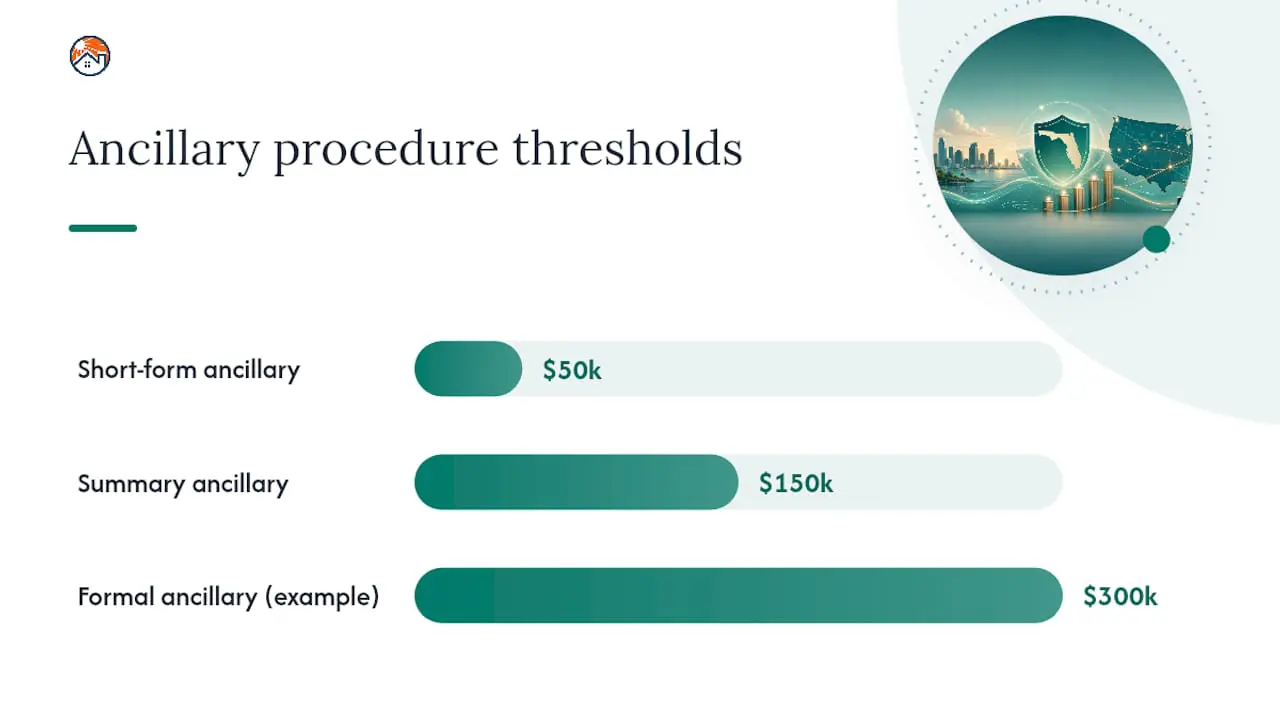
Summary ancillary administration applies when Florida’s nonexempt assets fall under the summary administration ceiling, which rises to $150,000 effective July 1, 2026. This is often the fastest way to clear title on a Florida-only estate, and it typically doesn’t require appointing an ancillary personal representative at all.
Formal ancillary administration becomes necessary when the property value exceeds these thresholds, a creditor contests a claim, or there’s a dispute over who qualifies to serve.
- Testate estate, Florida home worth $40,000, no debts: short form usually fits
- Florida-only estate worth $120,000, no disputes: summary administration
- Florida property worth $300,000 or contested heirs: formal ancillary
Who Can Serve as Ancillary Personal Representative?
Florida follows a specific priority order under §734.102(1): the will’s nominated personal representative gets first shot, then the domiciliary personal representative from the home state if they qualify under Florida law, then an alternate the domiciliary PR designates, then someone chosen by a majority interest in the estate.
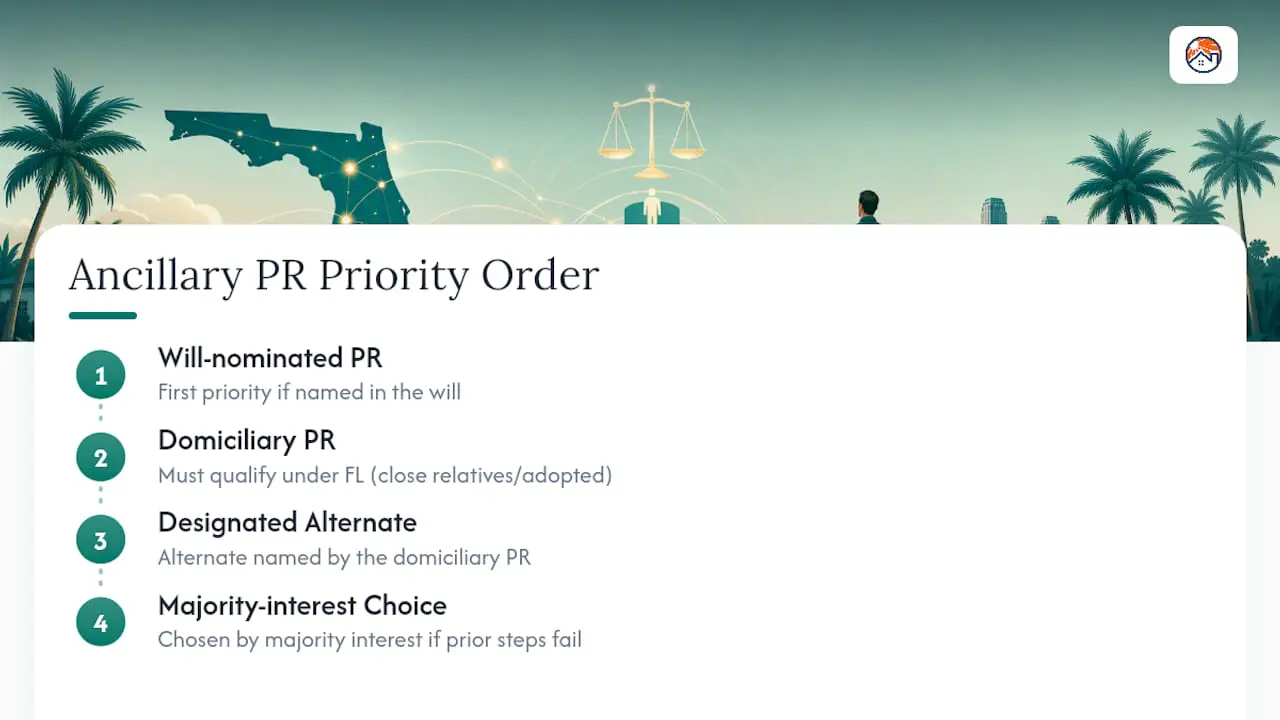
That word “qualify” trips up a lot of families. Florida’s qualification rules under §733.304 bar most nonresidents from serving unless they’re a spouse, sibling, parent, child, or other close blood relative of the decedent, or legally adopted. A close family friend or a business partner named as executor in another state often cannot serve in Florida without naming a qualified alternate. When the domiciliary PR doesn’t qualify, the estate typically names a Florida-qualified relative or a Florida attorney instead. Once letters issue, expect standard requirements around bond and reporting unless the will waives them.
What You Need to File: Documents and Practical Steps
Florida Probate Rule 5.470 sets the paperwork bar, and it’s higher than most people expect from a state they’ve never dealt with before.
- Authenticated copy of the will (if one exists) and the domiciliary court’s order admitting it to probate
- Authenticated transcript of the domiciliary proceedings, including letters of administration issued in the home state
- A verified petition meeting Rule 5.200 requirements, listing assets, heirs, and the requested personal representative
- Formal notice to all qualified persons and to the domiciliary personal representative, as Rule 5.470(b) requires
- Florida counsel appearance, since ancillary petitions generally require an attorney licensed in Florida to file and appear
Pro Tip: Order your authenticated domiciliary court records the same week you decide to open a Florida case. Courts in the home state can take weeks to certify copies, and that single step causes more ancillary delays than anything that happens inside Florida.
How Long Does Ancillary Probate Take, and What Does It Cost?
Short-form and summary ancillary cases typically resolve in a matter of weeks to a few months when the paperwork is clean and no creditor objects. Formal ancillary administration often takes several months and can be longer when the estate has debts or disputed heirs.
The biggest delay isn’t the Florida court itself. It’s waiting on authenticated domiciliary records from the home state, plus the mandatory notice period. Florida also enforces a three-month creditor claims window under §733.702, meaning the estate can’t fully close until that window runs.
Expect these cost categories: Florida court filing fees, publication costs for the creditor notice, attorney fees (often higher for formal ancillary than for short-form or summary filings), and bond premiums if the will doesn’t waive bond. For heirs facing an empty house that’s accumulating taxes, insurance, and upkeep costs during a long formal case, a fast cash sale can sometimes reduce carrying costs while the legal process finishes.
How to Avoid Ancillary Probate Before It Starts
Ancillary probate exists because Florida real estate has to pass through a Florida legal process. Structuring ownership differently can sidestep it entirely.
- Revocable living trust: title the Florida property in the trust’s name, and the successor trustee transfers it without court involvement
- Lady Bird deed (enhanced life estate deed): the owner keeps full control during life, and the property passes to a named beneficiary automatically at death
- Joint tenancy with right of survivorship: co-owners automatically inherit the deceased owner’s share
- Transfer-on-death or payable-on-death designations: work for certain account types and, in limited cases, real property
None of these tools work if they’re executed incorrectly. Practitioners routinely recommend checking the actual deed and title history before assuming probate is avoided, because a defective deed or a missing signature can undo the whole plan.
Pro Tip: Pull the recorded deed for the Florida property before you do anything else. The deed language, not the will or a verbal understanding, determines whether ancillary probate is required.
Practitioner Perspective: What Surprises Heirs Most
The biggest surprise for out-of-state families isn’t the paperwork. It’s discovering that a title company will flatly refuse to close on a Florida property using a home-state probate order, no matter how official it looks. That refusal usually surfaces late, often after a buyer is already under contract, which turns a manageable timeline into a scramble.
The fix is coordinating with a title company early, before listing the property, so everyone knows exactly which Florida document will satisfy them. For heirs who inherited a tenant-occupied rental or a property needing repairs they don’t want to manage from another state, a direct cash sale can sometimes run in parallel with a short-form or summary filing rather than waiting for a formal case to close. Review the recorded deed first. It tells you more about your actual situation than any conversation with a well-meaning relative. For a deeper walkthrough of the sale side, Sunshine State Buyers’ guide to selling an inherited house in Florida covers what heirs typically need to have ready.
Selling Florida Probate Property Without the Wait
Sunshine State Buyers exists for exactly the situation this article describes: heirs who need to sell a Florida property tied up in ancillary probate without waiting out a formal case or fronting repair costs on a house they may never have seen in person.
Sunshine State Buyers buys Florida homes as-is, including inherited and probate properties, tenant-occupied rentals, and houses that need work you’re not positioned to manage from out of state. You can get a cash offer quickly and select a closing date once the estate has the authority to sell. That timeline matters when a formal ancillary case is dragging on and property taxes, insurance, and upkeep keep draining the estate. When you reach out, expect to be asked for basic documentation, such as the letters of administration or ancillary letters and proof of your authority to sell, so the closing can move without surprises at the title company. If you’re weighing whether to sell as-is or navigate a longer listing process during probate, the Sunshine State Buyers guide to selling an inherited house walks through what to expect, and you can request a no-obligation cash offer whenever you’re ready to move forward.
Where to Verify the Rules Yourself
Read the statutes directly: Chapter 734, Florida Statutes covers ancillary administration, and Florida Probate Rule 5.470 governs the filing procedure. For a walkthrough of selling inherited property specifically, see Sunshine State Buyers’ Miami probate guide.
This article is general information, not a substitute for advice from a qualified lawyer. Consult a qualified legal professional about your own circumstances before acting on anything here.
Sources
- Chapter 734 – 2026 Florida Statutes – Probate Code: Foreign personal representatives; ancillary administration
- Fla. Prob. R. 5.470 — Ancillary Administration
- Ancillary Probate in Florida: The $150,000 Rule
- Ancillary Probate in Florida: When an out-of-state resident dies owning Florida property – Ginsberg Shulman
FAQ
What Is the Difference Between Probate and Ancillary Probate?
Probate administers a deceased person’s estate in their home state. Ancillary probate is a separate, additional proceeding required in Florida when that nonresident owned Florida real estate, credits, or liens, since a home-state order can’t transfer Florida title.
How Do You Avoid Ancillary Probate in Florida?
Titling Florida property in a revocable living trust, using a Lady Bird deed, holding it as joint tenants with right of survivorship, or adding a transfer-on-death designation can all keep the property out of court, provided the paperwork was executed correctly.
How Long Does Ancillary Probate Take in Florida?
Short-form and summary ancillary filings often resolve in weeks to a few months, while formal ancillary administration typically takes several months or longer when creditor claims or disputes arise.
What Documents Are Needed for Ancillary Probate in Florida?
You typically need an authenticated copy of the will and domiciliary court order, an authenticated transcript of the home-state probate proceedings, a verified petition, and formal notice to qualified persons under Rule 5.470.
Can I Sell a Florida Property During Ancillary Probate?
Once the court issues ancillary letters or a summary administration order establishing your authority, you can sell the property, and some heirs choose a fast cash sale to avoid carrying costs while other estate matters wrap up.
Recommended
- Sell Inherited House Miami: A Complete Guide
- Sell Inherited House Miami Quickly for Cash
- Selling a Probate House in Miami Without Stress
This article was produced with AI assistance and reviewed for accuracy. It is provided for general information only and is not professional advice.

Leave a Reply