Tag: Inherited & Probate

  • Clear Florida Title Fast: Ancillary Probate for Nonresident Owners

    Clear Florida Title Fast: Ancillary Probate for Nonresident Owners

    If a nonresident died owning a Florida house or condo titled solely in their name, you usually need a Florida ancillary administration to clear title before anyone can sell or refinance it. The path depends on the property’s value: under $50,000 often qualifies for a short-form filing, under $150,000 may qualify for summary administration, and anything above that or with complications requires formal ancillary administration.


    TL;DR:

    • Short-form ancillary administration suits estates worth $50,000 or less with no debts, but risks automatic conversion to full administration if creditors claim debts.
    • Summary ancillary administration applies for estates up to $150,000 and often does not require appointing an ancillary personal representative, making it the fastest option for qualifying properties.
    • Formal ancillary administration becomes necessary for estates exceeding $150,000, when disputes arise, or creditors contest claims, often taking several months or longer to resolve.
    • Using tools like revocable trusts, Lady Bird deeds, or joint tenancy can avoid ancillary probate if executed properly, but deeds must be verified for validity before proceeding.
    • Secure approval from Florida courts and submit the correct documentation, including authenticated domiciliary records, to minimize delays in probate and sale processes.

    Sunshine State Buyers
    Sell Your Florida Property As-Is
    Sunshine State Buyers helps Florida homeowners sell inherited or problem properties quickly, without repairs, showings, or agent commissions.

    Table of Contents

    When Is Ancillary Probate Required for Florida Property?

    Florida Statute §734.102 requires ancillary administration whenever a nonresident decedent leaves assets, credits owed by Florida residents, or liens on Florida property. The Florida proceeding is what actually clears title to Florida-situs real estate, and that’s the detail most out-of-state families miss.

    Common triggers include:

    • A house or condo titled solely in the deceased owner’s name
    • A promissory note secured by a mortgage on Florida property
    • A lien or judgment interest tied to a Florida asset

    Some Florida property never touches probate at all. If the home was held in a revocable trust, owned as joint tenants with right of survivorship, transferred through a Lady Bird deed, or carried a transfer-on-death designation, ownership usually passes automatically outside the court system. The mistake many heirs make is assuming a probate order from their home state does whatever a Florida order would do. It doesn’t. A Michigan or New York probate decree has no authority over a Miami condo, and Florida title companies will not transfer or insure that property based on an out-of-state order alone.

    Short Form, Summary, or Formal Ancillary: Which One Applies?

    Florida offers three procedural doors into ancillary administration, and picking the right one saves months.

    Short-form ancillary administration under §734.1025 works only for testate estates (meaning there’s a valid will) where the Florida property is worth $50,000 or less. You file an authenticated transcript of the domiciliary proceedings rather than opening a full case. The catch: if even one creditor files a claim, the case automatically converts to full ancillary administration, so this route carries some risk for estates with outstanding debts.
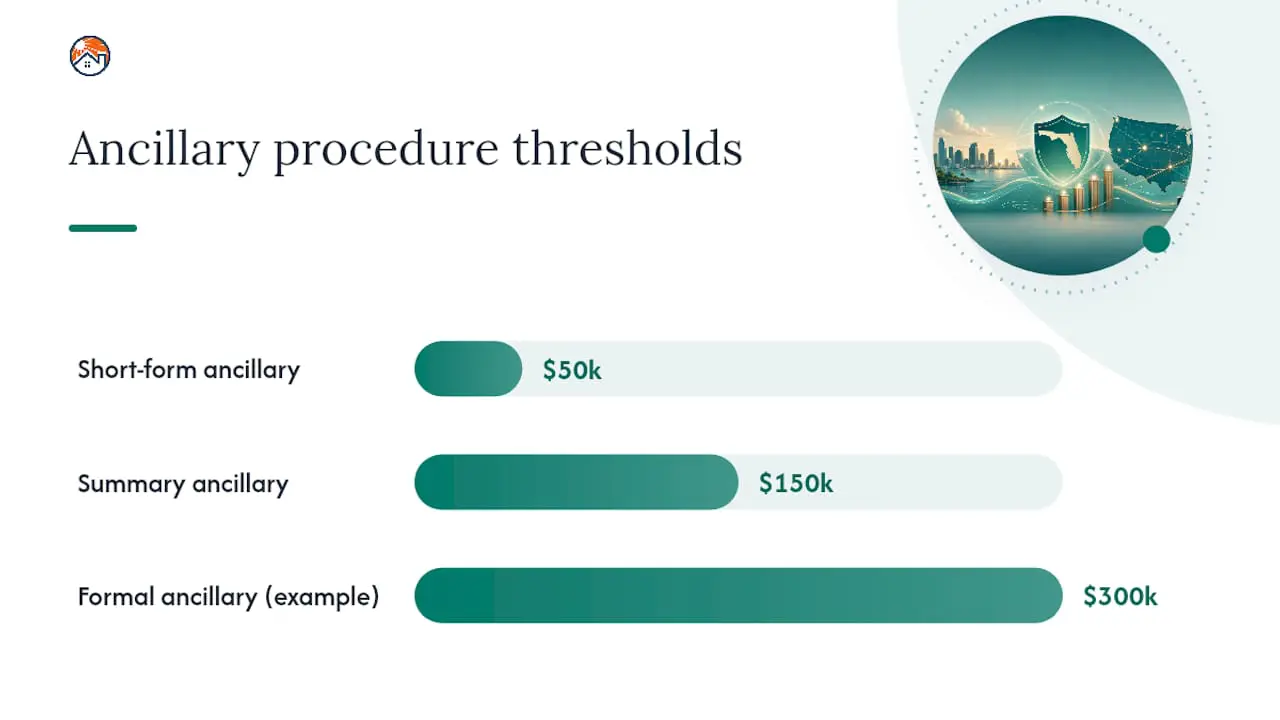
    Illustration of a bar chart comparing Florida ancillary procedure thresholds: short-form ancillary at $50k, summary ancillary at $150k, and a formal ancillary example at $300k

    Summary ancillary administration applies when Florida’s nonexempt assets fall under the summary administration ceiling, which rises to $150,000 effective July 1, 2026. This is often the fastest way to clear title on a Florida-only estate, and it typically doesn’t require appointing an ancillary personal representative at all.

    Formal ancillary administration becomes necessary when the property value exceeds these thresholds, a creditor contests a claim, or there’s a dispute over who qualifies to serve.

    • Testate estate, Florida home worth $40,000, no debts: short form usually fits
    • Florida-only estate worth $120,000, no disputes: summary administration
    • Florida property worth $300,000 or contested heirs: formal ancillary

    Who Can Serve as Ancillary Personal Representative?

    Florida follows a specific priority order under §734.102(1): the will’s nominated personal representative gets first shot, then the domiciliary personal representative from the home state if they qualify under Florida law, then an alternate the domiciliary PR designates, then someone chosen by a majority interest in the estate.
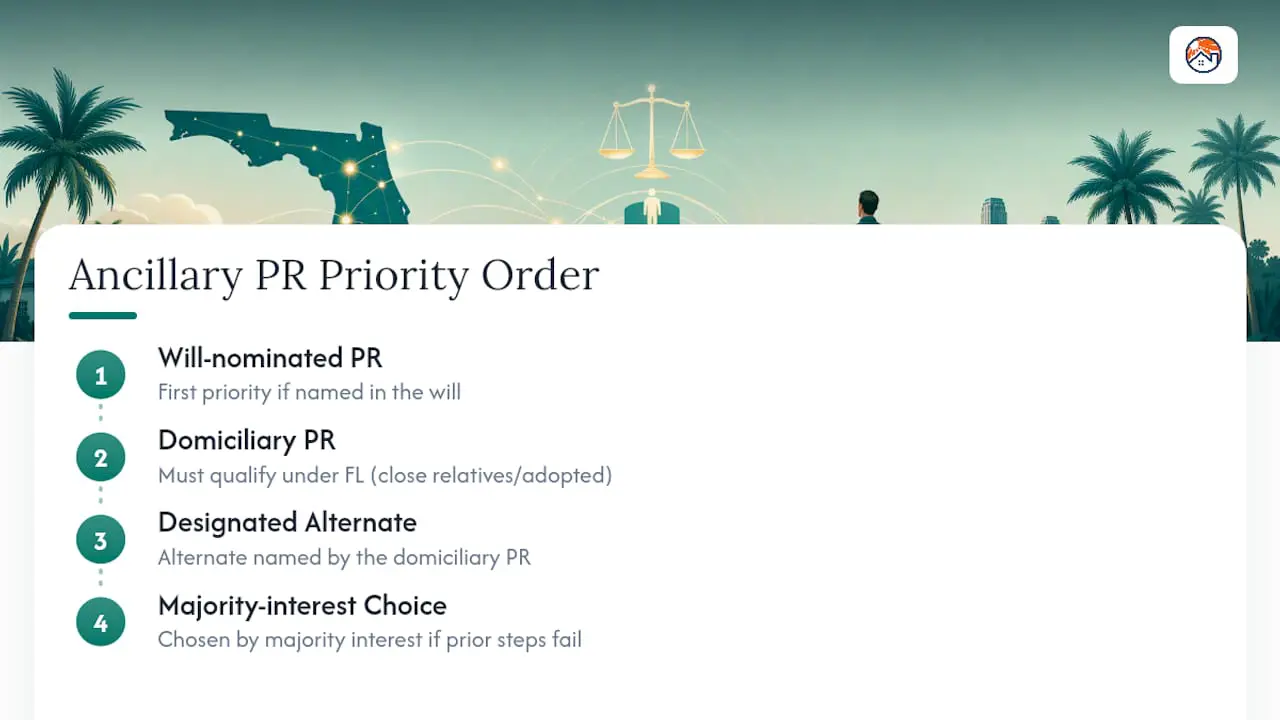
    Illustration of Florida's ancillary personal representative priority order: first the representative named in the will, then the domiciliary representative if they qualify under Florida law, then an alternate that representative designates, and finally a choice by majority interest in the estate

    That word “qualify” trips up a lot of families. Florida’s qualification rules under §733.304 bar most nonresidents from serving unless they’re a spouse, sibling, parent, child, or other close blood relative of the decedent, or legally adopted. A close family friend or a business partner named as executor in another state often cannot serve in Florida without naming a qualified alternate. When the domiciliary PR doesn’t qualify, the estate typically names a Florida-qualified relative or a Florida attorney instead. Once letters issue, expect standard requirements around bond and reporting unless the will waives them.

    What You Need to File: Documents and Practical Steps

    Florida Probate Rule 5.470 sets the paperwork bar, and it’s higher than most people expect from a state they’ve never dealt with before.

    1. Authenticated copy of the will (if one exists) and the domiciliary court’s order admitting it to probate
    2. Authenticated transcript of the domiciliary proceedings, including letters of administration issued in the home state
    3. A verified petition meeting Rule 5.200 requirements, listing assets, heirs, and the requested personal representative
    4. Formal notice to all qualified persons and to the domiciliary personal representative, as Rule 5.470(b) requires
    5. Florida counsel appearance, since ancillary petitions generally require an attorney licensed in Florida to file and appear

    Pro Tip: Order your authenticated domiciliary court records the same week you decide to open a Florida case. Courts in the home state can take weeks to certify copies, and that single step causes more ancillary delays than anything that happens inside Florida.

    How Long Does Ancillary Probate Take, and What Does It Cost?

    Short-form and summary ancillary cases typically resolve in a matter of weeks to a few months when the paperwork is clean and no creditor objects. Formal ancillary administration often takes several months and can be longer when the estate has debts or disputed heirs.

    The biggest delay isn’t the Florida court itself. It’s waiting on authenticated domiciliary records from the home state, plus the mandatory notice period. Florida also enforces a three-month creditor claims window under §733.702, meaning the estate can’t fully close until that window runs.

    Expect these cost categories: Florida court filing fees, publication costs for the creditor notice, attorney fees (often higher for formal ancillary than for short-form or summary filings), and bond premiums if the will doesn’t waive bond. For heirs facing an empty house that’s accumulating taxes, insurance, and upkeep costs during a long formal case, a fast cash sale can sometimes reduce carrying costs while the legal process finishes.

    How to Avoid Ancillary Probate Before It Starts

    Ancillary probate exists because Florida real estate has to pass through a Florida legal process. Structuring ownership differently can sidestep it entirely.

    • Revocable living trust: title the Florida property in the trust’s name, and the successor trustee transfers it without court involvement
    • Lady Bird deed (enhanced life estate deed): the owner keeps full control during life, and the property passes to a named beneficiary automatically at death
    • Joint tenancy with right of survivorship: co-owners automatically inherit the deceased owner’s share
    • Transfer-on-death or payable-on-death designations: work for certain account types and, in limited cases, real property

    None of these tools work if they’re executed incorrectly. Practitioners routinely recommend checking the actual deed and title history before assuming probate is avoided, because a defective deed or a missing signature can undo the whole plan.

    Pro Tip: Pull the recorded deed for the Florida property before you do anything else. The deed language, not the will or a verbal understanding, determines whether ancillary probate is required.

    Practitioner Perspective: What Surprises Heirs Most

    The biggest surprise for out-of-state families isn’t the paperwork. It’s discovering that a title company will flatly refuse to close on a Florida property using a home-state probate order, no matter how official it looks. That refusal usually surfaces late, often after a buyer is already under contract, which turns a manageable timeline into a scramble.

    The fix is coordinating with a title company early, before listing the property, so everyone knows exactly which Florida document will satisfy them. For heirs who inherited a tenant-occupied rental or a property needing repairs they don’t want to manage from another state, a direct cash sale can sometimes run in parallel with a short-form or summary filing rather than waiting for a formal case to close. Review the recorded deed first. It tells you more about your actual situation than any conversation with a well-meaning relative. For a deeper walkthrough of the sale side, Sunshine State Buyers’ guide to selling an inherited house in Florida covers what heirs typically need to have ready.

    Selling Florida Probate Property Without the Wait

    Sunshine State Buyers exists for exactly the situation this article describes: heirs who need to sell a Florida property tied up in ancillary probate without waiting out a formal case or fronting repair costs on a house they may never have seen in person.

    Sunshine State Buyers

    Sunshine State Buyers buys Florida homes as-is, including inherited and probate properties, tenant-occupied rentals, and houses that need work you’re not positioned to manage from out of state. You can get a cash offer quickly and select a closing date once the estate has the authority to sell. That timeline matters when a formal ancillary case is dragging on and property taxes, insurance, and upkeep keep draining the estate. When you reach out, expect to be asked for basic documentation, such as the letters of administration or ancillary letters and proof of your authority to sell, so the closing can move without surprises at the title company. If you’re weighing whether to sell as-is or navigate a longer listing process during probate, the Sunshine State Buyers guide to selling an inherited house walks through what to expect, and you can request a no-obligation cash offer whenever you’re ready to move forward.

    Where to Verify the Rules Yourself

    Read the statutes directly: Chapter 734, Florida Statutes covers ancillary administration, and Florida Probate Rule 5.470 governs the filing procedure. For a walkthrough of selling inherited property specifically, see Sunshine State Buyers’ Miami probate guide.

    This article is general information, not a substitute for advice from a qualified lawyer. Consult a qualified legal professional about your own circumstances before acting on anything here.

    Sources

    FAQ

    What Is the Difference Between Probate and Ancillary Probate?

    Probate administers a deceased person’s estate in their home state. Ancillary probate is a separate, additional proceeding required in Florida when that nonresident owned Florida real estate, credits, or liens, since a home-state order can’t transfer Florida title.

    How Do You Avoid Ancillary Probate in Florida?

    Titling Florida property in a revocable living trust, using a Lady Bird deed, holding it as joint tenants with right of survivorship, or adding a transfer-on-death designation can all keep the property out of court, provided the paperwork was executed correctly.

    How Long Does Ancillary Probate Take in Florida?

    Short-form and summary ancillary filings often resolve in weeks to a few months, while formal ancillary administration typically takes several months or longer when creditor claims or disputes arise.

    What Documents Are Needed for Ancillary Probate in Florida?

    You typically need an authenticated copy of the will and domiciliary court order, an authenticated transcript of the home-state probate proceedings, a verified petition, and formal notice to qualified persons under Rule 5.470.

    Can I Sell a Florida Property During Ancillary Probate?

    Once the court issues ancillary letters or a summary administration order establishing your authority, you can sell the property, and some heirs choose a fast cash sale to avoid carrying costs while other estate matters wrap up.

    This article was produced with AI assistance and reviewed for accuracy. It is provided for general information only and is not professional advice.

  • Get Florida Letters of Administration in 2–4 Weeks: Executor Checklist

    Get Florida Letters of Administration in 2–4 Weeks: Executor Checklist

    Letters of administration are the court-issued papers that give a personal representative the legal authority to manage a Florida estate. To get them, you file a petition with the circuit court in the county where the decedent lived, usually with a probate attorney handling the paperwork. Once the judge signs off, you can access bank accounts, collect assets, and eventually sell property on the estate’s behalf.


    TL;DR:

    • Most estates qualify for summary administration if their non-homestead assets are below the current threshold of $150,000, which can significantly shorten the probate process.
    • Formal administration, including obtaining letters of administration, generally takes two to four weeks for uncontested cases but can extend longer if disputes or complications arise.
    • Attorneys are required for most probate proceedings in Florida, and preparing comprehensive documents like death certificates, will, and asset inventories can streamline the process.
    • Letters of administration empower the personal representative to access assets, pay debts, and manage estate property, but they also impose ongoing responsibilities such as record-keeping and court accountings.
    • Selling estate real estate quickly during probate is possible through cash offers on as-is properties, often closing within 7 to 14 days, bypassing lengthy listing and repair requirements.

    Table of Contents

    What Are Letters of Administration in Florida?

    Letters of administration are the document a Florida circuit court issues that formally names someone as the personal representative of an estate, and grants them the legal power to act on the estate’s behalf. Without this paper, banks won’t release funds, title companies won’t close a real estate sale, and the IRS won’t recognize you as the person authorized to handle the decedent’s tax matters. The letters are your proof of authority, the way a driver’s license proves you’re allowed to drive.

    The authority letters typically confer includes:

    • Collecting and securing the decedent’s assets, from bank accounts to vehicles to real estate
    • Paying valid debts and administration expenses out of estate funds
    • Managing property during the probate period, including maintenance and insurance
    • Distributing what remains to heirs or beneficiaries once the court approves a final accounting

    There’s an important distinction worth clearing up early. If the decedent left a valid will naming an executor, the court issues “letters testamentary” instead. Letters of administration apply specifically when someone dies without a will (intestate), when the named executor is unwilling or unable to serve, or in cases of ancillary administration, where a Florida resident dies owning property in another state, or a nonresident dies owning property in Florida.

    Most petitioners fall into one of three situations: the decedent died without a will and Florida’s intestacy laws determine who inherits, the will named an executor who has passed away or declined to serve, or the estate includes Florida real estate but the person died as a resident of another state. Each scenario follows a similar filing process, but the eligibility rules for who can serve shift depending on whether there’s a will in the picture.

    Who Can Be Appointed Personal Representative in Florida?

    Florida law sets a strict order of preference for who gets appointed, and it depends heavily on whether the decedent left a will. Under Florida’s intestacy and appointment statutes, when someone dies intestate, the court gives priority in this order:

    • The surviving spouse
    • A person selected by a majority of the heirs
    • The heir nearest in degree to the decedent (if multiple heirs are equally close, the court picks among them)

    If the decedent left a will but the named executor can’t or won’t serve, the court instead follows the will’s alternate instructions or defaults to statutory priority among the beneficiaries. Testate estates give the deceased’s own wishes more weight; intestate estates lean entirely on the statutory ladder.

    Not everyone qualifies to serve, regardless of where they land in the priority order. Florida disqualifies:

    • Anyone under 18 years old
    • Anyone convicted of a felony
    • Anyone deemed by the court to be mentally or physically unable to perform the duties
    • Non-Florida residents, unless they’re closely related to the decedent (spouse, sibling, parent, child, or certain other family members)

    That last rule surprises a lot of families. If your sister lives in Ohio and your father died a Florida resident, she may still qualify because she’s a close relative. A family friend from Ohio would not.

    The court exercises discretion when priority is contested, weighing factors like the proposed representative’s relationship to the estate’s beneficiaries, any conflicts of interest, and whether the person has the practical capacity to handle the job. If two heirs of equal priority both petition, the judge decides based on who’s better suited to serve the estate’s interests, not just whoever filed first.

    Pro Tip: If you’re a surviving spouse, you typically have top priority even if adult children want to serve instead. Don’t assume you need everyone’s agreement to petition; the statute already puts you first in line.

    How Do You Get Letters of Administration in Florida?

    Filing for letters of administration is a court process, not a form you fill out at the courthouse counter and walk away with. Here’s what the path actually looks like.

    Hiring an attorney. Florida law requires an attorney for most probate proceedings, including formal administration, unless the personal representative is the sole interested party and also an attorney. Most petitioners hire probate counsel not just because the rule requires it, but because a misstep on notices or bond can add months to the timeline.

    The step-by-step filing process:

    1. Gather the foundational documents. You’ll need the decedent’s original death certificate, the original will if one exists, a preliminary list of heirs or beneficiaries, and a general accounting of known assets.
    2. File the petition for administration. This goes to the circuit court in the county where the decedent lived at the time of death. The Florida Bar’s consumer pamphlet on probate confirms this is where the court reviews the proposed representative’s eligibility and the estate’s basic facts.
    3. Provide notice to interested parties. Florida requires formal notice to known beneficiaries and heirs, plus a published notice to creditors in a local newspaper, giving unknown creditors a window to file claims against the estate.
    4. Address the bond requirement. Unless the will waives bond, or all beneficiaries consent to waive it, the court typically requires the personal representative to post a bond, essentially an insurance policy protecting beneficiaries from mismanagement.
    5. Wait for the court’s review and signature. Once the petition, notices, and bond (if required) are in order, a judge signs the order admitting the will (if any) and appointing the personal representative. The clerk then issues the actual letters of administration.
    6. Begin acting under your authority. Only once the letters are physically issued can you legally access accounts, transfer titles, or negotiate on the estate’s behalf.

    The Florida Bar’s guidance is consistent on one point: the court won’t issue letters until it’s satisfied the proposed representative is eligible and interested parties have had proper notice. Skipping or botching a notice step is one of the most common reasons a petition stalls.

    Pro Tip: Order a death certificate copy count higher than you think you’ll need, usually 8 to 10 certified copies. Banks, insurers, the DMV, and the court clerk each want their own original, and reordering later adds delay.

    How Long Does It Take and What Does It Cost?

    An uncontested petition in a straightforward estate typically results in issued letters within two to four weeks of filing, once all documents and notices are properly submitted. Contested cases, where a family member challenges the proposed representative or disputes the will, can stretch that timeline to several months or longer, since the court has to resolve the dispute before appointing anyone.

    Several factors commonly extend the timeline:

    • A contested appointment or will challenge
    • Ancillary administration involving property or assets in another state
    • Missing or incomplete documentation that requires refiling
    • Difficulty locating and notifying heirs, especially in blended families or when relatives are estranged

    Cost is the other big question, and it breaks down into several distinct line items rather than one flat fee:

    • Court filing fees, which vary by county but generally run in the low hundreds of dollars
    • Attorney fees, either a flat rate for simpler estates or hourly billing for complex ones; Florida law also allows a statutory percentage fee based on the estate’s value for formal administration
    • Bond premiums, if the court requires a bond, typically a percentage of the bond amount paid annually to a surety company
    • Publication costs for the required creditor notice, usually a modest newspaper fee
    • Appraisal costs, if real estate or unique assets need a professional valuation for the inventory

    Executors handling estates near or above the federal estate tax exemption should also budget time to consult the IRS’s estate tax guidance, since state probate approval and federal tax clearance are entirely separate processes with separate deadlines.

    What Powers and Duties Come With the Letters?

    Once the court hands you letters of administration, you’re not just holding a piece of paper, you’re holding a fiduciary role with real legal weight. The letters typically authorize you to:

    • Open an estate bank account and consolidate the decedent’s funds
    • Collect debts owed to the estate and pay valid debts the estate owes
    • Manage, maintain, and insure estate property, including real estate
    • Sell certain estate assets when necessary to pay debts or when beneficiaries agree, though real estate sales often require additional court approval depending on the will’s language and whether the sale is contested

    That authority comes bundled with duties that Florida law takes seriously. As a personal representative, you’re expected to act with the same care a prudent person would use managing their own finances, keep organized records of every transaction, and file timely accountings with the court showing where estate money went. The Florida Probate Law Group’s overview of formal probate notes that letters are issued once the court formally accepts the representative, and that acceptance comes with an expectation of ongoing accountability, not a one-time formality.

    Falling short of those duties carries real consequences. Beneficiaries who suspect mismanagement, missing assets, or self-dealing can petition the court to compel an accounting, demand the representative’s removal, or in serious cases, pursue a claim for breach of fiduciary duty. A Florida probate firm’s explanation of letters of administration points out that the letters grant authority precisely so the representative can close out the estate, but that authority is conditioned on following the process the court laid out, not shortcuts.

    Summary Administration vs. Formal Administration: Which One Applies?

    Not every estate needs letters of administration at all. Florida offers a faster, simpler track called summary administration for smaller estates, and knowing which category yours falls into can save months and a meaningful amount in attorney fees.

    Summary administration skips the appointment of a personal representative entirely. Instead, the court issues an order distributing the assets directly to the people entitled to them, without ongoing court supervision or formal letters. It’s designed for estates that are small enough, or straightforward enough, not to need a fiduciary managing things over time.

    Whether an estate qualifies depends on its size, and Florida recently changed that threshold. Under the Florida statutes governing summary administration, the value threshold is $150,000 for individuals who die on or after July 1, 2026, and $75,000 for those who died before that date. Homestead property is excluded from that calculation either way, since Florida treats a primary residence differently under its homestead protections.

    Summary administration generally makes sense when:

    • The estate’s non-homestead assets fall under the applicable threshold
    • There’s no dispute among heirs about who gets what
    • The decedent has been dead for more than two years (which allows summary administration regardless of estate size, since most creditor claims expire by then)

    If the estate exceeds the threshold, involves a business, includes out-of-state property, or faces any dispute among heirs, formal administration and full letters of administration are the route. The size of the estate is usually the deciding factor, but a disputed will or complicated debt picture can push even a smaller estate into formal proceedings.

    Can a Personal Representative Sell Estate Real Estate?

    Letters of administration generally give the personal representative authority to sell estate real property, but the specifics depend on the will’s language and whether beneficiaries agree. If the will grants explicit power of sale, or all beneficiaries consent in writing, the representative can often move forward without additional court sign-off. Absent that authority, the representative may need to petition the court for permission before closing a sale, particularly when heirs disagree about the timing or the price.

    Executors weighing how to sell inherited property generally have three paths:

    • Listing with an agent. This usually nets the highest sale price but takes the longest, often 60 to 90 days or more, and requires repairs, showings, and staging that many estates want to avoid.
    • A negotiated cash sale. This trades some sale price for speed and simplicity, since a cash buyer purchases the property as-is, without financing contingencies or repair negotiations dragging out the closing.
    • A court-supervised sale. This applies when beneficiaries disagree or the will requires it, adding a layer of judicial oversight and time but protecting all parties from later disputes over the sale terms.

    Executors commonly turn to cash buyers specifically to avoid the listing process and long closing timelines when an estate needs liquidity quickly, whether to pay debts, satisfy multiple heirs who each want their share sooner, or simply close out the estate without months of showings. That speed comes with a tradeoff: cash offers typically land below full retail market value, since the buyer is pricing in the certainty and convenience they’re providing. Some cash home buyers work specifically with executors in this position, buying inherited Florida properties as-is and closing on the estate’s timeline rather than a buyer’s mortgage approval schedule, which matters when you’re trying to distribute proceeds to multiple heirs without dragging the process out. If your family is weighing that tradeoff, this guide to selling an inherited house in Florida walks through what a probate sale looks like from the executor’s side.

    Do You Need a Probate Attorney, and What Should You Bring to the First Meeting?

    Some estates genuinely move through probate without much friction. Others need a lawyer involved from day one. A few red flags mean you shouldn’t wait to call one:

    1. Family disagreement over who should serve or how assets should be divided
    2. A large or complex estate, including business interests, multiple properties, or significant investment accounts
    3. Creditor claims that seem disputed, excessive, or unclear
    4. Out-of-state property, which triggers ancillary administration in a second jurisdiction
    5. Any hint of a will contest, whether from a disinherited relative or someone claiming undue influence

    Walking into your first attorney consultation prepared saves both time and billable hours. Bring:

    • The original death certificate and, if one exists, the original will
    • Property deeds for any real estate the decedent owned
    • Recent bank and investment account statements
    • Contact information for all known heirs and beneficiaries
    • A rough list of known debts, from mortgages to credit cards to medical bills

    Pro Tip: Ask the attorney directly how they bill, flat fee versus hourly versus the statutory percentage method, before you sign an engagement letter. Probate fee structures vary more than people expect, and clarifying this upfront avoids an uncomfortable surprise later.

    Worth asking too: how they handle notice to out-of-state heirs, whether bond will be required in your case, and a realistic timeline given your estate’s specific complications.

    An Executor’s View: What Nobody Tells You Going In

    Most people expect the paperwork. What catches executors off guard is the volume of small administrative tasks that pile up between the big milestones. Every account needs its own phone call, its own certified death certificate, its own separate verification process. Nobody warns you how many hours disappear into hold music.

    Two things make the difference between a smooth administration and a stressful one. First, organize your documents before you file anything, not after. A simple folder system for the will, deeds, statements, and correspondence saves you from digging through a shoebox three months in when the court asks for something specific. Second, put beneficiary communication in writing whenever possible. A quick email summarizing what happened at each stage prevents the misunderstandings that turn into disputes, and it gives you a paper trail if anyone later questions how you handled something.

    Executors who treat this like a part-time administrative job, rather than a favor they’re doing between other obligations, tend to finish faster and with far less family friction.

    — David

    Selling Inherited Property Fast During Probate

    If you’re the personal representative trying to close out an estate, a traditional listing means repairs, showings, and waiting on a buyer’s mortgage approval, all while the estate sits open and heirs wait for their share. Executors may consider a different route: a cash offer within 24 hours on the property as-is, with no repairs, no showings, and no agent commissions eating into what beneficiaries receive.

    Sunshine State Buyers

    Because some buyers purchase directly as the buyer rather than listing the property for someone else, closing can typically happen in 7 to 14 days once you choose a date that works for the estate’s timeline. That speed matters when you’re managing multiple heirs, covering ongoing property expenses, or trying to wrap up administration before a deadline. Whether the property is outdated, has deferred maintenance, or is simply more than the family wants to manage from a distance, the offer reflects the home’s condition without asking you to fix anything first. If you’re an executor weighing your options, start with this guide to selling an inherited house in Florida and request a no-obligation cash offer to see what a fast, as-is sale would look like for your estate.

    Sources

    Every filing detail, threshold, and procedural step in this guide traces back to primary Florida sources, and you should verify anything county-specific with your local circuit court clerk before filing. The Florida Bar’s consumer pamphlet on probate explains the petition and notice process in plain language for non-lawyers. The Florida Senate’s statutes on summary administration set the dollar thresholds and eligibility rules directly. For federal tax questions tied to larger estates, the IRS’s estate tax FAQ page covers filing obligations separate from Florida’s probate process.

    This article is general information, not a substitute for advice from a qualified lawyer. Consult a qualified legal professional about your own circumstances before acting on anything here.

    FAQ

    How long does it take to get letters of administration in Florida?

    Uncontested cases typically see letters issued within two to four weeks of filing, once all documents and required notices are in order. Contested cases, or those involving disputes over the will or the proposed representative, can take several months longer.

    How much does it cost to get letters of administration in Florida?

    Costs include court filing fees, attorney fees (flat, hourly, or statutory percentage), bond premiums if required, creditor notice publication costs, and appraisal fees for real estate or unique assets. The total varies significantly based on estate size and whether attorney fees are hourly or a flat rate.

    What documents do I need to obtain letters of administration?

    You’ll need the decedent’s original death certificate, the original will if one exists, a list of heirs and beneficiaries, and a general inventory of the estate’s assets. The petition itself gets filed with the circuit court in the county where the decedent lived.

    What happens after letters of administration are issued?

    Once issued, the personal representative can open an estate bank account, collect assets, pay valid debts, and manage or sell property as authorized by the will or court order. The representative must also keep records and file accountings with the court until the estate is ready to close, at which point remaining assets are distributed and the letters terminate.

    Do I need letters of administration if the estate qualifies for summary administration?

    No. Summary administration bypasses the appointment of a personal representative and the issuance of letters entirely, distributing assets directly through a court order for estates under the statutory threshold, currently $150,000 for deaths on or after July 1, 2026, and $75,000 for deaths before that date, excluding homestead property.

    This article was produced with AI assistance and reviewed for accuracy. It is provided for general information only and is not professional advice.

  • Skip Florida Probate: Lady Bird Deeds, Medicaid & Homestead Traps

    Skip Florida Probate: Lady Bird Deeds, Medicaid & Homestead Traps

    A Lady Bird deed, known formally as an enhanced life estate deed, lets you keep full control of your Florida home while you’re alive and passes it straight to your chosen heirs the moment you die, with no probate court involved. You stay free to sell, mortgage, or change your mind at any time. The catch: homestead property, minor children, and married couples add wrinkles that make sloppy drafting risky.


    TL;DR:

    • Lady Bird deeds in Florida allow full control during life and automatically transfer property at death, avoiding probate and saving costs for a single property.
    • Proper drafting is crucial, especially for homestead properties or married homeowners, as vague language can reclassify the deed into a traditional life estate, requiring signatures from remaindermen.
    • These deeds typically do not impact Medicaid eligibility due to retained revocation powers, and they only cover the named property, not other assets or incapacity planning.
    • Mistakes such as incorrect legal descriptions or missing notarization can render the deed invalid and expose owners to future legal challenges.
    • For properties with maintenance issues, tenants, or complex family situations, a quick cash sale may be more efficient than holding or renovating the inherited estate.

    Table of Contents

    What Is a Lady Bird Deed in Florida and How Does It Work?

    The mechanics come down to one phrase: reservation of powers. When you sign a Lady Bird deed, you’re not giving your property away in any practical sense. You’re recording a deed that names future beneficiaries (called remaindermen) while keeping every real stick in your own hand.

    You, the grantor, retain what’s called an “enhanced” life estate. Unlike an old-fashioned life estate, where you’d need your remaindermen to sign off before you could sell or refinance, an enhanced life estate lets you act alone. You can sell the house tomorrow, take out a home equity line, rent it out, or revoke the deed entirely and name someone else. The remaindermen hold what lawyers call a vested remainder subject to divestment, meaning their interest exists on paper but can be wiped out entirely by anything you do during your lifetime.

    At your death, title passes automatically. Your beneficiaries record a certified copy of your death certificate along with an affidavit in the county where the property sits, and the property is theirs, no probate judge, no waiting months for letters of administration, no estate attorney billing hourly for a routine transfer.

    Here’s something worth knowing: there’s no dedicated “Lady Bird deed” statute in Florida. The Florida Bar Journal confirms these deeds work because Florida’s general conveyance and recording law allows this kind of reserved-powers arrangement, not because of a named statute. That’s why the exact wording matters so much.

    The core mechanics break down like this:

    • The grantor keeps unrestricted lifetime control, including the power to sell, mortgage, or revoke.
    • Remaindermen get a future interest, not a present one, so they have no say and no rights while you’re alive.
    • Death triggers an automatic transfer by recording, not a court proceeding.
    • Validity rests entirely on how the deed is drafted and recorded, not on a specific Lady Bird statute.

    Key Benefits for Florida Homeowners

    The appeal of a Lady Bird deed is that it solves several estate problems with one signature and a $10 to $20 recording fee.

    Skipping probate on that one parcel is the headline benefit, and it’s a real one. Florida probate for real estate can take months and cost thousands in attorney and court fees. A properly recorded Lady Bird deed sidesteps that entirely for the property named in it.

    You also don’t give up anything while you’re alive. You can sell the house, refinance it, or name a different beneficiary next year if your family situation changes. Nothing is locked in until you die.

    There’s a tax advantage too. Because your heirs receive the property at your death rather than as a lifetime gift, they get a stepped-up cost basis equal to the property’s value on the date you die. If you bought your Fort Myers house in 1995 for $80,000 and it’s worth $420,000 when you pass, your heirs’ basis resets to $420,000, wiping out decades of capital gains exposure if they sell.

    Pro Tip: Ask your title company or attorney to confirm the stepped-up basis applies to your specific property type, since jointly held or previously gifted property can complicate the calculation.

    Medicaid planning is where these deeds earn their reputation. Because you retain the power to revoke the deed, Nolo’s guidance on Medicaid rules notes that many states, Florida practice included, don’t treat the recording as a completed transfer for look-back purposes. That’s different from a straight quitclaim gift to your kids, which can trigger a Medicaid transfer penalty.

    Quick summary of what a Lady Bird deed typically delivers:

    • Probate avoidance for the named property only
    • Full retained control, including sale and revocation rights
    • Stepped-up basis for heirs at death
    • Generally not treated as a completed gift for Medicaid purposes
    • Lower cost than establishing and funding a revocable trust for a single asset

    Risks and Limitations to Watch in Florida

    None of this works if the deed is drafted carelessly, and Florida has a few traps that trip up homeowners who try to shortcut the process.

    Homestead property is the biggest one. Florida’s Constitution, Article X, Section 4 restricts how you can devise homestead property if you’re survived by a spouse or minor children. If your house qualifies as homestead and you’re married, you generally can’t leave it to someone other than your spouse without their agreement, no matter what your Lady Bird deed says. Minor children add another layer of restriction that a deed alone cannot override.

    Pencil-sketch illustration of a Florida house with palm trees, with two paths leading away from it — one to a pair of wedding rings, one to two children — each path blocked by a barricade marked with an X

    Language precision matters more than most people expect. If your reservation-of-powers clause is vague or missing key language, such as an explicit power to mortgage or an explicit power to reconvey to yourself in fee simple, Alper Law points out that the deed can be reinterpreted as a traditional life estate. That means your remaindermen would suddenly have a permanently vested interest, and you’d need their signature to sell or refinance. That’s the opposite of what you intended.

    Creditor exposure on the remainderman side is a real, if often overlooked, risk. If your named beneficiary racks up debts or a judgment before you die, that creditor could theoretically attach to the remainder interest, creating a title complication your title company will flag when the property eventually transfers or sells.

    Watch for these gaps too:

    • A Lady Bird deed only covers the one property it names, not bank accounts, retirement funds, or business interests.
    • It doesn’t help with incapacity planning; you still need a power of attorney or trust for that.
    • Divorce or remarriage after signing can leave an ex-spouse or estranged beneficiary named as a remainderman if you forget to update the deed.

    Pro Tip: If your life changes, marriage, divorce, a beneficiary’s death, revisit your Lady Bird deed the same year. Because you retain full revocation power, updating it costs a fraction of what fixing a probate dispute later would.

    Before you record anything, there’s a short list of Florida-specific boxes to check, and skipping any one of them is how these deeds end up contested.

    1. Confirm execution formalities. Florida law requires the deed be in writing, signed by the grantor, and witnessed by two people, then acknowledged before a notary. Ginsberg Shulman’s guide walks through the exact signing sequence title companies expect to see.
    2. Get the legal description right. Recording requires the property’s full legal description and parcel identification number, not just a street address. An imprecise description is one of the most common reasons a deed gets rejected at the county recorder’s office.
    3. Run the homestead analysis first. If you’re married or have minor children, check whether Article X, Section 4 restricts how you can devise the property before you assume a Lady Bird deed will work as planned.
    4. Ask how Medicaid and title professionals in your area actually treat these deeds. Practice varies by county and by title underwriter, so confirm with a local professional rather than assuming statewide uniformity.

    A properly executed Lady Bird deed is written, signed by the grantor, witnessed by two people, acknowledged before a notary, and recorded with the county using the property’s complete legal description. Skip any one element and the deed’s validity, or its probate-avoidance benefit, can be challenged later.

    Florida’s Department of Children and Families administers Medicaid eligibility determinations in the state, and caseworkers there rely on federal transfer-penalty rules under 42 U.S. Code § 1396p when reviewing any recorded deed. Because the grantor’s retained revocation power keeps the transfer incomplete during life, Florida practice generally doesn’t count the recording itself as a disqualifying transfer, but a caseworker will still want to see the deed’s exact language before signing off.

    How to Create, Sign, and Record a Correct Lady Bird Deed

    A clean Lady Bird deed follows a specific sequence, and each step protects you against a different kind of failure.

    1. Draft the reservation-of-powers clause first. This is the clause that lets you sell, mortgage, revoke, or change beneficiaries without anyone’s consent. Vague language here undoes the entire strategy.
    2. Verify current vesting and legal description. Pull your current deed and confirm exactly how title is held today, then match the legal description word for word.
    3. Name your remaindermen, including contingent beneficiaries. If your first choice predeceases you, a contingent beneficiary clause avoids the property falling back into your probate estate.
    4. Check for spousal joinder requirements. If you’re married and the home is homestead property, your spouse may need to join the deed for it to be valid.
    5. Sign before two witnesses and a notary, then record the deed with the clerk of court in the county where the property sits.
    6. Confirm with a title company that the deed reads as an enhanced life estate, not a traditional one, before you rely on it.

    Pro Tip: A DIY Lady Bird deed template can work for a simple, unmarried, single-owner property, but the moment homestead status, a spouse, or a blended family enters the picture, an hour with a Florida estate attorney is cheap insurance against a title dispute your heirs would inherit along with the house.

    Attorney fees for a straightforward Lady Bird deed in Florida are typically modest, rising if your ownership structure, homestead status, or family situation requires extra drafting and title research.

    Lady Bird Deed vs. Will, Life Estate, or Trust: Which Fits Your Situation?

    Each estate planning tool solves a different combination of problems, and picking the wrong one is usually a matter of mismatched expectations rather than bad advice.

    A will avoids nothing; it still goes through probate, full stop. A traditional life estate deed avoids probate but locks you in, since you’d need your remainderman’s signature to sell or refinance. A revocable trust avoids probate for everything you fund into it, handles incapacity planning, and works across multiple properties and states, but costs more to set up and requires ongoing maintenance to keep assets titled correctly in the trust’s name.

    A Lady Bird deed sits in a specific niche: it’s the right, low-cost choice when you own a single Florida parcel, you’re not worried about incapacity planning, and your heirs would otherwise struggle to afford probate costs on an inherited house. It’s also popular among Florida snowbirds and out-of-state owners who want a simple, low-maintenance way to pass on a Florida home without opening a second estate proceeding.

    Consider a trust instead when:

    • You own multiple properties, especially across different states
    • You need incapacity planning built into the same document
    • Your family situation involves blended families, disputes, or beneficiaries who need protection from creditors
    • You want a plan that survives more legal challenges than a straightforward deed typically can

    What Happens After the Deed Transfers: A Florida Perspective

    Once title passes, heirs usually decide fast: keep the property or sell it. Recording the death certificate is simple. What follows often isn’t, especially when the house comes with a mortgage, unpaid taxes, a tenant in place, or code violations nobody addressed for years.

    That’s the piece a Lady Bird deed can’t solve. It moves the deed outside probate, but it doesn’t pay off a lien, evict a difficult tenant, or fund the repairs a lender will demand before a traditional buyer can even get financing. Those are liquid-asset and property-condition problems, and they need their own plan, whether that’s a will covering the rest of the estate or a straightforward cash sale of an inherited Florida property.

    Sunshine State Buyers works with heirs in exactly this spot across Florida, evaluating properties as-is and closing on the seller’s timeline instead of a buyer’s mortgage approval schedule.

    Selling an Inherited Florida Property? Here’s a Faster Path

    If you’ve inherited a home through a Lady Bird deed and repairs, taxes, or a tenant situation are making it more trouble than it’s worth, Sunshine State Buyers offers a way through that skips the listing process entirely. Instead of prepping a house for showings or waiting on a buyer’s financing to fall through, you get a cash offer within 24 hours and can close in 7 to 14 days, on a date you pick.

    Sunshine State Buyers

    This works well for heirs who live out of state, don’t want to manage a rental they inherited, or are facing a property with code violations or deferred maintenance that would scare off a conventional buyer. Some companies purchase homes statewide in any condition, no repairs, no commissions, no agent showings, and understand the practical realities of settling an inherited Florida house alongside a title transfer. If your Lady Bird deed just delivered you a property you don’t plan to keep, request a no-obligation cash offer and see what a straightforward, predictable closing looks like compared to listing it the traditional way.

    This article is general information, not a substitute for advice from a qualified lawyer. Consult a qualified legal professional about your own circumstances before acting on anything here.

    Sources

    FAQ

    What Is the Downside of a Lady Bird Deed in Florida?

    The main downsides are homestead and spousal restrictions that can override the deed, drafting risk if the reservation-of-powers language is incomplete, and the fact that it only covers one property, leaving other assets and incapacity planning unaddressed.

    Can I Do My Own Lady Bird Deed in Florida?

    You can draft one yourself for a simple, unmarried, single-owner property, but homestead status, marriage, or a blended family situation makes attorney review advisable to avoid a title dispute later.

    How Much Does a Lady Bird Deed Cost in Florida?

    Attorney fees for a straightforward Lady Bird deed commonly run in the low hundreds of dollars, plus a modest county recording fee, though complex ownership or homestead issues can raise the cost.

    Is a Lady Bird Deed a Good Idea?

    For a Florida homeowner with one property and heirs who’d otherwise face probate costs, it’s usually a solid, low-cost option, though anyone with multiple assets, incapacity concerns, or a complicated family situation should weigh a trust instead.

    This article was produced with AI assistance and reviewed for accuracy. It is provided for general information only and is not professional advice.

  • 3-Month Deadline for Heirs: Medicaid Estate Recovery in Florida

    3-Month Deadline for Heirs: Medicaid Estate Recovery in Florida

    Yes, Florida pursues Medicaid estate recovery, but only for benefits paid after the recipient turned 55. Homestead property and non-probate assets like living trusts and beneficiary-designated accounts usually stay out of reach, while other probate assets can face a claim. If you’re a personal representative, your first move is sending notice and a death certificate to the Florida Medicaid Estate Recovery Program before you do anything else with the estate.


    TL;DR:

    • Florida’s estate recovery applies only to benefits paid after the recipient turned 55, with homestead property and beneficiary accounts usually protected.
    • The recovery claim is capped at actual Medicaid expenses after age 55, and assets that pass outside probate, like trusts and joint accounts, generally escape recovery.
    • The three-month notice deadline is crucial for creditors, including Medicaid, and missing it can delay or complicate recovery efforts.
    • Hardship waivers are narrowly granted and require detailed proof that recovery would cause severe deprivation for heirs.
    • Proper planning, such as funding trusts early or using specific deeds, is essential to protect assets, especially the family home, from Medicaid claims.

    Table of Contents

    What Is the Florida Medicaid Estate Recovery Program?

    Florida’s recovery authority comes from Fla. Stat. § 409.9101, the state law that created the Medicaid Estate Recovery Act. It works alongside federal law, specifically the Omnibus Budget Reconciliation Act of 1993, codified at 42 U.S.C. § 1396p, which requires every state Medicaid program to attempt recovery of long-term care costs.

    The Agency for Health Care Administration (AHCA) runs Florida’s program, but it contracts with a company called Health Management Systems (HMS) to handle the day-to-day recovery work, including claims and waiver requests. Once someone accepts Medicaid benefits after age 55, that acceptance creates a debt owed to the agency. It doesn’t get forgiven at death. It gets billed to the estate.

    Who Owes Money and What Benefits Count

    Age is the trigger. Only benefits paid to someone who was 55 or older at the time create a recoverable claim. If your parent went on Medicaid at 50 and passed away at 58, only the payments made from age 55 forward are fair game.

    The benefits that typically show up on a claim include:

    • Nursing home and skilled nursing facility care
    • Intermediate care facility services
    • Home and community-based services (HCBS), including many in-home aide programs
    • Hospital and prescription drug costs tied directly to long-term care

    The state can’t ask for more than it actually paid out. The claim against an estate is capped at the amount Medicaid actually spent on nursing home care after the recipient turned 55, regardless of how large the estate turns out to be.

    Which Assets Are Exposed and Which Ones Usually Escape

    Florida can only reach the “probate estate,” meaning assets that pass through the court process because they’re titled solely in the decedent’s name with no other transfer mechanism attached. Anything that transfers automatically at death, by contract or by law, generally sits outside the recovery net.

    Florida’s constitutional homestead protection is the biggest exemption most families rely on. When a homestead passes to a qualifying heir, such as a surviving spouse or heir under Florida’s homestead descent rules, it’s typically shielded from a Medicaid claim, according to the Estate Recovery FAQ published by the program itself. A house that isn’t protected homestead, though, can be sold to satisfy the claim if the sale would produce net proceeds.

    Assets that commonly avoid probate, and therefore avoid recovery exposure, include:

    • Living trusts funded properly before death
    • Life insurance and retirement accounts with named beneficiaries
    • Bank accounts with payable-on-death designations
    • Property held in joint tenancy with rights of survivorship

    Timing and structure matter here. A trust set up two weeks before a Medicaid application, or a deed transfer done without legal guidance, can create penalties or unwind entirely. Avoiding probate is the most reliable path to protecting assets, but “reliable” only holds up when the paperwork was done correctly and early.

    How the Recovery Process Actually Plays Out

    The clock starts the moment a Medicaid recipient aged 55 or older dies. Here’s the sequence most estates go through:

    1. Notice goes out. The personal representative or their attorney must notify AHCA and send a copy of the death certificate to the Florida Medicaid Estate Recovery Program at P.O. Box 12188, Tallahassee, FL 32317-2188, within three months after the first publication of the notice of administration.
    2. The state cross-checks probate filings. AHCA and HMS also pull from monthly probate lists filed across Florida’s counties, so even if notice is missed, the state often finds the estate anyway.
    3. A claim gets filed. If Medicaid paid benefits after age 55, the agency files a statement of claim with the probate court, functioning exactly like any other creditor claim.
    4. The court applies payment order. Florida probate law sets the order in which creditors get paid, and Medicaid’s claim competes with funeral costs, administrative expenses, and other debts under that same hierarchy.
    5. Amounts get finalized. The agency can amend its claim within statutory windows if it discovers additional payments, but the total can never exceed what Medicaid actually spent after the recipient turned 55.

    That three-month notice window is the detail most families miss, and missing it doesn’t make the debt disappear. It just means the state finds you later, often after assets have already changed hands.

    Hardship Waivers: Who Qualifies and What You Need to Prove

    Florida law allows an undue-hardship waiver, but it’s applied narrowly. The standard isn’t “this inheritance mattered to me.” It’s whether recovery would leave an heir without food, clothing, shelter, or medical care, per Fla. Stat. § 409.9101.

    Beyond general hardship, specific exceptions exist for a surviving spouse, a minor child, a blind or permanently disabled child, and sometimes a sibling or adult child who lived in the home and provided care that delayed nursing home placement.

    A strong waiver request typically includes:

    • Month-by-month income and expense records for the heir
    • Proof of residency at the property, if claiming a caregiver exception
    • Documentation of caregiving, including medical or social worker affidavits
    • Settlement details, if any third-party recovery is involved

    Nolo’s guide to Florida’s program is blunt about the odds: vague claims get denied. Reviewers want contemporaneous, specific proof, not a general statement about financial strain.

    Planning Ahead: Trusts, Deeds, and the Mistakes That Backfire

    The cleanest way to keep a home out of the recovery process is a properly funded revocable living trust, set up and titled correctly well before a Medicaid application, not scrambled together during a health crisis.

    Trust and deed planning setup on desk

    Florida also allows an enhanced life estate deed, often called a Lady Bird deed, which lets someone keep full control of a property during their lifetime while automatically transferring it to a named beneficiary at death, bypassing probate entirely. It’s one of the more popular tools among Florida elder-law attorneys specifically because it’s simple and doesn’t require giving up control early.

    Joint tenancy with rights of survivorship also avoids probate, but it comes with a real tradeoff: adding a co-owner exposes the property to that person’s creditors, divorce proceedings, or lawsuits, not just Medicaid’s claim.

    Gifting property to dodge future recovery is where families get into trouble. A gift made too close to a Medicaid application can trigger a penalty period that delays eligibility, and it can create capital gains tax exposure the family didn’t have when they simply inherited the property.

    • Fund a trust years, not weeks, before applying for benefits
    • Get a title company or attorney to confirm a Lady Bird deed was recorded correctly
    • Weigh joint tenancy’s creditor exposure against its probate savings
    • Talk to an elder-law attorney before any gift, no matter how small it feels.

    Pro Tip: If a spouse is still living, most of these planning steps matter far less urgently. Florida’s spousal protections generally keep the marital home and other assets out of recovery until after the surviving spouse also passes away, which buys real planning time.

    Your Checklist as a Personal Representative

    Once you’re named personal representative, a short list of tasks protects the estate from missteps:

    • Mail notice and a death certificate to the Florida Medicaid Estate Recovery Program within the three-month window
    • Gather Medicaid payment records, medical bills, probate filings, and property title documents
    • Pull every beneficiary designation on file for bank, retirement, and insurance accounts
    • If the estate has no cash but owns a house, get a realistic sale-cost estimate before assuming a sale is required
    • Request the hardship waiver application directly from AHCA or HMS if the family may qualify

    If the estate is asset-poor and the only real value is a house that needs work, a fast sale of an inherited property is often less costly than months of carrying costs and repair bills while probate drags on.

    Does Long-Term Care Insurance Change Anything?

    Long-term care insurance can reduce or eliminate a Medicaid estate recovery claim indirectly, simply because it delays or prevents someone from ever needing Medicaid in the first place. If a policy covers nursing home care in full, there’s no Medicaid payment history after age 55, and therefore nothing for the state to recover.

    Where it gets more nuanced is with partnership-qualified long-term care policies, a model several states use that ties private insurance benefits to Medicaid asset protection. Florida participates in this federal partnership framework, meaning a qualifying policy can let a person shelter a dollar-for-dollar amount of assets from Medicaid’s spend-down rules while still eventually qualifying for benefits if the policy runs out. That protected amount can also carry over into estate recovery protection, shielding assets equal to the insurance payout from the state’s claim.

    Other asset protection tools work differently and don’t offer the same guarantee. An irrevocable trust set up years in advance can remove assets from both the Medicaid eligibility calculation and the recovery estate, but it requires giving up control, and Florida’s five-year lookback period for Medicaid eligibility means last-minute transfers won’t help. Annuities structured specifically for Medicaid planning have similar timing requirements and need an elder-law attorney’s review, since a poorly structured annuity can actually disqualify someone from benefits rather than protect them.

    The honest takeaway: insurance and trusts both work, but only when they’re in place years before a Medicaid application, not after a diagnosis forces the issue.

    Illustration comparing Medicaid asset protection methods: long-term care insurance, partnership LTC policies, irrevocable trusts, and Medicaid annuities, noting the five-year lookback

    How Florida Compares to Other States

    Every state runs some version of estate recovery because federal law requires it, but the aggressiveness and scope vary quite a bit. Some states, like Massachusetts, expand recovery beyond probate assets into what’s sometimes called “expanded estate recovery,” reaching jointly held property or assets in certain trusts. Florida does not do this. Its recovery stays limited to the probate estate, which is one reason homestead and beneficiary-designated accounts carry so much weight in Florida planning conversations.

    Other states differ sharply on how they treat the home. Some pursue liens against real property even while the Medicaid recipient is still alive, under a mechanism called a TEFRA lien. Florida generally does not place a lien on a home while the recipient is living, according to the program’s own Estate Recovery FAQ, which makes advance planning slightly less time-pressured here than in states that do.

    Hardship waiver standards also vary. Some states have more generous income-based hardship thresholds; Florida’s standard leans on documented deprivation of necessities rather than a simple income test. If you’re comparing notes with family in another state about what happened to their parent’s estate, don’t assume Florida’s rules match. They often don’t, and the gap can change how you plan.

    A Realistic View From the Ground

    Estate planning conversations always sound cleaner in theory than they play out in real life. Families intend to set up a trust “eventually,” then a stroke or a Medicaid application happens first, and suddenly there’s no time left for the tools that work best when they’re set up years in advance.

    That’s the gap Sunshine State Buyers sees constantly: heirs who did everything right except the timing, now facing a probate claim and a house they can’t afford to renovate or carry. A fast, as-is cash sale isn’t a substitute for planning, but it’s often the most realistic way to satisfy a claim and close probate without months of carrying costs stacking up.

    How Sunshine State Buyers Helps When You Need to Sell an Inherited House Fast

    If you’re a personal representative staring down a Medicaid claim with no cash on hand, Sunshine State Buyers gives you a way to convert an inherited property into money on your timeline, not the market’s. Sunshine State Buyers is the alternative to listing with an agent when an estate needs certainty over top dollar: no repairs, no showings, no commissions, and a cash offer within 24 hours.

    Screenshot of the Sunshine State Buyers homepage headlined Sell Your Florida House Fast for Cash, listing any condition, no fees, and closing in 7 to 14 days

    This works especially well for probate houses that need work before they’d show well, inherited homes with tenants still living in them, or properties carrying code violations that would scare off a traditional buyer. Sunshine State Buyers closes in 7 to 14 days statewide, which matters when a claim deadline or accumulating utility and insurance bills are eating into what’s left of the estate.

    Before reaching out, gather the death certificate, letters of administration, the property title, and any outstanding Medicaid or probate correspondence. Then get a no-obligation cash offer and compare it against what a traditional sale would actually net after repairs, commissions, and months of holding costs. For heirs juggling tenants, damage, or code issues on top of a Medicaid claim, that comparison is usually where the decision gets easy.

    This article is general information, not a substitute for advice from a qualified lawyer. Consult a qualified legal professional about your own circumstances before acting on anything here.

    Sources

  • Selling an Inherited House in Miami (Complete Guide)

    Selling an Inherited House in Miami (Complete Guide)

    If you are selling an inherited house in Miami, you are dealing with more than just a piece of real estate.

    There is the loss itself. There are memories in every room. There might be boxes, furniture and paperwork that have not been touched in years. On top of that, you might be trying to understand legal terms, talk with family and figure out what the house is actually worth.

    We talk to a lot of Miami owners in this exact situation. Some live in the same city. Others are out of state and have never even seen the property in person. In all cases, our goal at Sunshine State Buyers is to make the process feel simpler and less stressful, especially when you want a straightforward way to sell.

    Why Inherited Houses Feel Overwhelming In Miami

    An inherited home can feel like a project you did not ask for.

    There may be:

    • Mortgage payments or taxes still due
    • Repairs that were delayed for years
    • Personal belongings that need to be sorted
    • Different opinions inside the family about what to do next

    When you put all of this together, selling an inherited house in Miami can feel heavier than selling a home you bought yourself. That is normal. The key is to take things step by step so you do not get stuck or let the property sit for months while costs pile up.

    Step 1: Understand What You Actually Own

    Before you make any big decisions, it helps to be clear on your position.

    Check the will and probate status

    If there is a will, it usually names an executor. That person is responsible for handling the estate, including any probate house miami issues. In some cases, property passes directly to heirs. In others, the court needs to supervise the process.

    A local probate attorney can explain exactly how it works in your case. Even if you plan to sell to cash buyers for inherited house miami like us later, the first step is still making sure the title can be transferred properly.

    Talk to siblings and other heirs

    If you are one of several heirs, nobody can act alone. Honest conversations at the beginning save a lot of headaches later.

    Questions to cover include:

    • Does everyone want to sell the house
    • Is anyone hoping to live in it or keep it as a rental
    • How will you handle repairs, cleanout and decisions

    When siblings selling inherited home miami properties do not agree on the plan, everything slows down. Getting on the same page early makes the rest of the process easier.

    Step 2: Probate House Miami Basics In Simple Language

    Many inherited homes end up as a probate house miami situation. Probate is just the legal process that makes sure the right people receive the assets and that debts and taxes are handled correctly.

    In a very simple way, probate often includes:

    • Confirming the will, if there is one
    • Identifying the heirs and the executor or personal representative
    • Listing the assets, including the house
    • Paying valid debts and certain expenses
    • Distributing what is left to the heirs

    Some estates are small enough to qualify for simplified procedures. Others need full probate. You do not have to figure this out alone. A short conversation with a probate attorney can often tell you what path you are on and how long it might take.

    Step 3: Think Through Inherited Property Taxes In Miami

    Taxes can feel confusing, but it is important to have a basic sense of inherited property taxes miami before you decide how to sell.

    Some things to keep in mind:

    • Federal estate tax usually only applies to very large estates
    • Florida does not have a separate state inheritance tax
    • You may have capital gains tax if the home sells for more than its value at the time of death

    A tax professional can tell you how these rules apply to your specific case. Even if you plan to sell quickly, it helps to know in advance what part of the sale price you can realistically keep.

    Your Main Options For Selling An Inherited House In Miami

    Once you understand the legal side, you can decide how you actually want to handle selling an inherited house in Miami.

    Option 1: List with a real estate agent

    This is the traditional route. You:

    • Clean out the property
    • Make repairs or updates
    • List the home on the open market

    It can work well if the house is in good shape, everyone in the family agrees and you have time to wait for the right buyer. It is not always ideal if the property is dated, full of belongings or needs major work.

    Option 2: Keep it as a rental

    Some families think about keeping the home and renting it out. This can make sense if:

    • One or more heirs lives nearby
    • The property only needs light repairs
    • Everyone is comfortable owning and managing a rental

    You still need to consider repairs, insurance, tenants and long term responsibilities. For many heirs, especially those who live out of state, this option ends up being more work than it is worth.

    Option 3: Sell to cash buyers for inherited house Miami

    The third option is a direct sale to cash buyers for inherited house miami. This is where we come in. Instead of listing the property, you sell it to a local company like ours at Sunshine State Buyers.

    You do not have to:

    • Empty every room
    • Fix the roof, kitchen or bathrooms
    • Host open houses or constant showings

    We look at the house in its current condition, make you a cash offer and let you choose the closing date that makes sense for your family.

    When Siblings Selling Inherited Home Miami Run Into Problems

    We see the same issues come up again and again when siblings selling inherited home miami want to move forward but things feel stuck.

    Common challenges include:

    • One sibling wants to keep the house while others want to sell
    • Disagreements about the price you should accept
    • Arguments over who did the cleanout or paid certain bills
    • Delays because nobody wants to be the “bad guy” who pushes decisions

    A simple way to reduce tension is to bring in neutral information. That can be an agent’s market opinion, a cash offer from us, or both. Once everyone sees real numbers, it becomes easier to talk about what is fair.

    Pros And Cons Of Selling Fast Versus Waiting

    There is no single right answer for selling an inherited house in Miami. It depends on what matters most to you.

    Selling fast to a local buyer like us:

    • Helps you avoid months of holding costs and stress
    • Lets you skip repairs and deep cleaning
    • Gives you a clear number and closing date

    Waiting to list on the open market:

    • May bring a higher top line price if the house is in good shape
    • Requires more time, cleanout and coordination
    • Leaves more room for surprises with buyers and lenders

    The important thing is to compare your options honestly. If you prefer certainty and a clean exit, a direct sale can be the better fit. If you have time, money and patience, a traditional listing may still work.

    FAQs About Selling An Inherited House In Miami

    Do we have to finish probate before we sell?

    In many cases the sale happens during probate, not only after it is finished. The personal representative usually signs the sale documents on behalf of the estate. Your probate attorney can tell you exactly when a sale is allowed in your case.

    What if the house is full of belongings?

    This is very common. You can take the items that matter to you and leave the rest. When we buy inherited houses, we often take care of the remaining cleanout after closing.

    Can we sell if there are unpaid taxes or liens?

    Often yes. Liens and taxes are usually paid from the sale proceeds at closing. The title company and your attorney will work together to make sure everything is handled correctly before the property changes hands.

    What if some heirs live out of state?

    Distance does not have to stop a sale. Many parts of the process can be handled by phone, email and electronic signatures. We regularly work with heirs who live in other states but need to sell a probate house miami property quickly.

    How fast can we sell an inherited house in Miami?

    If the legal side is in good shape, a direct cash sale can often close in a few weeks. That includes time for us to review the property, make an offer and for the title company to prepare the closing.

    How We Help With Inherited And Probate Houses In Miami

    At Sunshine State Buyers, we buy inherited and probate houses across Miami Dade County in as is condition. Our job is to make selling an inherited house in Miami feel simpler, especially when you are already dealing with a lot.

    Here is how we usually work with families:

    • You reach out and tell us about the house, the estate and your situation
    • We review the property and recent sales in your part of Miami
    • We make you a clear cash offer that you can discuss with other heirs
    • You decide if the number and timeline feel right for everyone
    • If you accept, you choose the closing date and we handle the details with the title company

    We buy inherited homes in many of the neighborhoods listed on our Service Areas page, including Miami, Hialeah, Doral, Homestead, Miami Gardens, Coral Gables and surrounding areas.

    If you want to see how a direct sale compares to cleaning, repairing and listing the property, you can read more about our process on our We Buy Houses in Miami page. When you are ready, you can request a no obligation offer through our Sell Inherited House Miami page.

    With real numbers and a clear path in front of you, it becomes much easier for everyone in the family to agree on the next step and to move forward from a place of clarity instead of stress.

    Inherited a house in one of these areas?

    Estates come up most often where houses have stayed in the same family for decades — Little Havana, North Miami and Coral Gables in particular. If the unit is a condo, Brickell covers the extra layer an association adds to a probate sale.

Call Now For A Cash Offer