
Category: Costs & Process

Understand the true cost of selling your house in Florida. Learn about realtor commissions, closing costs, seller fees, repair expenses, and holding costs that eat into your proceeds. Discover whether you should fix your house before selling or sell as-is, how to avoid surprise costs at closing, and what HOA and condo fees mean for your sale. Get clarity on what you’ll really keep after all fees and expenses—so you can make smart financial decisions about your home sale.

  • Act Fast: Florida Foreclosure Timeline and Cash Offers in 24 Hours

    Act Fast: Florida Foreclosure Timeline and Cash Offers in 24 Hours

    Florida judicial foreclosures typically run through circuit court and, in routine uncontested cases, the timeframe from first missed payment to certificate of title commonly takes about 12 to 18 months; contested or aggressively defended cases often take longer. The sale itself gets scheduled 20 to 35 days after final judgment, with a 10-day window to object before title transfers. Your most urgent move right now is contacting your servicer about loss mitigation, talking to a foreclosure attorney, or getting a cash offer on the table before a sale date locks in.


    TL;DR:

    • Most Florida foreclosures take about 12 to 18 months from missed payment to sale if uncontested, but heavily defended cases can extend beyond 24 months.
    • A 20 to 35-day window follows the final judgment for the sale, with a 10-day objection period before the certificate of title issues to the winning bidder.
    • Filing an answer within 20 days of service and acting early with loss mitigation or a quick sale significantly improves your chances to delay or stop a foreclosure.
    • The key deadlines are governed by statutes and rules such as Fla. Stat. § 45.031 for sale scheduling and Fla. R. Civ. P. 1.140 for answer timing.
    • Factors like court backlog, case complexity, contesting, and lender efficiency influence the case duration, with proactive homeowners gaining more options.

    Sunshine State Buyers
    Explore a Faster Way to Sell
    Sunshine State Buyers helps Florida homeowners sell as-is, receive a cash offer within 24 hours, and choose a closing date.

    Learn about selling your home

    Table of Contents

    How Long Is the Foreclosure Timeline in Florida?

    Florida is a judicial foreclosure state, which means your lender cannot simply take your house. Every case has to go through circuit court, and that court process is what creates the calendar you’re trying to understand. Here’s how the stages typically unfold, from the first missed mortgage payment to the day a new owner holds the certificate of title.

    1. Missed payment and servicer contact. Federal servicing rules generally require your servicer to reach out and provide loss-mitigation information within about 36 to 45 days of a missed payment, and most servicers cannot legally start foreclosure until you’re more than 120 days delinquent.

    2. Breach letter and acceleration. Your lender sends a formal notice of default, often called a breach or acceleration letter giving you a cure period commonly of 30 days to catch up before the loan is called due in full.

    3. Complaint filed and lis pendens recorded. The lender files a lawsuit in circuit court and records a lis pendens, a public notice attached to your property’s title that alerts anyone doing a title search that foreclosure is pending.

    4. Service of process and your 20-day answer window. Once you’re formally served, you have 20 days to file a response under Florida Rule of Civil Procedure 1.140. Missing this deadline is the single fastest way to lose your case by default.

    5. Discovery, mediation, and summary judgment. Contested cases move into discovery and sometimes court-ordered mediation, a phase that commonly adds 3 to 9 months. Many cases end here through a summary judgment motion rather than a full trial.

    6. Final judgment and sale. Once the court enters final judgment, Florida law sets the sale date between 20 and 35 days later. The clerk conducts the auction, and the winning bidder typically posts a 5% deposit that day, according to DefaultResearch’s overview of Florida foreclosure auctions.

    7. Certificate of sale, objection period, certificate of title. After the auction, there’s a 10-day window to object to the sale. If nobody successfully objects, the clerk issues the certificate of title, and ownership officially transfers.

    What Statutes and Court Rules Actually Set These Deadlines?

    Every date in your foreclosure case traces back to a specific statute or rule, and knowing them lets you check whether the notices you’ve received are actually on schedule.

    • Fla. Stat. § 45.031 governs the sale itself: the 20 to 35 day scheduling window, publication requirements, deposit rules, and the 10-day post-sale objection period before a certificate of title issues.
    • Chapter 702 covers the broader foreclosure procedure, including order-to-show-cause hearings and, in certain uncontested cases, expedited final judgment within 90 days from the close of pleadings.
    • Fla. R. Civ. P. 1.140 sets your 20-day answer deadline once you’re served.
    • Federal Regulation X requires servicer contact and loss-mitigation notices generally within 36 to 45 days of default, and bars foreclosure filing before 120 days delinquent in most cases.

    Statutory snapshot: A homeowner who is served on a Monday has until the following third Monday to file an answer. Miss it, and the court can enter a default judgment without ever hearing your side.

    Which Factors Make a Florida Foreclosure Faster or Slower?

    Four things drive how long your specific case takes, and understanding them helps you predict where you’ll land on the timeline.

    • Court backlog. Circuit courts in high-volume counties move slower than courts with lighter dockets, and this alone can add months regardless of anything you do.
    • Case complexity. Multiple liens, HOA disputes, or title defects require extra legal steps and extra time to resolve.
    • Whether you contest the case. Filing an answer, requesting discovery, and attending mediation all add time, but they also add leverage.
    • Lender and servicer efficiency. Some servicers move through paperwork quickly and have clean standing to foreclose; others get delayed by their own documentation gaps.

    Based on these factors, routine uncontested cases often wrap up in roughly 12 to 18 months, routine contested cases run similarly at 12 to 18 months, and heavily defended or legally complex cases commonly stretch past 24 months.

    Pro Tip: Your own responsiveness often matters more than how aggressive your lender is. A homeowner who files an answer, negotiates in mediation, and shows up to hearings usually gets more time and more options than one who ignores the mail.
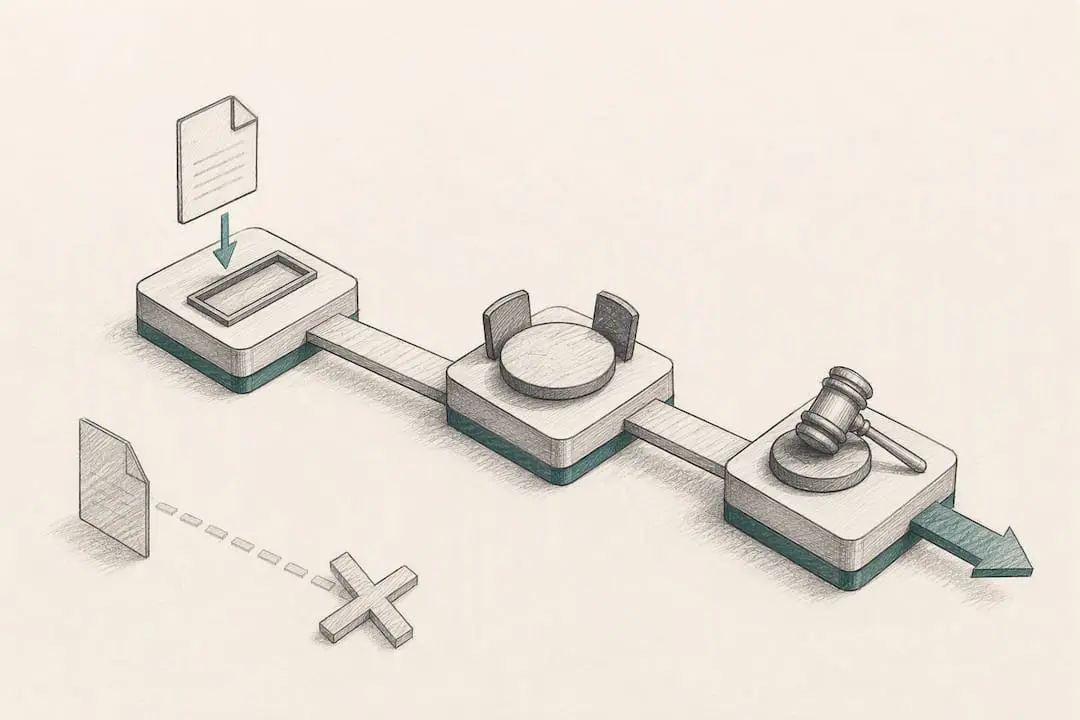
    Isometric sketch of a foreclosure response pathway: a filed document moves along a track from an intake tray to a round mediation table to a judge's gavel and out the far side, while a second document branches off on a dashed line to a large X

    What Are Your Options for Stopping or Delaying a Sale?

    You have real choices at nearly every stage, and the earlier you act, the more of them stay open.

    1. Apply for loss mitigation. Ask your servicer about a loan modification or forbearance as soon as you miss a payment. You’ll need proof of income, a hardship letter, and recent bank statements.
    2. Use mediation and consider a short sale. Court-ordered mediation, when available, is often where loan modifications and short sales actually get worked out, according to foreclosure defense timeline research.
    3. File bankruptcy if it fits your situation. Chapter 7 typically pauses a sale for a few months through the automatic stay; Chapter 13 can delay it considerably longer while you catch up on payments through a repayment plan, though both carry credit and cost tradeoffs worth discussing with an attorney.
    4. Sell to a cash buyer. If you’re close to a sale date, don’t have the time or money for repairs, or you’re dealing with a rental property with tenants, selling directly for cash can close before the auction ever happens.

    What to gather now, regardless of which path you choose:

    • Your mortgage statement and loan number
    • Any breach letters or court papers you’ve received
    • Recent tax and homeowners insurance statements
    • Government-issued ID and proof of ownership

    Why Most Homeowners Lose Time They Didn’t Have to Lose

    The biggest mistake isn’t falling behind on payments. It’s what happens after: letting breach letters and court summonses pile up unopened, or assuming there’s more time than the calendar actually allows. A missed 20-day answer deadline can end your case before you’ve made a single decision.

    Acting early, whether that means answering the lawsuit, applying for loss mitigation, or lining up a fast sale, keeps every option on the table. Waiting closes them one by one. Verify your actual deadlines against the statutes, talk to a foreclosure attorney or housing counselor, and if a quick sale makes sense for your situation, talk to a buyer you trust before the court sets your date.

    How Sunshine State Buyers Can Help You Beat the Clock

    Some cash home buyers provide fast offers often within 24 hours, instead of leaving you guessing while your court date approaches. That speed matters when a sale is already scheduled and every week counts.

    Sunshine State Buyers

    Cash home buyers purchase homes as-is, including houses needing repairs, rentals with tenants, or inherited properties that you don’t want to manage. Selling as-is to a cash buyer can avoid showings, agent commissions, and financing delays. Closings can often occur quickly, sometimes within one to two weeks, with sellers able to choose their closing date. Some companies hold high ratings with the Better Business Bureau and operate statewide, with experience assisting homeowners facing tight deadlines.

    If your sale date is approaching or you need to explore options before the court moves forward, consider obtaining a no-obligation cash offer. Start by visiting the Stop Foreclosure Florida guide to see what a direct sale could look like for your specific timeline, and have your mortgage statement and any court paperwork ready when you call.

    Where to Verify These Deadlines Yourself

    This article is general information, not a substitute for advice from a qualified financial advisor. Consult a qualified financial professional about your own circumstances before acting on anything here.

    Sources

    FAQ

    What is the 120-day rule for foreclosure?

    Federal servicing rules generally prohibit your mortgage servicer from starting foreclosure until you’re more than 120 days past due, giving you a window to pursue loss mitigation before legal proceedings begin.

    How long can you go without paying your mortgage before foreclosure starts in Florida?

    Most servicers wait until you’re past the 120-day mark before filing, though the breach letter and cure period notices typically start showing up much earlier, often around 36 to 45 days after your first missed payment.

    How long after foreclosure do I have to move in Florida?

    Once the clerk issues the certificate of title, the new owner can begin eviction proceedings, which commonly gives occupants a matter of weeks rather than months to vacate, depending on how quickly the new owner files.

    Do I still owe money after a foreclosure in Florida?

    Possibly. If the sale price doesn’t cover your full loan balance, the lender can pursue a deficiency judgment for the difference, though selling before the sale date, such as through a direct cash sale, avoids that risk entirely.

    This article was produced with AI assistance and reviewed for accuracy. It is provided for general information only and is not professional advice.

  • Clear Florida Title Fast: Ancillary Probate for Nonresident Owners

    Clear Florida Title Fast: Ancillary Probate for Nonresident Owners

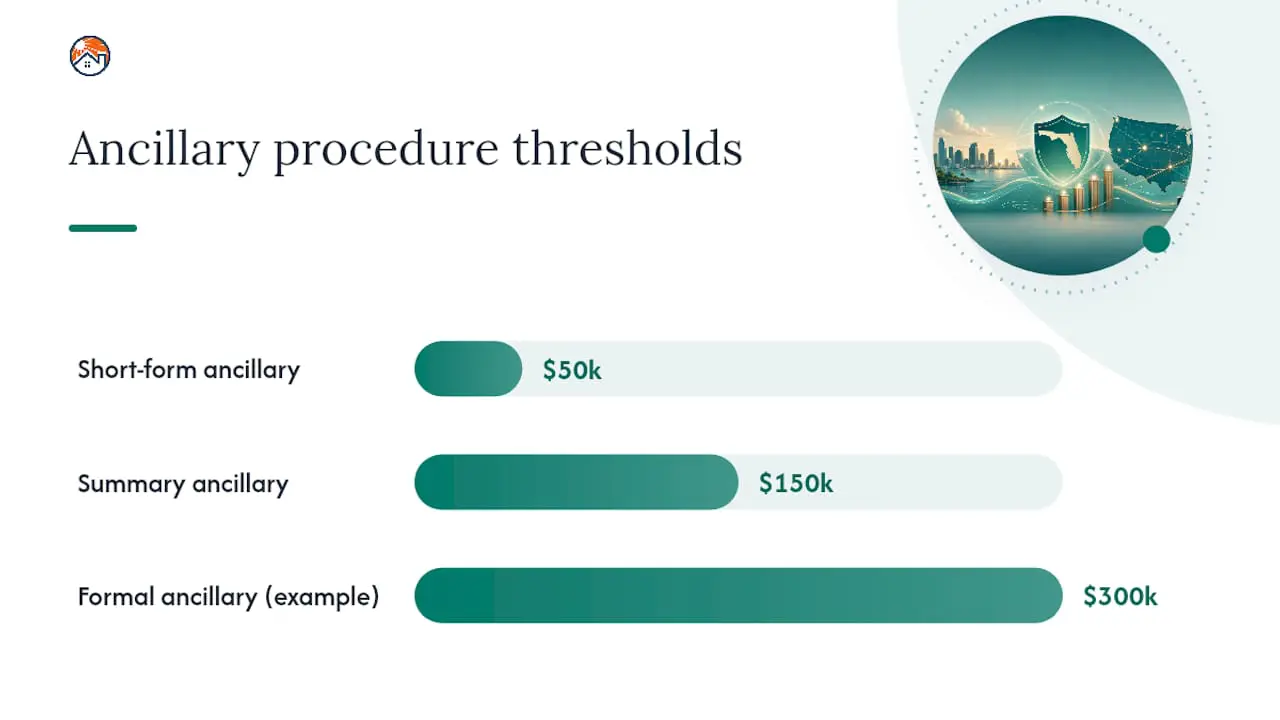
    If a nonresident died owning a Florida house or condo titled solely in their name, you usually need a Florida ancillary administration to clear title before anyone can sell or refinance it. The path depends on the property’s value: under $50,000 often qualifies for a short-form filing, under $150,000 may qualify for summary administration, and anything above that or with complications requires formal ancillary administration.


    TL;DR:

    • Short-form ancillary administration suits estates worth $50,000 or less with no debts, but risks automatic conversion to full administration if creditors claim debts.
    • Summary ancillary administration applies for estates up to $150,000 and often does not require appointing an ancillary personal representative, making it the fastest option for qualifying properties.
    • Formal ancillary administration becomes necessary for estates exceeding $150,000, when disputes arise, or creditors contest claims, often taking several months or longer to resolve.
    • Using tools like revocable trusts, Lady Bird deeds, or joint tenancy can avoid ancillary probate if executed properly, but deeds must be verified for validity before proceeding.
    • Secure approval from Florida courts and submit the correct documentation, including authenticated domiciliary records, to minimize delays in probate and sale processes.

    Sunshine State Buyers
    Sell Your Florida Property As-Is
    Sunshine State Buyers helps Florida homeowners sell inherited or problem properties quickly, without repairs, showings, or agent commissions.

    Table of Contents

    When Is Ancillary Probate Required for Florida Property?

    Florida Statute §734.102 requires ancillary administration whenever a nonresident decedent leaves assets, credits owed by Florida residents, or liens on Florida property. The Florida proceeding is what actually clears title to Florida-situs real estate, and that’s the detail most out-of-state families miss.

    Common triggers include:

    • A house or condo titled solely in the deceased owner’s name
    • A promissory note secured by a mortgage on Florida property
    • A lien or judgment interest tied to a Florida asset

    Some Florida property never touches probate at all. If the home was held in a revocable trust, owned as joint tenants with right of survivorship, transferred through a Lady Bird deed, or carried a transfer-on-death designation, ownership usually passes automatically outside the court system. The mistake many heirs make is assuming a probate order from their home state does whatever a Florida order would do. It doesn’t. A Michigan or New York probate decree has no authority over a Miami condo, and Florida title companies will not transfer or insure that property based on an out-of-state order alone.

    Short Form, Summary, or Formal Ancillary: Which One Applies?

    Florida offers three procedural doors into ancillary administration, and picking the right one saves months.

    Short-form ancillary administration under §734.1025 works only for testate estates (meaning there’s a valid will) where the Florida property is worth $50,000 or less. You file an authenticated transcript of the domiciliary proceedings rather than opening a full case. The catch: if even one creditor files a claim, the case automatically converts to full ancillary administration, so this route carries some risk for estates with outstanding debts.

    Illustration of a bar chart comparing Florida ancillary procedure thresholds: short-form ancillary at $50k, summary ancillary at $150k, and a formal ancillary example at $300k

    Summary ancillary administration applies when Florida’s nonexempt assets fall under the summary administration ceiling, which rises to $150,000 effective July 1, 2026. This is often the fastest way to clear title on a Florida-only estate, and it typically doesn’t require appointing an ancillary personal representative at all.

    Formal ancillary administration becomes necessary when the property value exceeds these thresholds, a creditor contests a claim, or there’s a dispute over who qualifies to serve.

    • Testate estate, Florida home worth $40,000, no debts: short form usually fits
    • Florida-only estate worth $120,000, no disputes: summary administration
    • Florida property worth $300,000 or contested heirs: formal ancillary

    Who Can Serve as Ancillary Personal Representative?

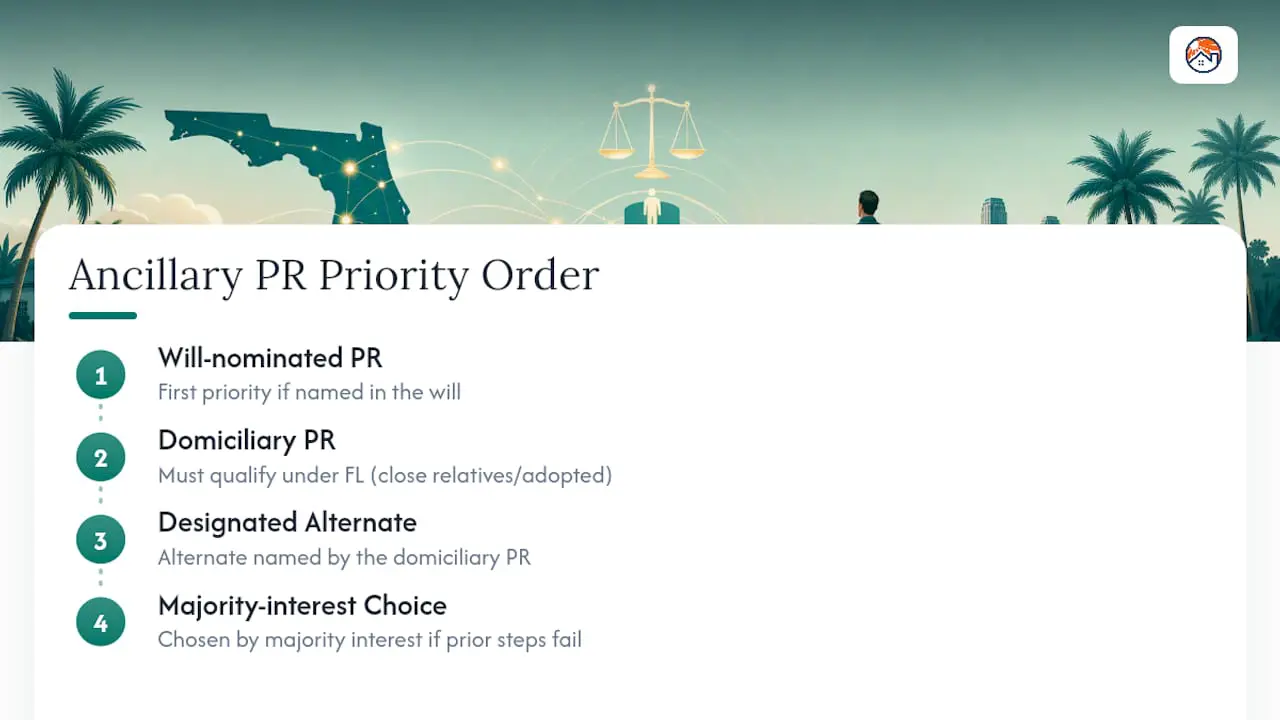
    Florida follows a specific priority order under §734.102(1): the will’s nominated personal representative gets first shot, then the domiciliary personal representative from the home state if they qualify under Florida law, then an alternate the domiciliary PR designates, then someone chosen by a majority interest in the estate.

    Illustration of Florida's ancillary personal representative priority order: first the representative named in the will, then the domiciliary representative if they qualify under Florida law, then an alternate that representative designates, and finally a choice by majority interest in the estate

    That word “qualify” trips up a lot of families. Florida’s qualification rules under §733.304 bar most nonresidents from serving unless they’re a spouse, sibling, parent, child, or other close blood relative of the decedent, or legally adopted. A close family friend or a business partner named as executor in another state often cannot serve in Florida without naming a qualified alternate. When the domiciliary PR doesn’t qualify, the estate typically names a Florida-qualified relative or a Florida attorney instead. Once letters issue, expect standard requirements around bond and reporting unless the will waives them.

    What You Need to File: Documents and Practical Steps

    Florida Probate Rule 5.470 sets the paperwork bar, and it’s higher than most people expect from a state they’ve never dealt with before.

    1. Authenticated copy of the will (if one exists) and the domiciliary court’s order admitting it to probate
    2. Authenticated transcript of the domiciliary proceedings, including letters of administration issued in the home state
    3. A verified petition meeting Rule 5.200 requirements, listing assets, heirs, and the requested personal representative
    4. Formal notice to all qualified persons and to the domiciliary personal representative, as Rule 5.470(b) requires
    5. Florida counsel appearance, since ancillary petitions generally require an attorney licensed in Florida to file and appear

    Pro Tip: Order your authenticated domiciliary court records the same week you decide to open a Florida case. Courts in the home state can take weeks to certify copies, and that single step causes more ancillary delays than anything that happens inside Florida.

    How Long Does Ancillary Probate Take, and What Does It Cost?

    Short-form and summary ancillary cases typically resolve in a matter of weeks to a few months when the paperwork is clean and no creditor objects. Formal ancillary administration often takes several months and can be longer when the estate has debts or disputed heirs.

    The biggest delay isn’t the Florida court itself. It’s waiting on authenticated domiciliary records from the home state, plus the mandatory notice period. Florida also enforces a three-month creditor claims window under §733.702, meaning the estate can’t fully close until that window runs.

    Expect these cost categories: Florida court filing fees, publication costs for the creditor notice, attorney fees (often higher for formal ancillary than for short-form or summary filings), and bond premiums if the will doesn’t waive bond. For heirs facing an empty house that’s accumulating taxes, insurance, and upkeep costs during a long formal case, a fast cash sale can sometimes reduce carrying costs while the legal process finishes.

    How to Avoid Ancillary Probate Before It Starts

    Ancillary probate exists because Florida real estate has to pass through a Florida legal process. Structuring ownership differently can sidestep it entirely.

    • Revocable living trust: title the Florida property in the trust’s name, and the successor trustee transfers it without court involvement
    • Lady Bird deed (enhanced life estate deed): the owner keeps full control during life, and the property passes to a named beneficiary automatically at death
    • Joint tenancy with right of survivorship: co-owners automatically inherit the deceased owner’s share
    • Transfer-on-death or payable-on-death designations: work for certain account types and, in limited cases, real property

    None of these tools work if they’re executed incorrectly. Practitioners routinely recommend checking the actual deed and title history before assuming probate is avoided, because a defective deed or a missing signature can undo the whole plan.

    Pro Tip: Pull the recorded deed for the Florida property before you do anything else. The deed language, not the will or a verbal understanding, determines whether ancillary probate is required.

    Practitioner Perspective: What Surprises Heirs Most

    The biggest surprise for out-of-state families isn’t the paperwork. It’s discovering that a title company will flatly refuse to close on a Florida property using a home-state probate order, no matter how official it looks. That refusal usually surfaces late, often after a buyer is already under contract, which turns a manageable timeline into a scramble.

    The fix is coordinating with a title company early, before listing the property, so everyone knows exactly which Florida document will satisfy them. For heirs who inherited a tenant-occupied rental or a property needing repairs they don’t want to manage from another state, a direct cash sale can sometimes run in parallel with a short-form or summary filing rather than waiting for a formal case to close. Review the recorded deed first. It tells you more about your actual situation than any conversation with a well-meaning relative. For a deeper walkthrough of the sale side, Sunshine State Buyers’ guide to selling an inherited house in Florida covers what heirs typically need to have ready.

    Selling Florida Probate Property Without the Wait

    Sunshine State Buyers exists for exactly the situation this article describes: heirs who need to sell a Florida property tied up in ancillary probate without waiting out a formal case or fronting repair costs on a house they may never have seen in person.

    Sunshine State Buyers

    Sunshine State Buyers buys Florida homes as-is, including inherited and probate properties, tenant-occupied rentals, and houses that need work you’re not positioned to manage from out of state. You can get a cash offer quickly and select a closing date once the estate has the authority to sell. That timeline matters when a formal ancillary case is dragging on and property taxes, insurance, and upkeep keep draining the estate. When you reach out, expect to be asked for basic documentation, such as the letters of administration or ancillary letters and proof of your authority to sell, so the closing can move without surprises at the title company. If you’re weighing whether to sell as-is or navigate a longer listing process during probate, the Sunshine State Buyers guide to selling an inherited house walks through what to expect, and you can request a no-obligation cash offer whenever you’re ready to move forward.

    Where to Verify the Rules Yourself

    Read the statutes directly: Chapter 734, Florida Statutes covers ancillary administration, and Florida Probate Rule 5.470 governs the filing procedure. For a walkthrough of selling inherited property specifically, see Sunshine State Buyers’ Miami probate guide.

    This article is general information, not a substitute for advice from a qualified lawyer. Consult a qualified legal professional about your own circumstances before acting on anything here.

    Sources

    FAQ

    What Is the Difference Between Probate and Ancillary Probate?

    Probate administers a deceased person’s estate in their home state. Ancillary probate is a separate, additional proceeding required in Florida when that nonresident owned Florida real estate, credits, or liens, since a home-state order can’t transfer Florida title.

    How Do You Avoid Ancillary Probate in Florida?

    Titling Florida property in a revocable living trust, using a Lady Bird deed, holding it as joint tenants with right of survivorship, or adding a transfer-on-death designation can all keep the property out of court, provided the paperwork was executed correctly.

    How Long Does Ancillary Probate Take in Florida?

    Short-form and summary ancillary filings often resolve in weeks to a few months, while formal ancillary administration typically takes several months or longer when creditor claims or disputes arise.

    What Documents Are Needed for Ancillary Probate in Florida?

    You typically need an authenticated copy of the will and domiciliary court order, an authenticated transcript of the home-state probate proceedings, a verified petition, and formal notice to qualified persons under Rule 5.470.

    Can I Sell a Florida Property During Ancillary Probate?

    Once the court issues ancillary letters or a summary administration order establishing your authority, you can sell the property, and some heirs choose a fast cash sale to avoid carrying costs while other estate matters wrap up.

    This article was produced with AI assistance and reviewed for accuracy. It is provided for general information only and is not professional advice.
  • Avoid a Tax Deed for Florida Back Taxes: Dates, Costs, Fast Cash

    Avoid a Tax Deed for Florida Back Taxes: Dates, Costs, Fast Cash

    Florida does not seize your home the moment you miss a property tax payment. State law gives you a multi-stage process spanning years, but the costs climb fast and the clock never pauses. Taxes are due by March 31, become delinquent April 1, and a tax certificate sale follows later in the year. Your first move today: check your county tax collector’s website or call directly to confirm your exact balance and payment options.


    TL;DR:

    • Homeowners can still stop the tax process at each stage by paying the owed amount before the tax deed is filed, which typically occurs two years after delinquency.
    • Tax certificates are liens, not property deeds, with interest rates capped at 18% but a minimum return of 5% often applies, affecting the payoff amount for redemption.
    • Once a tax deed application is filed, the property can be sold at auction, but certain liens may persist, requiring a quiet title process for marketability.
    • Quick cash sales through specialized companies can often settle back taxes and deed fees within days, providing a faster alternative to waiting for legal proceedings.
    • The county tax collector’s website is the best resource to verify current balances and payment options before taking any action.

    Sunshine State Buyers
    Need to Sell Before the Deadline?
    Sunshine State Buyers purchases Florida homes as-is, with cash offers within 24 hours and closing dates typically within 7, 14 days.

    Table of Contents

    Back Taxes on a House in Florida: The Step-by-Step Timeline

    Florida runs this process on a strict statutory calendar, and knowing the dates matters more than almost anything else you’ll read here.

    Your property tax bill covers the calendar year and is due by March 31. Payment is based on when your county receives it, not when you mailed it, so a check postmarked March 30 that arrives April 2 counts as late. Miss that deadline, and here’s what happens:

    • April 1: Your account becomes officially delinquent. The county adds a mandatory 3% penalty, and interest starts accruing immediately.
    • May: The county publishes your name and parcel in a local newspaper over several weeks, warning that a tax certificate sale is coming. Advertising costs get added to your bill.
    • On or before June 1: The county holds its tax certificate sale, auctioning off the debt itself, not your house.
    • Two years later: The certificate holder becomes eligible to apply for a tax deed, which can eventually force a public auction of the property if unpaid.

    Each stage gives you a real opportunity to stop the process. None of them require you to lose the house.

    What a Tax Certificate Sale Actually Does to Your Property

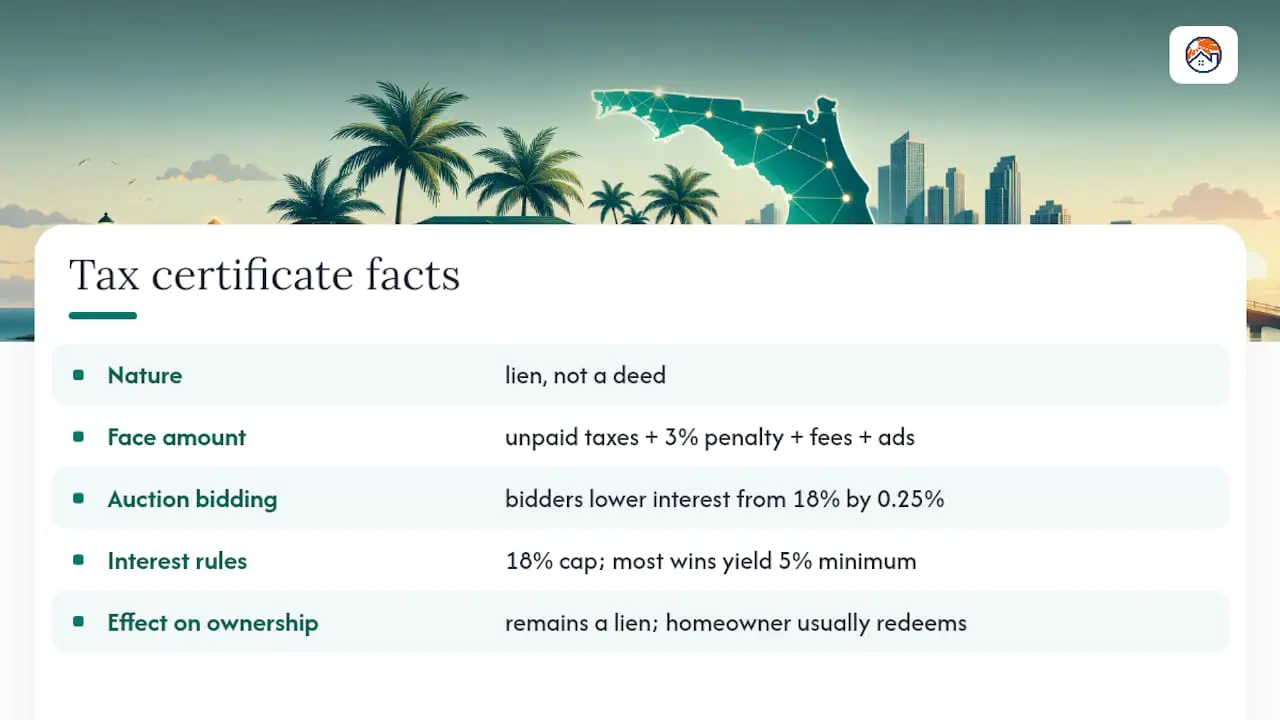
    A tax certificate is not a deed. It’s a lien investors buy from the county, essentially paying your overdue tax bill in exchange for the right to collect it back from you, with interest.

    The certificate’s face amount includes your unpaid taxes, the 3% penalty, tax collector fees, and advertising costs. At auction, investors don’t bid on price. They bid the interest rate down, starting at the state’s statutory maximum of 18% and dropping in quarter-percent increments. Whoever accepts the lowest rate wins the certificate.

    Statistic Callout: Florida caps certificate interest at 18% annually, but a mandatory minimum of 5% applies whenever a certificate would otherwise earn less, so a low winning bid still costs you 5% at redemption. Certificates bid at 0% are the exception — Fla. Stat. §197.472(2) excludes them from that mandatory minimum.

    If nobody bids on a certificate, the county itself holds it. County-held certificates behave differently: they can later be bundled and sold, and they still accrue interest, but there’s no private investor pushing for a faster resolution. Either way, the certificate does not transfer ownership of your home. It’s a lien, and most certificates get redeemed by the homeowner long before anything more serious happens.

    Illustration of a tax certificate facts table: the certificate is a lien rather than a deed, its face amount covers unpaid taxes plus a 3% penalty, fees and advertising, bidders lower the interest rate from 18% in 0.25% steps, and ownership is unaffected because most homeowners redeem

    When a Tax Deed Application Can Force a Sale of the House

    Two years after your taxes first became delinquent on April 1, the certificate holder gains the legal right to apply for a tax deed under Florida Statute §197.502. This is the step that actually threatens ownership.

    Filing the application doesn’t transfer the house immediately. It triggers a formal process:

    • The certificate holder pays outstanding taxes on the property (if any accrued since the original certificate) plus an application fee and title search costs.
    • The Clerk of the Circuit Court sets an auction date and the opening bid covers all back taxes, interest, and fees owed.
    • The property sells to the highest bidder at public auction, and the certificate holder often bids the amount owed just to recoup their investment.

    Winning a tax deed doesn’t always mean a clean title. Certain liens, including some federal tax liens and specific municipal assessments, can survive the sale. Anyone buying at a tax deed auction typically needs a quiet title action before the property is truly marketable.

    How to Redeem Your Property and What It Costs

    Redemption means paying off the certificate before a deed forces a sale, and it’s available at any point up until the clerk issues the tax deed. Here’s how the math works:

    1. Pay the face amount of the certificate, which covers your original delinquent taxes plus the 3% penalty and county fees.
    2. Add accrued interest at whatever rate won the auction, calculated from the certificate’s issue date.
    3. Cover the minimum return if the bid rate was low. Florida requires certificate holders to receive at least a 5% return in most cases, so a 1% winning bid still costs you 5%.
    4. Add deed-related costs if an application has already been filed: an application fee, title search charges, and clerk’s processing costs, which can run into several hundred dollars on top of the certificate amount.

    A $3,000 certificate redeemed after 18 months at a 5% annual bid rate costs roughly $3,225 before any deed-stage fees appear. Wait until a deed application is filed, and that number climbs quickly.

    Your Realistic Options Before the Deadline Hits

    You have more choices than the statute lets on, and the right one depends entirely on how much time is left on your clock.

    • Pay in full. The simplest fix if you have the cash on hand. Contact your county tax collector directly for the current payoff amount.
    • Redeem before the deed sale. Even after a certificate is sold, you retain the right to redeem right up until the deed is issued.
    • Ask about payment plans. Some counties offer installment programs or hardship provisions, particularly for homesteaded property, though availability varies by county.
    • Sell voluntarily. Selling before a deed application often preserves far more equity than waiting, since application and legal fees escalate the closer you get to auction.
    • File bankruptcy. An automatic stay can pause certain collection actions temporarily, but it does not erase the tax debt and has limited power to stop a deed sale already in motion.

    Pro Tip: Before contacting anyone, pull your parcel number, current certificate status, and payoff quote from your county tax collector’s website. Having those three things ready cuts your first phone call from twenty minutes to five.

    If you’ve inherited a property with back taxes attached, the equity-preservation math works the same way, and speed matters even more since inherited homes often carry unresolved liens alongside the tax debt.

    Why a Direct Cash Sale Can Beat Waiting Out the Clock

    Once a tax deed application is filed, costs escalate and your timeline shrinks to weeks rather than years. Certain local companies purchase Florida houses as-is, may deliver cash offers within 24 hours, and close sales within 7 to 14 days, potentially fast enough to settle with the county before an auction date arrives.

    A direct sale beats waiting when the payoff amount plus deed fees would eat most of your remaining equity anyway. Before accepting any offer, require written proof the buyer will handle payoff directly with your county tax collector, get the closing timeline in writing, and confirm the offer accounts for the exact certificate balance owed.

    An Editor’s Take on the Real Risk Homeowners Miss

    Most articles on this topic focus on the tax certificate sale like it’s the dangerous moment. It isn’t. Redemption rates are high, and most certificates get paid off long before a deed application ever gets filed.

    The real danger is complacency during the two-year gap. Owners assume silence means safety, then get blindsided when an application notice arrives, by which point legal fees have already stacked on top of the certificate balance. If you take one thing from this, check your county balance today. If a deed application already looks imminent, a quick sale often protects more of your equity than fighting the clock alone.

    Ready to Sell Fast? Here’s How Sunshine State Buyers Works

    If your tax deed timeline is closing in, waiting for a traditional listing to sell isn’t realistic. Some companies offer Florida homeowners quick cash offers without requiring repairs, showings, or agent commissions, and allow sellers to select a closing date that fits their timeline, often within 7 to 14 days.

    Sunshine State Buyers

    This works whether you’re behind on taxes, holding an inherited property you didn’t ask for, or dealing with a tenant situation that’s draining your patience. Learn exactly how the process works from offer to closing table, and if foreclosure is also part of your situation, our guide to stopping foreclosure in Florida walks through your parallel options.

    Before closing with any buyer, confirm they’ll coordinate payoff directly with your county tax collector and get that commitment in writing. Ready to see your number? Request your no-obligation cash offer today and find out what your equity is actually worth before the deed clock runs out.

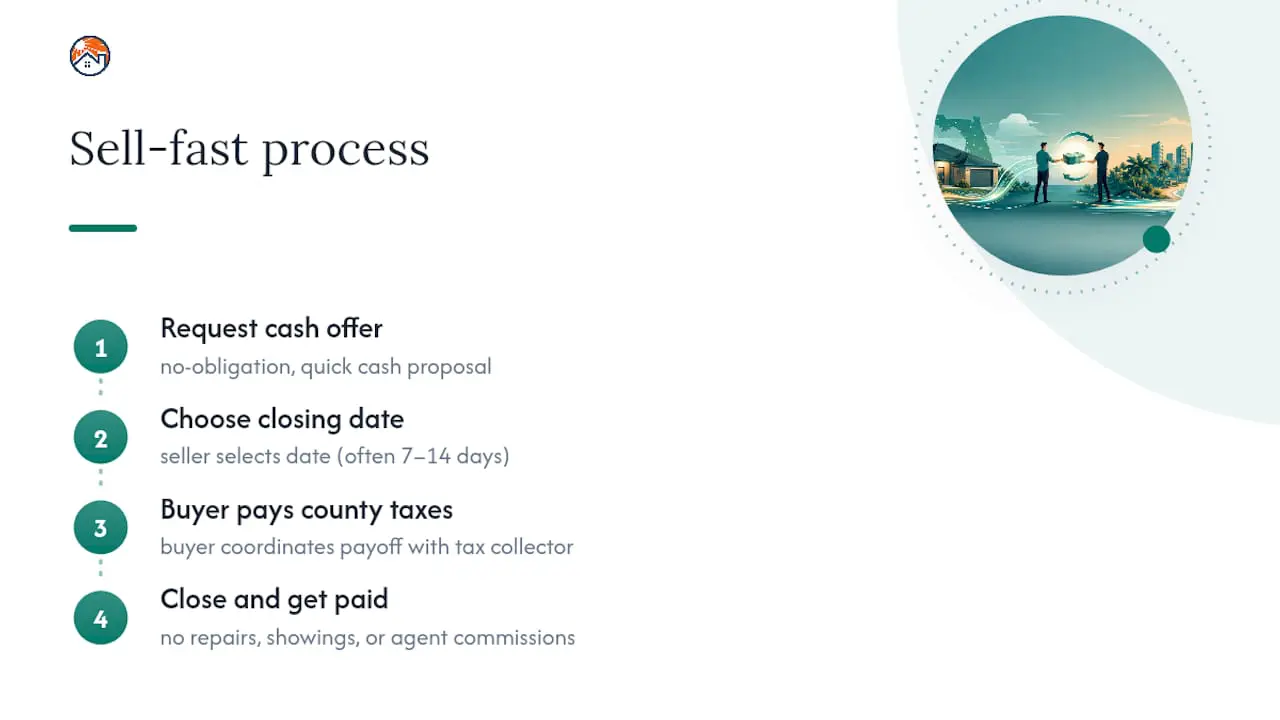
    Illustration of a four-step sell-fast process: request a no-obligation cash offer, choose a closing date often 7 to 14 days out, the buyer coordinates the tax payoff with the county tax collector, then close with no repairs, showings or agent commissions

    Where to Verify Your County’s Exact Numbers

    Your county tax collector’s website is the only reliable source for your current balance, certificate status, and payment options. Florida’s statutory framework governing this entire process lives in Chapter 197 of the Florida Statutes, covering everything from the certificate sale to deed applications and the eventual escheat of unsold property to the county after three years on the lands-available list.

    This article is general information, not a substitute for advice from a qualified financial advisor. Consult a qualified financial professional about your own circumstances before acting on anything here.

    Sources

    FAQ

    Can you buy a property in Florida for back taxes?

    Yes. Investors buy tax certificates at the June auction, and if the homeowner never redeems, the certificate holder can eventually apply for a tax deed and bid at the resulting public auction.

    How many years can you be behind on property taxes in Florida?

    The certificate holder can apply for a tax deed two years after the April 1 delinquency date, so realistically you have roughly two years from your first missed payment before a deed application becomes possible.

    How do I buy delinquent property taxes in Florida?

    You register with your county tax collector’s certificate sale platform and bid down the interest rate at the annual auction held on or before June 1, with the lowest bidder winning the certificate.

    What happens if you buy a house at a tax deed sale?

    You may not get a clean title immediately. Some liens, including certain federal and municipal ones, can survive the sale, so most buyers pursue a quiet title action before reselling or financing the property.

    Is selling to a cash buyer a good option if I owe back taxes?

    It can be, especially once a tax deed application looks close. A company like Sunshine State Buyers can close in days and coordinate payoff with the county, often preserving more equity than waiting for a forced auction.

    This article was produced with AI assistance and reviewed for accuracy. It is provided for general information only and is not professional advice.

  • Save Weeks and Up to Two Months’ Rent: Florida Cash for Keys Clauses

    Save Weeks and Up to Two Months’ Rent: Florida Cash for Keys Clauses

    Cash for keys is a voluntary, written payment that a property owner or buyer offers an occupant in Florida to secure a quick, peaceful move-out. It’s usually faster and cheaper than a formal eviction, but only if you put it in writing and pay conditionally at handover. Florida law treats it as a private contract, not a legal requirement, so the terms you write are the only protection either side has.


    TL;DR:

    • Cash for keys typically offers tenants a payment of roughly half a month to two months’ rent to vacate promptly, often within one to two weeks.
    • It is only effective if all terms are documented in a signed written agreement, with signatures from every leaseholder, and after a thorough property inspection.
    • Accepting cash for keys is risky if the occupant refuses to leave or if the agreement is not properly drafted to prevent legal waivers or disputes.
    • Florida law treats cash for keys as a private contract outside the landlord-tenant statutes, making clear documentation essential for enforceability.
    • For owners needing rapid possession, selling to a cash buyer can avoid negotiations, with offers usually within 24 hours and closing in one to two weeks.

    Sunshine State Buyers
    Sell Your Florida Home Without Repairs
    Sunshine State Buyers purchases Florida homes as-is, with cash offers within 24 hours and closing dates you can choose.

    Explore your selling options

    Table of Contents

    How Cash for Keys Works in Florida

    Cash for keys shows up most often in three situations: a landlord wants a problem tenant out without an eviction filing, a new owner inherits tenants after buying a foreclosure or distressed property, and a homeowner selling a tenant-occupied house wants it vacant before closing. Banks holding foreclosed homes use it too, since an empty house sells faster and shows better than one with a reluctant occupant still living in it.

    The appeal is speed. Every week a unit sits occupied by someone who isn’t paying, or who’s fighting a sale, costs the owner money in lost rent, legal fees, or a stalled closing. Cash for keys skips the court calendar entirely.

    The basic sequence looks like this:

    • The owner or buyer makes a written offer stating the amount and the move-out date.
    • Both sides sign a cash-for-keys agreement spelling out terms.
    • The occupant vacates; the owner inspects the property and confirms condition.
    • Payment changes hands, conditioned on a clean handover and keys returned.
    • Both parties sign a mutual release closing out any further claims.

    Skip any of these steps and you’re negotiating on trust alone, which rarely ends well for either side.

    Cash for Keys vs. Formal Eviction: What It Actually Costs You

    The clearest advantage of cash for keys is time. A negotiated move-out can close in days to a couple of weeks. A formal eviction in Florida, by contrast, often runs weeks to months once you factor in filing, service, court dates, and a possible writ of possession.

    Here’s how the two paths typically compare:

    1. Timeline. Cash for keys can wrap up in under two weeks. Eviction, even uncontested, usually takes longer once court scheduling and service requirements are added in.
    2. Direct cost. Eviction means filing fees, process server costs, and often attorney fees on top of the rent you’re not collecting while the case moves through court. Cash for keys trades that expense for a single negotiated payment.
    3. Legal exposure. Accepting rent or a partial payment during a dispute can waive a landlord’s right to proceed with an existing eviction claim, which is why any cash-for-keys payment needs airtight language separating it from rent.

    A key figure to remember: industry guidance built around real landlord cases typically pegs cash-for-keys payments at roughly half a month to two months’ rent, a fraction of what a contested eviction can cost in fees and lost income.

    Eviction still wins in certain cases. If the occupant has engaged in criminal activity, refuses to negotiate in good faith, or you need the enforcement power of a sheriff-executed writ of possession, cash for keys won’t get you there. It only works when both sides are willing to cooperate.

    How to Write a Cash for Keys Agreement That Actually Holds Up

    A verbal handshake deal is worth exactly nothing if the occupant changes their mind. Everything needs to be on paper, signed by every adult leaseholder, before any money moves.

    Work through the process in this order:

    • Put the offer in writing first, spelling out the dollar amount and proposed move-out date.
    • Get signatures from every leaseholder named on the lease, not just one household member.
    • Walk the property together and complete a written inspection checklist before releasing final payment.
    • Confirm all keys, fobs, and garage remotes are returned.
    • Release payment only after the handover is confirmed complete.

    Your written agreement should include a handful of clauses that do the real legal work:

    • Exact vacate date and time, not a vague “end of the month.”
    • Payment terms, including the amount, form (certified check, cashier’s check, or bank transfer with a receipt trail), and the exact trigger for release.
    • Property condition standard, defining what “broom clean” or “normal wear and tear” actually means.
    • Security deposit handling, stating whether it’s returned separately or rolled into the cash-for-keys total.
    • Mutual release of claims, so neither side can come back later over rent owed or damages.
    • Breach remedies, spelling out what happens if either side doesn’t follow through.
    • Governing jurisdiction, naming the Florida county where any dispute would be filed.

    On payment structure, the safest approach splits the money: a small token amount at signing to show good faith, with the bulk paid only after the walkthrough confirms the unit is empty and undamaged. This protects the payer if the occupant takes the token and stays anyway, since the real money never left their hands.

    Pro Tip: Photograph the entire unit during the final walkthrough, and have a neutral third party witness the key handover if you can arrange it. If the deal ever gets disputed, that documentation is what protects you.

    Pencil illustration of a man photographing an empty rental room with his phone while a woman inspects a set of keys beside an open cardboard box

    Florida has no statute requiring landlords to pay relocation money to tenants. Chapter 83 of the Florida Statutes governs the landlord-tenant relationship, but cash for keys exists entirely outside it as a private contract between two willing parties. That cuts both ways: no law obligates you to offer it, and no law obligates a tenant to accept it.

    A few statutory guardrails matter more than people expect:

    • Florida law preempts local relocation or buyout ordinances, which is why cities like Orlando have no cash-for-keys rules of their own beyond state law.
    • Self-help tactics like changing locks or shutting off utilities to force a move-out are illegal, exposing the landlord to statutory damages and attorney fees under that same statute.
    • Accepting rent or a partial payment mid-dispute can waive your right to continue an eviction case already filed.
    • Section 83.595 outlines a landlord’s remedies after a tenant breaks a lease or leaves early, including reletting duties, which matters if a cash-for-keys deal falls through.

    If the occupant takes the payment and simply doesn’t leave, Florida law offers no shortcut. The agreement is only a private contract, so the owner still has to pursue eviction or a breach-of-contract claim in court to get possession back.

    Talk to an attorney before finalizing a deal involving Section 8 vouchers or HUD-assisted housing, since those programs carry their own federal rules layered on top of state law. The same goes for any high-dollar offer or a tenant who’s already contesting the terms.

    What a Fair Cash for Keys Offer Looks Like

    A useful way to price an offer: estimate what eviction would cost you in legal fees and lost rent, subtract what you’d save by avoiding that timeline, and offer somewhere in between. If eviction would run you $2,500 in fees and two months of unpaid rent, and cash for keys gets the unit back in two weeks instead of two months, the math often favors paying the tenant a fraction of that avoided cost to walk away peacefully now.

    Bar chart titled Cash-for-keys offer sizes, comparing 0.5 months rent as the typical low, 1.5 months as the example avoided cost, and 2 months as the typical high

    In practice, most agreements land between half a month and two months of rent, though flat-fee offers are common too, especially for a fast, no-drama exit.

    A few protections keep the deal clean on both sides:

    • Release the bulk of payment only at handover, never before.
    • Use a neutral witness or third party for the final walkthrough if possible.
    • Address the security deposit and any unpaid utilities explicitly in writing.
    • Tenants should insist on a signed proof-of-payment document, since the IRS can treat a cash buyout as taxable income requiring a 1099 form above certain thresholds.

    Get everything in writing before you shake hands. A verbal promise about “a couple thousand dollars to be out by Friday” protects nobody once one side changes their mind.

    When Selling Outright Beats Negotiating a Buyout

    Some owners decide the negotiation itself isn’t worth the hassle, especially with tenants who are difficult, a foreclosure clock ticking, or a property that just needs to be gone. Selling the house as-is to a cash buyer sidesteps the entire cash-for-keys conversation, since the new buyer takes on the tenant situation directly rather than the current owner negotiating a move-out first.

    Sunshine State Buyers purchases Florida properties in any condition, including tenant-occupied rentals, and provides cash offers within 24 hours with closings available in 7 to 14 days. That timeline matters most for owners facing foreclosure or who simply don’t have the bandwidth to manage an eviction or a buyout negotiation themselves.

    An Editorial Take on Cash for Keys

    Most disputes I see in this space trace back to one mistake: someone paid before confirming the handover, or never wrote anything down. If you’re a landlord, draft the agreement and document everything. If you’re a tenant, get the terms in writing and ask about tax implications before you sign. If you’re a homeowner facing a difficult tenant situation, weigh a straight cash sale against the negotiation itself. Never resort to lockouts or shutoffs, and call an attorney the moment a deal gets complicated.

    — David

    A Faster Path for Florida Homeowners Who’d Rather Skip the Negotiation

    Cash-for-keys negotiations take patience, paperwork, and a tenant willing to cooperate. Not every owner has the time or appetite for that back-and-forth, especially with a foreclosure clock running or a property that needs to sell fast. There are direct alternatives for Florida homeowners that offer a cash offer within 24 hours and a closing date you choose, typically within 7 to 14 days, with no repairs, showings, or agent commissions to worry about.

    Sunshine State Buyers

    This works well for owners of tenant-occupied rentals who’d rather hand the whole situation to a buyer than negotiate a move-out themselves, and for anyone racing a foreclosure timeline where speed matters more than maximizing every last dollar. A company holds a BBB rating and buys homes statewide in as-is condition, whatever shape the property or the tenant situation is in. If you’re weighing a buyout negotiation against a straightforward sale, get a no-obligation cash offer for your Miami property and compare your real net before you decide.

    Sources

    Verify any legal specifics against the primary statutes and a licensed professional before signing:

    This article is general information, not a substitute for advice from a qualified lawyer. Consult a qualified legal professional about your own circumstances before acting on anything here.

    FAQ

    Who Typically Offers Cash for Keys in Florida?

    Landlords, banks holding foreclosed properties, new property buyers, and homeowners selling tenant-occupied homes are the most common ones offering it, usually to avoid the time and cost of formal eviction.

    How Quickly Can I Get Paid With Cash for Keys?

    Payment usually happens at handover once the property is inspected and keys are returned, often within one to two weeks of signing the agreement, though the exact timing depends entirely on what the written contract specifies.

    How Do I Offer Cash for Keys the Right Way?

    Put a written offer in writing that states the amount, the move-out date, and the payment trigger, get every leaseholder’s signature, and release the bulk of payment only after a documented walkthrough confirms the unit is empty and undamaged.

    Is Cash for Keys a Good Deal?

    It’s often a good deal for both sides when speed matters more than maximizing every dollar. Landlords save on legal fees and lost rent, and occupants get cash and flexibility they wouldn’t get from a court-ordered eviction, but the agreement has to be written and conditional to actually protect either party.

    This article was produced with AI assistance and reviewed for accuracy. It is provided for general information only and is not professional advice.
  • 1031 Timing in Florida: Why 7–14 Day Cash Sales Break 45/180 Rules

    1031 Timing in Florida: Why 7–14 Day Cash Sales Break 45/180 Rules

    Yes, you can sell a Florida property fast for cash, and the numbers back it up. Most cash buyers respond with an offer within 24 to 48 hours of a request, and when the title is clean, closings typically wrap up in 7 to 14 days. This path fits homeowners facing foreclosure, heirs sorting out an inherited estate, landlords stuck with difficult tenants, and anyone who needs to relocate on short notice.


    TL;DR:

    • Cash offers in Florida typically range from 70% to 95% of market value, depending on property condition and urgency of the sale.
    • A 7 to 14 day closing is achievable with a clean title and immediate documentation, while delays often stem from title issues or probate.
    • Preparing documents early, using electronic signatures, and coordinating timelines can significantly reduce closing times by up to a week.
    • The 45-day identification and 180-day closing rules for 1031 exchanges require proactive planning, especially when sales close in 7 to 14 days.
    • Verifying proof of funds and the title company’s track record before signing ensures a smoother, faster transaction.

    Sunshine State Buyers
    Explore a Faster Florida Sale
    Sunshine State Buyers purchases Florida homes as-is, with cash offers within 24 hours and closing dates selected around your needs.

    Visit Sunshine State Buyers

    Table of Contents

    How Fast Is a Florida Cash Home Sale, Really?

    Not every sale moves at the same speed, and knowing which bucket your property falls into helps you set realistic expectations before you start.

    A 7 to 14 day close is the fast lane, and it’s achievable more often than sellers assume. It requires a clean title, no outstanding liens, and a seller who can produce mortgage payoff details and ownership documents right away. Cash buyers can skip the appraisal and mortgage underwriting steps that typically stall traditional sales, which is the main reason this window is realistic at all.

    14 to 21 days is the more common range for a “smooth” cash deal, and title company scheduling is usually the reason. Title searches typically take about two weeks to complete, and if the title company handling your closing has a backlog, that timeline stretches even when nothing is wrong with the property itself.

    More than a month is common when there’s a real complication. That includes:

    • Probate proceedings that haven’t cleared yet
    • Existing liens or judgments attached to the property
    • Out-of-state heirs or co-owners who need to sign remotely
    • Title defects that require a formal cure before closing

    Even in these cases, a cash buyer can still help. They just need extra lead time to coordinate signatures, verify legal standing, and resolve outstanding claims before the deed transfers.

    What Actually Happens During a Florida Cash Sale?

    The process is more linear than most sellers expect, and knowing the sequence helps you avoid surprises.

    1. Submit your property information. You’ll typically provide the address, a general description of the home’s condition, your remaining mortgage balance (if any), and any known title issues, like a lien or an open permit.
    2. Receive a written offer. Most cash buyers respond within 24 to 48 hours, often using Florida’s standard As-Is Residential Contract for Sale and Purchase. You pick the closing date; there’s no financing contingency to negotiate around.
    3. Inspection period (if included). Some contracts include a short inspection window, but As-Is deals rarely require repairs. The buyer is agreeing to purchase the home in its current condition.
    4. Title search and escrow. The title company confirms ownership, checks for liens or judgments, and prepares the closing documents. This step is where most of the timeline variability comes from.
    5. Closing. You sign the deed, the buyer wires funds, and ownership transfers. Many title companies now support remote online notarization, which matters if you live out of state or can’t make it in person.

    Pro Tip: Gather your mortgage payoff statement, property tax bill, and HOA contact information before you request an offer. Handing this over on day one instead of day ten can shave a full week off your closing.

    Cash Offer or Full Market Price? What You’re Really Trading

    Speed has a cost, and it’s worth seeing the number before you decide it’s worth it.

    Cash offers in Florida commonly land between 70% and 95% of market value, depending on the buyer, the property’s condition, and how quickly you need to close. A home in good shape with a clean title tends toward the higher end. A property with deferred maintenance, code violations, or a complicated title sits lower, because the buyer is pricing in the work and risk they’re taking on.

    What you save by skipping the traditional route:

    • No real estate agent commission.
    • No repair costs or staging expenses before showings
    • No mortgage contingency risk, meaning the deal doesn’t collapse over an appraisal gap
    • No weeks of open houses and buyer negotiations

    What you still pay, even in a cash deal, includes documentary stamp tax required under Florida law, prorated property taxes, and payoff of any existing liens.

    Quick math: on a home worth $300,000, a cash offer at 80% of value is $240,000. Skip a 6% commission ($18,000) and $8,000 in typical repairs, and your net proceeds gap versus a traditional sale narrows to roughly $34,000. For a seller facing foreclosure or juggling an out-of-state estate, that gap often buys real peace of mind.

    How to Shave Days Off Your Closing Timeline

    If speed is your top priority, a few upfront moves make a real difference.

    1. Pull your documents together first. That means a government ID, your mortgage payoff quote, the most recent property tax bill, and HOA contact information if applicable.
    2. Get ahead of title issues. Providing your payoff details and any lien information upfront lets the title company start clearing them immediately instead of discovering problems mid-process.
    3. Agree to electronic signatures. Remote online notarization is widely accepted in Florida and eliminates the scheduling back-and-forth of in-person closings.
    4. Coordinate tenant access early. If the property is occupied, confirm access windows for inspection or walkthrough before the buyer asks.
    5. Confirm your closing date availability now. Knowing exactly when you can sign avoids a last-minute delay on the buyer’s side.

    Pro Tip: If you’re managing this from out of state, tell your title company on day one. Many can prep remote signing packages in advance, which prevents a two-day delay from becoming a two-week one.

    Because title company workload is the biggest variable in most cash deals, the fastest sellers are the ones who remove every piece of friction they control before the process even starts.

    What Slows Down Florida Closings, and Who Absorbs the Risk?

    Most delays trace back to one of a few recurring problems, and each has a typical fix.

    • Title defects like old liens, unresolved judgments, or a break in the chain of ownership usually take one to three weeks to cure, depending on how far back the issue goes.
    • Probate delays are common with inherited property. If the estate hasn’t cleared probate, a cash buyer may still proceed but often needs the personal representative’s authority documented before closing.
    • Insurance and inspection problems matter more than sellers expect. A failed 4-point inspection on an older home can prevent a financed buyer from securing insurance, which stalls or kills a traditional sale entirely. Cash buyers aren’t relying on a lender’s insurance requirement, so this obstacle mostly disappears.
    • Disclosure obligations still apply. Florida law requires sellers to disclose known defects even in an As-Is sale, so title company workload aside, honesty here protects you from post-closing disputes.

    Before signing with any cash buyer, ask directly who absorbs title risk if a problem surfaces after the contract is signed.

    Why Sunshine State Buyers Can Be the Fast Option, and What to Verify First

    Sunshine State Buyers is built around the timeline sellers in a hurry actually need: written offers typically within 24 hours, and closings commonly finished in 7 to 14 days. The company holds an A+ Better Business Bureau rating, which matters in an industry where marketing promises don’t always match reality.

    Before signing with any cash buyer, including this one, ask for proof, not just promises:

    • Evidence of funds showing the buyer can actually close
    • A sample closing timeline from a recent, comparable transaction
    • The name of the title company they plan to use
    • References or a documented track record you can verify independently

    A buyer confident in their process will hand over this information without hesitation. If you’re dealing with an inherited home specifically, Sunshine State Buyers’ guidance for heirs covers the probate wrinkles that most general advice skips.

    The 45-Day and 180-Day Rules That Govern Exchange Timing

    A 1031 exchange runs on two fixed clocks, and missing either one collapses the entire tax-deferred structure. From the day your relinquished property closes, you have exactly 45 calendar days to formally identify a replacement property in writing, and 180 calendar days total to close on it. There is no flexibility built into either number, and no extension for weekends, holidays, or a slow closing.

    Florida investors face a specific timing pressure here: the state’s fast-moving cash-sale market often produces closings in 7 to 14 days, which is good news for speed but bad news for exchange planning if you haven’t lined up a replacement property strategy in advance. The 45-day clock starts the moment your sale closes, not when you decide to pursue an exchange, so a quick sale without a plan already in motion eats into your identification window fast.

    Florida’s lack of a state income tax doesn’t exempt you from the federal capital gains and depreciation recapture taxes a 1031 exchange defers, so the incentive to get the timing right is just as strong here as anywhere else. The 180-day period runs concurrently with, not after, the 45-day identification window, meaning both deadlines are counted from the same closing date on your original property.

    Where Investors Get the Timing Wrong

    The most common mistake is treating the 45-day identification period as a soft target instead of a hard deadline. Investors who wait to see how their sale proceeds before searching for a replacement property routinely run out of runway, especially in competitive Florida markets where good inventory moves quickly.

    A second frequent error involves identifying a property on paper within 45 days but failing to close within the full 180-day window because financing on the replacement property falls through. The IRS doesn’t grant leniency for a stalled loan approval; the exchange fails regardless of the reason for the delay.

    Sellers also underestimate how quickly a fast Florida cash sale can work against them. Closing your relinquished property in 7 to 14 days feels like a win, but if you haven’t already lined up qualified intermediary paperwork and started scouting replacement properties, that speed compresses your identification window rather than giving you breathing room.

    Another overlooked pitfall: naming too many replacement properties without following IRS identification rules correctly, or naming a property you can’t realistically close on within 180 days. Overreaching on the identification list, hoping one option works out, often backfires when none of them close in time.

    The fix for all of these is the same. Start replacement property research before your relinquished property even goes under contract, and build your closing timeline backward from day 180, not forward from day one.

    Illustration headed "Common timing mistakes" with two cards. Do: research replacements before listing, build the closing timeline backward from day 180, line up qualified intermediary paperwork early. Avoid: treating 45 days as a soft target, waiting to search until the sale completes, relying on unresolved replacement financing, naming too many unrealistic properties.

    Building a Timeline That Works With a Fast Florida Sale

    A fast cash sale and a compliant exchange aren’t in conflict, but they only work together with sequencing planned before you sign anything.

    Start by engaging a qualified intermediary before your relinquished property closes, not after. This is a hard requirement, not a formality, and it has to happen before you receive any sale proceeds.

    Next, begin searching for replacement properties in parallel with your sale process rather than waiting for closing day. Since a Florida cash sale can close in as few as 7 to 14 days, that compressed timeline means your 45-day identification clock starts almost immediately after you accept an offer.

    A practical sequence looks like this: identify likely replacement candidates while your sale is under contract, finalize your qualified intermediary agreement before closing, close your relinquished property, formally identify your replacement property or properties in writing within 45 days, and complete due diligence and financing on the replacement property with enough runway to close well before day 180.

    Illustration of a "Fast Florida 1031 Timeline" with five milestones: before close, engage a qualified intermediary and start searching; day 0 to 14, the cash sale closes; day 45, identify replacements; day 150, target buffer deadline; day 180, close on the replacement.

    Building in a buffer matters more than most guides admit. Financing delays, appraisal issues, or a seller backing out on your replacement property can eat weeks you don’t have if you’re already close to the deadline. Treat day 150 as your real target, not day 180, and you’ll have room to recover if something goes wrong on the replacement side.

    The Qualified Intermediary’s Role in Florida Exchanges

    A qualified intermediary is not optional. Federal tax rules require that exchange proceeds pass through this third party rather than through your own hands, and touching the money directly, even briefly, disqualifies the entire exchange.

    In Florida, qualified intermediaries typically operate through title companies, escrow firms, or dedicated exchange facilitation companies. Unlike some states, Florida doesn’t impose additional licensing requirements on intermediaries beyond federal rules, so vetting the intermediary’s track record and bonding is entirely on you as the investor.

    The intermediary’s core responsibilities include holding the sale proceeds in escrow, preparing the exchange agreement documentation, tracking your 45-day and 180-day deadlines, and disbursing funds to acquire the replacement property once you’ve identified it correctly. A competent intermediary also flags identification rule violations before they become a problem, rather than after the IRS does.

    Choosing an intermediary early, ideally before you even list the relinquished property, gives you a partner who can advise on realistic timing given how fast Florida cash sales tend to move. Waiting until after closing to find one is a common and costly mistake, since some intermediaries won’t take on an exchange that’s already past its sale date.

    What Happens if You Miss a 1031 Deadline

    Missing either the 45-day identification deadline or the 180-day closing deadline disqualifies the entire exchange, with no partial credit for having done everything else correctly. The transaction reverts to a standard taxable sale, and you owe capital gains tax and depreciation recapture on the full gain in the year the sale closed.

    There is no Florida-specific extension, waiver, or penalty relief tied to the state itself, since 1031 exchanges are governed entirely by federal tax code. The only recognized extensions come from IRS disaster relief declarations, which have occasionally applied to Florida counties after major hurricanes, giving affected investors additional time to complete pending exchanges.

    Outside of a formal disaster declaration, there’s no appeal process for a missed deadline caused by a slow closing, a financing delay, or a change of heart on a replacement property. This is precisely why building buffer time into your plan, rather than targeting day 45 and day 180 exactly, protects investors from a costly and irreversible mistake.

    Coordinating Your Sale and Purchase Without Blowing the Deadline

    The core challenge is sequencing two closings that don’t naturally want to line up. Your Florida property sale might move in 7 to 14 days, while a replacement property purchase, especially one involving financing, can take 30 days or longer to finalize.

    The most reliable approach is decoupling the search from the clock. Start touring and making offers on replacement properties while your relinquished property is still under contract, so you’re not starting your 45-day search from zero the day your sale closes. Line up financing pre-approval on the replacement side early too, since loan underwriting delays are one of the most common reasons investors blow through day 180.

    If your relinquished property sale is genuinely fast, coordinate with your qualified intermediary on exact closing dates before you sign anything, so the exchange clock starts on a day you’ve planned around rather than a day that catches you off guard.

    Ready to Request a No-Obligation Cash Offer?

    If the timing conversations above have you leaning toward speed, here’s exactly what happens next. Send Sunshine State Buyers the property address, a brief description of its condition, your remaining mortgage balance, and photos if you have them handy. That’s the full list, no lengthy application required.

    Screenshot of the Sunshine State Buyers homepage, headlined "Sell Your Florida House Fast for Cash", with a no-obligation 24-hour cash offer form.

    Most sellers hear back with a written offer within about 24 hours, and closings commonly finish in 7 to 14 days once you accept. You choose the closing date, and there’s no repair list, no showings, and no commission coming out of your proceeds. If you’re managing an inherited property from out of state or juggling a tenant situation that’s dragging on, this is the route that removes the guesswork: see how the process works from offer to closing table.

    For homeowners specifically weighing whether a cash offer is fair given today’s market, it’s worth reading what a realistic cash offer looks like before you compare numbers. When you’re ready, reach out with your property details and get your no-obligation offer started today.

    When Speed Should Beat Price

    Here’s the honest framing most articles skip: a cash sale is the right move when the cost of waiting exceeds the discount you’re accepting. If you’re facing a foreclosure deadline, an estate that needs to close before probate complications multiply, or a tenant situation draining your patience and your bank account, a 20% or even 30% discount off market value can still leave you ahead once you account for months of carrying costs, legal fees, or lost equity.

    Where I’d push back on conventional wisdom: too many sellers treat “getting full market value” as the default correct answer, when it’s really just the default slower answer. Speed has a price, but so does time.

    Whatever buyer you choose, verify their documentation before you sign anything. Ask for proof of funds and a real closing timeline from a past deal, not just a promise. If your situation calls for speed, Sunshine State Buyers is worth a direct conversation and a same-day quote.

    — David

    Sources

    FAQ

    How Fast Can You Sell a House for Cash in Florida?

    Most cash buyers provide a written offer within 24 to 48 hours, and closings on properties with a clean title commonly finish in 7 to 14 days.

    What Slows Down a Florida Cash Home Sale?

    Title defects, unresolved liens, probate on inherited property, and insurance issues on older homes are the most common reasons a closing stretches past 14 days.

    Do Cash Buyers Pay Less Than Market Value?

    Yes, typical cash offers fall between about 70% and 95% of market value, with the exact number depending on the property’s condition and how quickly you need to close.

    What Documents Do I Need to Sell My House Fast for Cash?

    You’ll generally need a government ID, your mortgage payoff statement, your most recent property tax bill, and HOA contact information if the property has an association.

    Is Sunshine State Buyers a Legitimate Cash Home Buyer in Florida?

    Sunshine State Buyers holds an A+ Better Business Bureau rating and typically provides offers within 24 hours with closings in 7 to 14 days, though you should still request evidence of funds before signing.

    This article was produced with AI assistance and reviewed for accuracy. It is provided for general information only and is not professional advice.
  • Find Florida Elevation Certificates Fast Using the 30 Day Rule

    Find Florida Elevation Certificates Fast Using the 30 Day Rule

    If your Florida property sits in a high-risk flood zone, was newly built, or recently underwent a substantial improvement, you likely need an elevation certificate, and your fastest path forward is checking the FDEM portal or your county floodplain office before paying for a new survey. Since 2023, Florida Statute 472.0366 has required surveyors to submit these certificates digitally within 30 days of completion, so more records are searchable than ever. If no certificate turns up, your next move is hiring a Florida-licensed Professional Surveyor and Mapper.


    TL;DR:

    • Over 2023, Florida law requires surveyors to submit elevation certificates digitally within 30 days, making records more accessible in the FDEM portal.
    • Elevation certificates are needed mainly for new construction, substantial improvements, lender requirements, and flood zone map amendments.
    • Searching county records and the FDEM portal should be your first step before hiring a licensed surveyor for a new elevation certificate.
    • Costs range from a few hundred dollars with a typical turnaround of three to seven days, with higher fees possible for complex or remote sites.
    • Updating or correcting an existing certificate requires re-surveying by a licensed Professional Surveyor and Mapper and re-submitting the data within 30 days.

    Sunshine State Buyers
    Sell Your Florida Home As Is
    Sunshine State Buyers helps Florida homeowners sell quickly for cash, without repairs, showings, or agent commissions.

    Table of Contents

    What Is an Elevation Certificate in Florida?

    An elevation certificate is a standardized FEMA form that documents how high your building’s lowest floor sits relative to the base flood elevation for your area. It also records the lowest adjacent grade around the structure, the foundation type, and details like whether machinery or equipment sits below the flood level. This document forms the backbone of how flood insurance providers evaluate risk and how local floodplain managers confirm your property meets construction rules.

    The measurements on the form serve three main purposes:

    • Determining flood insurance premiums through the National Flood Insurance Program
    • Proving compliance with local floodplain ordinances during permitting
    • Supporting Letter of Map Amendment (LOMA) or LOMR-F applications that can remove a property from a mapped flood zone

    Here’s a misconception worth clearing up: an elevation certificate doesn’t set your insurance rate by itself. It’s a data document. Insurers use those numbers, particularly the gap between your first floor height and the base flood elevation, as a deciding factor in qualifying for premium discounts, but the rate calculation itself happens on the insurer’s side using that data plus other underwriting variables.

    When Do You Actually Need One?

    Not every Florida home needs an elevation certificate, but a surprising number of situations call for one. Here are the most common triggers:

    • New construction or substantial improvement in any Special Flood Hazard Area (Zones A and V on your flood map)
    • Lender requirements, since many mortgage companies request one before closing on a property in a mapped flood zone
    • Insurance underwriting, where your agent needs current elevation data to quote or renew a policy accurately
    • LOMA or LOMR-F applications, where you’re trying to prove your property sits above the base flood elevation despite its mapped zone
    • Local permitting, since some counties require one as part of the certificate of occupancy process for new builds

    Local ordinances and lender policies vary by jurisdiction, so it pays to confirm requirements with your county floodplain manager rather than assume statewide uniformity. Even outside these triggers, having a current EC on file carries real strategic value. It gives future buyers, lenders, and insurers a clear, documented answer to a question they’ll ask anyway, and that can smooth a sale or refinance considerably down the road.

    How to Find an Existing Elevation Certificate Before You Order a New One

    Paying for a fresh survey when a valid certificate already exists on your property is money down the drain. Work through these sources in order before hiring anyone new.

    1. Search the FDEM public EC portal, built in partnership with Forerunner, which displays certificates surveyors have submitted since January 1, 2023 alongside parcel and flood map data.
    2. Contact your county or municipal floodplain office. Many Florida counties, including Pinellas County, maintain their own elevation certificate archives and even publish maps showing which permitted structures have one on file, sometimes going back decades further than the state portal.
    3. Check your closing documents or ask your flood insurance agent. If you bought the home through a standard closing, an EC may already be sitting in your file. Your agent may also have a copy used for your current policy, and the prior owner or title company is worth a call if records come up empty.

    Getting a New Elevation Certificate: What the Process Looks Like

    If no certificate exists, you’ll need to hire a Florida-licensed Professional Surveyor and Mapper (PSM) to create one from scratch. Verify licensure through the Florida Department of Business and Professional Regulation before you sign anything. Not every surveyor holds this specific credential, and an EC prepared by someone unlicensed for the work won’t hold up with insurers or permitting offices.

    On-site, the surveyor connects to a published benchmark to establish your elevation datum, then measures your building’s lowest floor, the lowest and highest adjacent grade around the foundation, the foundation type, and whether an attached garage or mechanical equipment sits below the flood elevation.

    Before the appointment, tell the surveyor exactly why you need the certificate, whether that’s insurance, a permit application, or a LOMA request. Each purpose can call for slightly different supporting detail, and a surveyor who knows the end use upfront will build the certificate correctly the first time.

    • Confirm PSM licensure before booking
    • State your purpose (insurance, permit, LOMA) at the outset
    • Request both a signed and sealed original and a digital copy formatted for FDEM submission

    Pro Tip: Keep the surveyor’s contact information with your paperwork. If a lender or insurer later questions a measurement, you’ll want to reach the person who took it, not just the document they produced.

    What an Elevation Certificate Costs and How Long It Takes

    Expect a standard residential elevation certificate to take 3 to 7 business days from field visit to delivery, with rush service available for an added fee if you’re racing a closing deadline.

    Illustration headed "Certificate timeline" showing four steps: field visit for on-site measurements, survey prep for data processing and drafting, delivery of digital and paper copies, and rush service for a shorter turnaround at an added fee.

    Several factors move the price up or down. Distance from your property to the nearest published survey benchmark matters, since surveyors bill for travel and setup time on remote or rural parcels. Building complexity plays a role too: a simple slab home is faster and cheaper to certify than a home with a raised foundation, an attached garage, and multiple grade points to measure. Site access, dense landscaping, locked gates, difficult terrain, can also add time.

    When you request quotes, ask for an itemized breakdown rather than a flat number. That lets you compare turnaround against price across a couple of surveyors and spot whether a lower quote is skipping something you actually need, like the digital copy formatted for FDEM submission.

    How the State Portal and County Records Work Together

    Florida Statute 472.0366 requires licensed surveyors to submit an unaltered digital copy of every completed elevation certificate to FDEM within 30 days. The owner’s name may be redacted, but the original signed and sealed copy stays with the surveyor who prepared it.

    The FDEM portal, run in partnership with Forerunner, centralizes these recent submissions and pairs them with parcel and flood map data. It’s a genuinely useful tool, but FDEM doesn’t independently verify the accuracy of what’s uploaded, since surveyors submit the records directly. If a number on the portal looks inconsistent with what you expect, or you can’t find a certificate at all:

    • Contact the county floodplain manager for an independent copy
    • Request the surveyor’s original signed and sealed document
    • Hire a PSM to re-evaluate the datum and measurements if the discrepancy affects insurance or permitting

    Older certificates completed before January 2023 won’t appear on the state portal at all, which is exactly why county records remain essential for pre-2023 construction.

    Practical Tips If You’re Selling or Refinancing

    An elevation certificate sitting in your file, ready to hand over, prevents one of the most common closing delays sellers run into. Underwriters and lenders often request the document late in the process, and scrambling to find or order one at that stage can push your closing date back by weeks. Request copies early, ideally before you list.

    If you know you’ll need a Letter of Map Amendment down the line, mention it to your surveyor before the fieldwork begins. LOMA requests sometimes need a base flood elevation derived specifically for your site, which can require additional data your surveyor won’t know to gather unless you flag the purpose in advance. Skipping this conversation is one of the more expensive mistakes owners make.

    Keep both your signed and sealed original and a digital copy organized with your other property records. Lenders, insurers, and any future buyer will all ask for it eventually, and a fast, clean answer during negotiations builds trust in a way that a “we’ll have to look into that” never does.

    Pro Tip: If you inherited a Florida property and can’t locate any elevation records, check with the county floodplain office before assuming none exists. Older homes built decades ago often have a certificate buried in permit files that never made it into digital searches.

    How to Update or Correct an Existing Elevation Certificate

    An elevation certificate isn’t a living document. It reflects conditions at the moment a surveyor measured them, so if your property has changed since that measurement, through an addition, a foundation modification, or fill added to the lot, the old certificate no longer accurately represents your building. You can’t simply edit a prior form. You need a new survey.

    The process looks similar to obtaining a first certificate: hire a Florida-licensed PSM, ideally the same firm if the original is recent and reliable, and have them re-measure the specific elevations that changed. If the update is due to a data error rather than a physical change to the property (a transposed number, an incorrect datum reference, a wrong foundation type), tell the surveyor exactly what looks wrong and provide the original document for comparison. Some errors trace back to a datum mismatch between NAVD88 and NGVD29, which requires the surveyor to show explicit conversion calculations rather than a simple resubmission.

    Once a corrected or updated certificate is complete, it needs to go through the same submission path as a new one. The surveyor submits the digital copy to FDEM within the 30-day window required under Florida Statute 472.0366, and you should also send a copy to your insurance agent and your county floodplain office so every party working from your file has the current version. Holding onto an outdated certificate after a known change to your property can create real problems if an insurer or lender later discovers the discrepancy.

    Common Errors on Elevation Certificates and How to Avoid Them

    The most frequent mistake on Florida elevation certificates involves datum inconsistency. NAVD88 and NGVD29 produce different reference points, and if a surveyor pulls a benchmark elevation in one datum but records the building measurement in another without converting, the resulting numbers can misstate a property’s actual flood risk. FEMA’s own guidance stresses that surveyors must show their conversion work whenever a datum switch is involved, precisely because this error is so common and so consequential.

    A second recurring problem is an incomplete description of the building. Certificates sometimes miss details like an attached garage, a crawl space vent, or mechanical equipment installed below the flood elevation, all of which affect how insurers rate the property. If your home has any non-standard feature, mention it directly to the surveyor rather than assuming they’ll spot it during a routine walk-through.

    Photo documentation gaps cause trouble too. The FEMA form requires specific photos showing the building and its elevation reference points, and a certificate missing these can get kicked back by an insurer or floodplain office during review.

    Before you accept a completed certificate, check that the section for your building’s flood zone matches your current FIRM designation, that the elevation datum is labeled clearly, and that all listed measurements make sense relative to each other (the lowest adjacent grade should never sit higher than the lowest floor elevation, for instance). Catching a data entry error at delivery is far easier than fixing one after it’s already influenced a permit decision or insurance quote.

    Illustration headed "Avoid common EC errors" with two cards. Do: show datum conversion work, tell the surveyor about non-standard features, provide required elevation photos, verify flood zone, datum and measurements. Avoid: mixing NAVD88 and NGVD29 without converting, omitting attached garages or vents, skipping FEMA photo requirements, accepting a certificate without checking the data.

    Reading Your Elevation Certificate for Insurance and Compliance

    The number that matters most on your certificate is the difference between your building’s lowest floor elevation and the base flood elevation (BFE) listed for your zone. A positive difference, meaning your floor sits above the BFE, generally supports lower flood insurance premiums and stronger compliance standing. A negative difference flags your property as sitting below the base flood elevation, which typically means higher premiums and, in some cases, additional permitting requirements for any future construction.

    For compliance purposes, your local floodplain manager compares the certificate’s lowest floor elevation against the community’s adopted flood map to confirm a new build or substantial improvement meets the minimum elevation standard required for that zone. This is also where machinery and equipment placement matters. If your certificate shows an air conditioning unit or electrical panel installed below the required elevation, that can trigger a compliance flag even if the main living space sits above the BFE.

    For insurance, remember that the certificate supplies data, it doesn’t set your premium directly. Your flood insurance agent uses the BFE comparison alongside your zone, building type, and coverage level to calculate the actual rate. Two neighboring homes with nearly identical elevation numbers can still see different premiums depending on these other factors, so treat the certificate as one input among several rather than a final answer.

    Elevation Certificates vs. Floodproofing Certificates: Know the Difference

    These two documents get confused often, but they serve different purposes and apply to different buildings. An elevation certificate measures how high a building sits relative to flood levels, full stop. It applies to any structure in a mapped flood zone, residential or commercial, and its numbers feed directly into insurance rating and floodplain compliance decisions.

    A floodproofing certificate applies specifically to non-residential buildings that have been designed or retrofitted to resist flood damage through methods other than elevation, things like watertight barriers, sealed walls, and elevated utilities. This certificate documents that the structure can withstand flood conditions up to a specified level without being physically raised off the ground. Residential structures generally can’t use floodproofing certificates in place of an elevation certificate under NFIP rules, since flood-resistant construction for homes almost always relies on elevation rather than sealing.

    If you’re unsure which document applies to your property, the deciding factor is usually building use. Homes and most residential structures need an elevation certificate. Commercial and industrial buildings sometimes qualify for floodproofing certification instead, but confirming that with your local floodplain office before assuming either way saves a wasted survey appointment.

    What Sunshine State Buyers Sees Behind the Paperwork

    Elevation certificates rank among the most avoidable closing delays we see in Florida real estate, and that’s the piece conventional advice tends to skip. Most guides walk through how to get a certificate. Few explain that the real cost isn’t the survey fee, it’s the weeks a missing or outdated EC can add to a sale once a lender or insurer flags it during underwriting.

    The 2023 statutory change under Florida Statute 472.0366 helps, but it’s not a complete fix. The FDEM portal only covers certificates filed after January 2023, which means a huge share of Florida’s housing stock, homes built well before that date, still depends entirely on county archives or a fresh survey. Owners who assume the state portal is comprehensive are the ones who get caught flat-footed.

    If you’re holding an inherited property or a rental with unclear elevation records and a looming sale timeline, sorting this out through traditional channels can eat weeks you don’t have. That’s exactly the kind of situation where selling directly for cash sidesteps the paperwork chase entirely, since Sunshine State Buyers purchases Florida properties as-is and doesn’t require an elevation certificate to make an offer or close.

    — David

    Sources

    FAQ

    What Is an Elevation Certificate?

    It’s a FEMA form documenting a building’s lowest floor height, adjacent grade, and foundation details relative to the base flood elevation, used for flood insurance rating, floodplain compliance, and LOMA applications.

    How Much Does an Elevation Certificate Cost in Florida?

    Costs vary based on distance to the nearest survey benchmark, building complexity, and site access, with standard turnaround running 3 to 7 business days and rush service available for an added fee. Request an itemized quote from a licensed PSM for an accurate price specific to your property.

    How Can I Find Out If My Florida Property Already Has an Elevation Certificate?

    Search the FDEM public EC portal for certificates filed since January 2023, then contact your county floodplain office, since many counties like Pinellas maintain older records the state portal doesn’t cover.

    Do I Need an Elevation Certificate to Sell My Florida Home?

    Not always, but lenders and insurers frequently request one for properties in Special Flood Hazard Areas, and having it ready ahead of time helps avoid closing delays.

    Who Is Legally Allowed to Prepare an Elevation Certificate in Florida?

    Only a Florida-licensed Professional Surveyor and Mapper (PSM) can legally complete and seal an elevation certificate that insurers, lenders, and floodplain offices will accept.

    This article was produced with AI assistance and reviewed for accuracy. It is provided for general information only and is not professional advice.

  • Vet 24 Hour Cash Offers in Florida and Spot Red Flags Fast

    Vet 24 Hour Cash Offers in Florida and Spot Red Flags Fast

    Yes, a legitimate written cash offer can land in your inbox within 24 hours of contacting a Florida cash buyer, but that offer and a closed sale are two different milestones. The offer is a no-obligation number based on your address, photos, and a phone call. The funded closing, where money actually moves and title changes hands, typically follows around one to two weeks later. A local buyer like Sunshine State Buyers builds its entire process around hitting that first 24-hour mark without cutting corners on the paperwork that comes after.


    TL;DR:

    • A 24-hour cash offer in Florida indicates a quick response time for a written valuation, not a guarantee of fast closing; actual closing typically takes one to two weeks.
    • Most cash buyers, including Sunshine State Buyers, require only basic property details, photos, and sometimes a brief walkthrough to provide an offer, even for properties needing repairs or with tenants.
    • The real delay in closing comes from the title search and clearance process, which can extend beyond two weeks if there are liens, probate issues, or HOA approval requirements.
    • Verify the buyer’s proof of funds, the detailed offer breakdown, the title company, and closing costs to avoid red flags, since transparency and credibility are crucial for a smooth transaction.

    Sunshine State Buyers
    Get a Clear Cash Offer Quickly
    Sunshine State Buyers purchases Florida homes as-is, with no repairs, showings, or agent commissions, and offers a transparent, no-pressure process.

    Request a cash offer

    Table of Contents

    What a 24-Hour Cash Offer Actually Means

    A 24-hour cash offer is a promise about speed of response, not speed of closing. When a buyer says you’ll have an offer within a day, they mean you’ll have a written, no-obligation number in hand that fast. Signing, funding, and title transfer come later.

    HomeLight’s research on Florida cash sales confirms this pattern across the industry: cash buyers commonly issue offers within 24 to 48 hours of intake and can close in a week or so once title is clear. That’s a meaningfully different timeline than a traditional listing, where an accepted offer alone can take weeks to arrive.

    Getting to that fast offer requires a specific intake process. Most buyers, including Sunshine State Buyers, ask you to fill out a short online form or call in with your property address. From there, they’ll usually request photos of the interior and exterior, sometimes paired with a brief phone walkthrough covering the roof, HVAC system, foundation, and any obvious repair needs. Some situations call for a quick in-person visit, especially for larger properties or when photos raise questions a buyer needs answered before committing to a number.

    Illustration headed "24-Hour Offer Intake Process" listing four steps: submit your address via a short online form or phone, send interior and exterior photos, take a brief phone walkthrough covering roof, HVAC and foundation, and an in-person visit if needed for larger properties or photo questions.

    The 24-hour figure assumes the buyer has what they need to run a fast valuation: comparable sales in your area, a reasonable repair estimate, and no major surprises hiding in the property’s history. A few conditions can still apply even to a fast written offer. It’s usually contingent on a title search coming back clean, a final walkthrough matching what was described, and sometimes a short due-diligence window before funds are wired. None of that changes the 24-hour promise on the offer itself. It just means the number you receive quickly still needs verification before it becomes cash in your account.

    Who Qualifies for a Fast Cash Offer in Florida?

    Most Florida homeowners qualify, and that’s the point of this model. Cash buyers built their businesses around properties that traditional buyers avoid, which means condition rarely disqualifies you the way it would with a retail buyer relying on a mortgage lender’s inspection requirements.

    Properties commonly accepted for fast cash offers include:

    • Homes needing significant repairs, from cosmetic issues to structural damage
    • Tenant-occupied rentals, including situations with problem tenants or unpaid rent
    • Inherited or probate properties, even before probate fully closes
    • Houses with open code violations or unpermitted work
    • Vacant or storm-damaged homes sitting unused for months or years
    • Condos and multi-family properties, though HOA rules can add a step

    Certain seller circumstances make speed the priority rather than just a convenience. If you’re facing foreclosure, dealing with a contested estate, relocating for a new job, or managing a rental with tenants who won’t cooperate with showings, a fast written offer removes a lot of pressure fast. These are exactly the situations where waiting 60 to 90 days for a traditional buyer isn’t realistic.

    A few things still add time even within a cash sale. Complicated liens, missing heirs in a probate case, or an out-of-state owner who needs remote notarization can stretch the process past the typical window. None of these situations make a cash sale impossible. They just mean the about one to two week closing estimate becomes more like 3 to 4 weeks while the title company works through the paperwork.

    How the 24-Hour Cash Offer Process Works Step by Step

    Knowing what happens at each stage takes the mystery out of a fast cash sale and helps you spot a buyer who’s cutting corners.

    Before you request an offer, gather a few basics: your deed or last property tax bill, your current mortgage payoff amount if you have a loan, HOA documents if you’re in a condo or planned community, and a handful of clear photos of each room and the exterior. You don’t need to fix anything or stage the house. You just need enough information for the buyer to run their numbers accurately.

    Here’s the typical sequence once you reach out:

    1. Submit your property details through an online form or a phone call, including the address and a brief description of its condition.
    2. The buyer runs a valuation using recent comparable sales, your photos, and any notes from a phone walkthrough or brief visit.
    3. You receive a written offer within 24 hours, outlining the price and a proposed closing timeline, with no obligation to accept.
    4. If you accept, the buyer opens a file with a licensed Florida title company to begin the title search.
    5. The title company clears any liens or issues and prepares the closing documents while you choose your preferred closing date.
    6. You close, typically about one to two weeks after acceptance, either in person or remotely, with funds wired directly to you at closing.

    Remote signing has become standard for Florida cash sales, particularly for out-of-state heirs or landlords who can’t be present in person. Title companies handle this through mobile notaries or approved remote online notarization platforms, and your proceeds arrive by wire transfer to your bank account rather than a paper check. This is standard practice at reputable title companies across the state, and it’s worth asking your buyer which method they use before you sign anything.

    Pro Tip: Ask the buyer to name their title company before you sign a purchase agreement. A hesitant answer or a company you can’t find online is worth pausing over.

    If you want a closer look at how flexible closing dates work in practice, Sunshine State Buyers’ overview of closing timelines breaks down what determines whether you close in 7 days or closer to 14.

    Bar chart headed "Cash offer timings" comparing three milestones: 24 hours for a written offer, 7 days for a fast closing, and 14 days for a standard closing.

    How Cash Buyers Calculate Your Offer (And What That Means for Your Bottom Line)

    Every legitimate cash offer comes from roughly the same formula, even when the number on the page looks lower than what a real estate agent might quote you for a retail sale. Buyers start with the after-repair value, or ARV, which is what your home would sell for once it’s fully fixed up and market-ready. From there, they subtract estimated repair costs and the margin they need to make the deal worthwhile as an investment.

    The math generally looks like this:

    • ARV — what comparable, renovated homes in your area are selling for
    • Minus repair estimate — the buyer’s projected cost to fix roof, HVAC, flooring, or structural issues
    • Minus resale margin — the buyer’s required profit to cover holding costs, resale expenses, and risk
    • Equals your cash offer

    Investor guides on cash buyer economics show that once you account for what a traditional sale actually costs, a cash offer often lands closer to a traditional sale’s net proceeds than the sticker price suggests.

    Here’s a simplified comparison. Say your home would sell for $300,000 fully renovated on the retail market, but it needs about $40,000 in repairs and updates. A cash buyer might offer somewhere around $220,000 to account for those repairs and their margin.

    The eliminated commissions and carrying costs are often what makes a cash offer competitive despite the lower headline price. Always ask the buyer for a written breakdown showing their ARV, repair estimate, and margin. If they can’t or won’t provide one, that’s a sign to keep shopping.

    Title Work and Florida Closing Logistics That Affect Your Timeline

    Florida closings run through licensed title agents and title companies, and their work is the single biggest variable in how fast your sale actually closes. A cash buyer can hand you a written offer in a day, but the title company still has to search public records, confirm the chain of ownership, and clear any liens before funds can legally change hands. Florida Realtors’ industry guidance makes clear that this search and clearance process, not the buyer’s decision speed, sets the real pace of closing.

    Several factors can extend that timeline beyond the typical 7 to 14 day window:

    • Open probate cases or missing heirs who need to sign off on the sale
    • Judgment liens, tax liens, or code enforcement liens attached to the property
    • HOA or condo association approval requirements for transferring ownership
    • County record backlogs, which vary by county and can add several days to a search

    Experienced cash buyers often pre-clear simple title issues and work with title companies they’ve used before to keep searches moving, which is part of why some closings hit the 7-day mark while others land closer to two weeks. For remote sellers, most Florida title companies now offer mobile notary visits or remote online notarization, with proceeds wired directly to your account at closing rather than mailed as a check.

    Pro Tip: Ask which title company will handle your closing and look them up independently. A buyer who insists on using an unfamiliar or out-of-state title company is worth a second look.

    Questions to Ask Before You Accept Any Cash Offer

    A few direct questions separate a serious buyer from one hoping you won’t ask too many.

    1. Can you show proof of funds? A real cash buyer can produce a bank statement or lender letter confirming they can close without financing.
    2. Can I see a written breakdown of the offer? You want the ARV, repair estimate, and margin, not just a final number.
    3. Which title company will handle the closing? An unfamiliar or unnamed company deserves more scrutiny.
    4. Who pays closing costs? Reputable buyers typically cover most or all closing costs, but get it in writing.
    5. Is the closing date firm, and what’s your deposit refund policy? You want clarity on what happens if the deal falls through.

    A few red flags should stop you from signing anything: requests for non-refundable upfront fees, pressure to wire money to a private individual rather than a title company, resistance to using an independent title company of your choosing, or offer math that doesn’t add up when you ask for details.

    Verification takes just a few minutes. Check the buyer’s BBB rating and read their customer reviews, ask for references from recent sellers, and request a sample purchase agreement before you commit to anything.

    When a 24-Hour Cash Offer Actually Makes Sense

    A fast cash sale fits certain situations far better than others, and knowing which category you fall into makes the decision much easier.

    Cash offers tend to make the most sense when:

    • You’re facing foreclosure and need to close before a sale date arrives
    • The home needs repairs you can’t afford or don’t want to manage
    • You’ve inherited a property and want to avoid family disputes over renovations
    • Problem tenants make showings and a traditional sale impractical

    Listing with an agent is usually the stronger move when your home is already market-ready, you have the time and cash to handle repairs, and you can afford to wait for a potentially higher offer. If you want a side-by-side look at how the two paths compare financially, this breakdown of cash offers versus traditional sales walks through the numbers in more depth.

    The one-line version: if time pressure, repair costs, or title complexity outweigh the gap between a cash offer and a hypothetical top-dollar sale, the cash offer usually wins on real net proceeds, not just convenience.

    How Sunshine State Buyers Delivers on the 24-Hour Promise

    A typical cash buyer builds its intake process to hit that 24-hour window without skipping the diligence that protects sellers later. A homeowner submits their address and photos, gets a phone call to confirm condition and any complications like tenants or code violations, and receives a written offer with a full breakdown the same day or the next morning in most cases.

    Some companies hold an A+ BBB rating and cover properties statewide, from foreclosure situations in South Florida to inherited homes in the Panhandle. That statewide reach matters because title issues, HOA rules, and county recording speeds vary significantly across Florida, and a buyer who only knows one market tends to underestimate those local quirks. Sellers dealing with foreclosure timelines, contested probate estates, or tenants who won’t cooperate with showings often find that a fast, transparent written offer solves a real problem, not just a convenience.

    Get a No-Obligation 24-Hour Cash Offer From Sunshine State Buyers

    A cash buyer can be the alternative to waiting weeks for a retail buyer to get financing approved. You can get a written offer within 24 hours, sometimes backed by a full breakdown of the ARV, repair estimate, and margin behind the number, and you may be able to pick the closing date. To get started, submit your property address, a few photos, and your mortgage balance if you have one, either through an online form or by phone.

    Screenshot of the Sunshine State Buyers homepage, headlined "Sell Your Florida House Fast for Cash", with a no-obligation 24-hour cash offer form.

    Once you accept, Sunshine State Buyers works with a licensed Florida title company to run the title search, clear any liens, and prepare closing documents, with most sales completing in around one to two weeks. If foreclosure is part of your timeline, the foreclosure-specific guide walks through how a fast cash sale can stop the process before it costs you your equity. If you’re weighing whether the offer you’ll get is fair, this look at cash offer pricing explains how the math actually works. Visit Sunshine State Buyers to request your offer today.

    Sources

    Before accepting any offer, it helps to cross-check what a buyer tells you against independent sources. Florida Realtors publishes ongoing guidance on market conditions and closing practices statewide. HomeLight’s guide to selling fast in Florida covers how to compare multiple offers side by side rather than accepting the first one you receive.

    For your specific situation, a tax advisor can explain how a cash sale gets reported, and a licensed Florida title company can walk you through closing costs and timing specific to your county and property.

    FAQ

    Which companies in Florida offer the best cash offers on houses?

    The strongest options are companies that provide a written offer breakdown, use an independent title company, and carry verifiable credentials like a BBB rating. Sunshine State Buyers meets each of these markers with statewide Florida coverage and a written offer within 24 hours.

    What is the hardest month to sell a home?

    Winter months, particularly December and January, tend to see the slowest traditional home sales due to lower buyer activity and holiday distractions. Cash sales aren’t affected by seasonal buyer demand the same way, since the buyer isn’t relying on retail market timing.

    Does buying a house with cash get reported to the IRS?

    Cash real estate transactions typically get reported through IRS closing disclosures filed by the title company, and any capital gains from the sale must be reported on your tax return. A tax advisor can confirm how your specific sale should be reported based on your situation.

    What is the 3-3-3 rule in real estate?

    Definitions of this rule vary by source and region, so it’s worth confirming with a local real estate professional exactly how it applies to your situation before relying on it.

    This article was produced with Al assistance and reviewed for accuracy. It is provided for general information only and is not professional advice.

  • Florida Lis Pendens: Clear Title Faster or Sell for Cash in 7–14 Days

    Florida Lis Pendens: Clear Title Faster or Sell for Cash in 7–14 Days

    A lis pendens in Florida is a notice recorded under Florida Statute §48.23 that tells the world a lawsuit affecting your property is pending. It does not create a lien, but in practice it clouds your title and stops most sales, refinances, and closings cold. You typically get it removed through a court-ordered discharge, a transfer to bond, or by resolving the underlying lawsuit.


    TL;DR:

    • Lis pendens does not create a lien but significantly clouds title, often halting sales, refinancing, and closings due to practical risks for buyers and lenders.
    • Recorded notices must include specific party, case, and property details; failure to comply or expiration can lead to legal challenges and removal.
    • The notice’s effect is limited to recorded interests; unrecorded claims generally remain unaffected, especially in foreclosure or lien cases.
    • Challenging or expediting the removal of a lis pendens relies on court motions, bonds, or waiting for the one-year expiration unless based on recorded documents.
    • Buyers should consider cash purchases or legal review before acquiring property affected by a lis pendens, due to the high risk of losing full ownership or financing options.

    Sunshine State Buyers
    Explore a Faster Way to Sell
    Sunshine State Buyers purchases Florida homes as-is, with cash offers within 24 hours and closing dates you choose, typically within 7, 14 days.

    Table of Contents

    What Does Florida Statute §48.23 Require for a Lis Pendens Notice?

    Section 48.23 is the entire legal foundation for this notice. It lets a party involved in a lawsuit touching real property record a notice in the county where that property sits, warning anyone who checks the title that litigation is pending. Once recorded, that notice becomes part of the public record, and any title search will flag it immediately.

    The statute is specific about what the notice must contain. Leave one of these out, and the notice can be challenged on its face:

    • The names of the parties involved in the lawsuit
    • The date the action was filed or the case number
    • The name of the court where the case is pending
    • A legal description of the property (not just a street address)
    • A statement of the relief being sought

    The one-year rule trips up a lot of filers. If the lawsuit isn’t based on a recorded instrument, like a mortgage or deed, or a construction lien under Chapter 713, the lis pendens expires one year after the case was filed unless a court extends it for good cause. Courts consider extensions carefully before granting them. A plaintiff who lets the clock run out without asking for an extension loses the notice’s protective effect, even if the underlying lawsuit is still very much alive.

    There’s a narrower but important provision buried in §48.23(1)(d): the recorded notice doesn’t reach back and affect interests that were never recorded. If someone had an unrecorded claim to the property before the lis pendens went on record, that claim generally doesn’t get swept into the litigation’s shadow just because the notice exists. This matters most in disputes over unrecorded contracts or handshake agreements involving the same parcel.

    If the underlying claim is based on a mortgage, a recorded deed, or a construction lien, the one-year clock doesn’t apply at all. Those lis pendens filings stay in effect for as long as the case is active, which is one reason foreclosure-related notices can sit on a title for years while litigation drags through the courts.

    How a Lis Pendens Clouds Title, Scares Off Buyers, and Stalls Closings

    A lis pendens is not a lien. That distinction confuses a lot of homeowners, and it’s worth getting straight before anything else. A lien attaches a debt to your property. A lis pendens simply announces that a lawsuit exists that could change who owns the property, or what it’s worth, once a judge rules. No money is owed because of the notice itself. But the practical effect on your ability to sell is often worse than an actual lien, because it introduces uncertainty that most buyers and every lender want no part of.

    Here’s the mechanism: once a lis pendens is recorded, any buyer who closes on the property takes it “subject to” the lawsuit. That means if the plaintiff wins, the new owner could lose the property or face other consequences tied to the judgment, regardless of what the purchase contract says. Buyers lose their bona fide purchaser protection, the legal shield that normally lets an innocent buyer keep clean title even if problems surface later. The Florida Bar Journal has documented how this single fact drives almost all of the practical fallout from a recorded notice.

    Title insurance underwriters respond predictably. Most will not issue a policy while a lis pendens sits on the title, because insuring the buyer would mean absorbing the exact risk the lawsuit created. Lenders follow the same logic. A bank isn’t going to fund a mortgage on collateral that might belong to someone else in six months. In practice, this means:

    • Cash buyers may still close, but often at a steep discount to offset the risk
    • Financed buyers almost always walk away or the lender denies the loan
    • Refinancing is effectively impossible until the notice clears
    • Even after a discharge order, some insurers wait for the appeal period to lapse before underwriting a policy

    Where lis pendens shows up most often: mortgage foreclosures, specific-performance suits (where a buyer sues to force a seller to complete a contracted sale), partition actions between co-owners, and construction lien disputes under Chapter 713.

    A lis pendens can create significant practical obstacles to selling or insuring title, and industry commentary consistently notes that lenders and title insurers commonly decline to close while the notice remains active, regardless of how the underlying case eventually turns out.

    Is Every Lis Pendens Valid? The Fair Nexus Test Explained

    Not every lis pendens carries the same legal weight, and knowing which type you’re dealing with tells you a lot about how vulnerable it is to challenge.

    A lis pendens of right applies when the lawsuit is founded on a recorded instrument, a mortgage foreclosure, or a Chapter 713 construction lien. These get strong statutory protection. The one-year expiration rule doesn’t apply to them, and courts give the filer wide latitude because the underlying claim is already documented in the public record.

    A garden-variety lis pendens is everything else, disputes over property ownership, partition suits, fraud claims tied to a piece of real estate, and similar actions that aren’t anchored to a recorded document. These face real scrutiny. Florida courts apply what’s known as the fair nexus test, asking whether there’s a genuine, direct connection between the lawsuit and the specific property named in the notice.

    Courts have grown less tolerant of plaintiffs who record a lis pendens as a pressure tactic rather than a genuine legal necessity. Case law reviewed by Zoecklein Law shows judges looking past how a complaint is labeled and examining what the lawsuit actually seeks. If the claim is really about money damages and only tangentially mentions the property, the fair nexus test tends to fail.

    The consequences of failing that test are immediate. A judge can discharge or expunge the lis pendens outright, which strips its legal effect and clears the title as though the notice never existed. That’s a significant loss of leverage for a plaintiff who was hoping the recorded notice alone would pressure a settlement, and it’s exactly the outcome a property owner facing a bad-faith filing should be pushing for.

    Chart comparing two types of Florida lis pendens: "of right" (founded on a recorded instrument or mortgage, strong statutory protection, one-year rule does not apply) and "garden-variety" (other property disputes such as ownership, partition or fraud, subject to scrutiny, one-year rule can apply)

    How Do You Discharge or Expunge a Lis Pendens in Florida?

    If you’re the property owner and a lis pendens just landed on your title, you have real procedural options. None of them are instant, but all of them are worth pursuing quickly.

    1. File a motion to discharge or expunge. This asks the court to remove the notice, either because it fails the fair nexus test, because the notice itself is defective under §48.23, or because the underlying lawsuit lacks merit. The burden generally falls on the party who recorded the lis pendens to justify it once it’s challenged, particularly for garden-variety filings.
    2. Request an expedited hearing. Because a lis pendens actively blocks a pending sale, Florida courts often treat discharge motions with some urgency, especially when a closing date is on the calendar and documented.
    3. Ask the court to transfer the lis pendens to a bond. Instead of discharging the notice outright, a judge can order the plaintiff, or sometimes the property owner, to post a bond that covers potential damages. Once the bond is in place, the lis pendens comes off the title and the sale can proceed while the underlying lawsuit continues. Jimerson’s overview of Florida lis pendens practice describes this as one of the more common negotiated outcomes when neither side wants to litigate the discharge motion to the end.
    4. Track the one-year deadline religiously. For lawsuits not based on a recorded instrument, mark the filing date and count forward. If the plaintiff hasn’t sought an extension by the anniversary, the lis pendens should lapse automatically, though you may still need a court order confirming that lapse for title purposes.
    5. Watch the appeal window even after a win. Getting a discharge order isn’t necessarily the finish line. Title insurers sometimes wait out the appeal period before they’ll underwrite a policy, since a successful appeal could reinstate the notice.

    Bond amounts and conditions vary significantly by court and case, and a judge weighing a bond transfer typically wants some assurance the amount reasonably reflects what the property owner stands to lose if the sale falls through.

    Pro Tip: If you’re facing a hard closing deadline, ask your attorney to request the discharge hearing on an expedited basis and mention the closing date explicitly in the motion. Judges respond to concrete deadlines far more than to general urgency.

    What Should You Do First After a Lis Pendens Is Recorded?

    The first 72 hours matter more than most owners realize, because documentation gaps become expensive later.

    1. Pull a certified copy of the recorded notice and the underlying complaint or motion. You need to know exactly what’s being alleged and whether the notice meets the statutory requirements under §48.23.
    2. Order a full title search immediately, even if you already have one from when you bought the property. You want to see the lis pendens exactly as it appears to a buyer or lender running a search today.
    3. Log every date and communication. When the notice was recorded, when you learned about it, and any contact with the opposing party or their attorney all matter if you end up arguing bad faith or seeking damages later.
    4. If the case involves a construction lien claimant, consider whether a statutory demand requiring them to commence foreclosure within the required period applies. Some lienors let their lis pendens lapse simply because they miss that deadline.
    5. File your motion to discharge or explore a bond transfer before you invest more time marketing the property to buyers who will walk the moment a title search turns up the notice.

    Pro Tip: Pause active showings and new offers until you understand exactly why the lis pendens was filed. Continuing to market a property under a cloud you haven’t diagnosed usually wastes everyone’s time, including yours.

    If code violations or deferred maintenance are also tangled up in the situation, a property with existing code violations often faces compounding title problems that are worth untangling separately from the lawsuit itself.

    Should You Buy Property With a Recorded Lis Pendens?

    Buying a property with an active lis pendens is a calculated risk, and most retail buyers should avoid it without serious legal review first.

    The core problem is that you lose bona fide purchaser protection. If the plaintiff in the underlying lawsuit wins, you could end up with a property that’s subject to a judgment, a forced sale, or even a reversal of the transfer that got you the deed. Financing is the other wall: lenders almost never fund a purchase while the notice is active, and title insurers, per the Florida Bar Journal’s underwriting analysis, frequently decline coverage until the case resolves or the appeal window closes.

    That doesn’t mean nobody buys these properties. Experienced investors sometimes do, but they build in specific protections:

    • Independent legal review of the underlying complaint before making an offer
    • Escrowed sale proceeds tied to resolution of the litigation
    • Indemnity agreements with the seller covering losses if the lawsuit turns unfavorable
    • Purchase prices discounted enough to absorb the risk if the deal goes sideways

    If none of those safeguards are on the table, walking away is usually the smarter move.

    When Should You Hire a Lis Pendens Attorney in Florida?

    Certain moments call for a Florida real estate lawsuit attorney immediately, not after you’ve tried to handle it yourself. If a title insurer denies coverage, a closing is days away, or foreclosure is bearing down on the same property, the clock is working against you and self-help research only goes so far.

    Owners who prove a lis pendens was recorded in bad faith, without a legitimate connection to the underlying claim, have real remedies. Courts can award attorney’s fees, and Florida recognizes slander of title claims where a wrongful filing damaged the owner’s ability to sell or finance the property. A bond requirement can also shift leverage fast, since it forces the filer to put real money behind the claim instead of just parking a notice on the title.

    • Immediate counsel: title insurer denial, closing days away, foreclosure exposure
    • Remedies for wrongful filings: attorney’s fees, damages, slander of title claims
    • Bond posting shifts financial risk onto the filer, not just the owner
    • Realistic timeline: discharge motions can take weeks; appeals add months

    Set expectations early. Even a strong case rarely resolves overnight.

    What If Litigation Is Blocking Your Sale and You Need Out Fast?

    When a title insurer won’t insure and a lender won’t fund, a traditional buyer is largely off the table no matter how good your price is. That’s the exact gap a direct cash sale is built to fill, because the transaction doesn’t depend on a mortgage underwriter or a title policy in the same way a retail sale does.

    Sunshine State Buyers purchases Florida properties as-is, including homes tangled up in foreclosure, inherited or probate situations, or tenant disputes that often accompany litigation. Offers typically come within 24 hours, and closings can happen in 7 to 14 days once title issues are cleared enough to transfer. The company holds an A+ BBB rating and covers properties statewide, with familiarity in the local legal and landlord issues that tend to surface alongside a lis pendens.

    Be clear-eyed about the tradeoff: a cash sale like this usually comes at a discount compared to what you might get on the open market with clean title and no time pressure. This path makes the most sense when foreclosure is imminent, when you need cash quickly regardless of litigation timelines, or when the legal process to clear title could take longer than you can afford to wait. It is not the right move if you have time to fight a bad-faith filing and preserve full market value.

    Florida courts have spent years refining the fair nexus test precisely because lis pendens is powerful enough to freeze a sale on the strength of an allegation alone. That balance, protecting legitimate plaintiffs while screening out pressure-tactic filings, means the system generally works, but only for owners who move fast and document everything from day one.

    What I’d tell any homeowner staring at a freshly recorded notice: get certified copies immediately, talk to a real estate lawsuit attorney before you do anything else, and don’t assume the notice will just expire on its own. Waiting costs you leverage every single day. The owners who come out ahead are the ones who treat the first week after recording as the most important week of the entire dispute, not an afterthought while they wait for a court date.

    — David

    Get a Fast, Certain Cash Offer While the Lis Pendens Gets Sorted Out

    Some companies offer an option for Florida owners who can’t wait on a title insurer or a lender when a lis pendens has already scared off traditional buyers. Instead of chasing a financed buyer through months of underwriting delays, they provide cash offers quickly—often within 24 hours—with closings on a date selected by the seller, typically within 1 to 2 weeks.

    This approach works especially well if foreclosure is closing in, if the property is tied up in probate or an inherited estate, or if a tenant dispute is part of what triggered the litigation in the first place. Certain buyers purchase homes as-is statewide, requiring no repairs, no showings, and no agent commissions eating into what the seller walks away with. If financing collapsed on a deal or your closing fell through because of a title problem, the foreclosure guidance page walks through your options in more detail, and you can also see how a cash offer stacks up against a traditional sale before deciding. Request your no-obligation offer today and get a real number in hand while you sort out the legal side.

    Where to Verify Florida Lis Pendens Law and Practice

    This article is general information, not a substitute for advice from a qualified lawyer. Consult a qualified legal professional about your own circumstances before acting on anything here.

    Sources

    FAQ

    What Is a Lis Pendens in Florida?

    It’s a notice recorded under Florida Statute §48.23 warning that a lawsuit affecting the property is pending, which clouds title and typically halts sales or refinancing until it’s resolved.

    What Is the Difference Between a Lien and a Lis Pendens?

    A lien is a direct financial claim attached to the property for a debt owed, while a lis pendens carries no debt at all, it simply warns that a lawsuit could change ownership or rights to the property.

    What Is the Purpose of Lis Pendens?

    It protects a plaintiff’s claim to real property by warning any future buyer or lender that they’ll take the property subject to the outcome of pending litigation, preventing a defendant from selling the property to an innocent third party while the case is unresolved.

    Can I Buy a Property With a Lis Pendens?

    You can, but financing is rarely available and title insurance is often denied until the case resolves, so most buyers who proceed do so with cash, discounted pricing, and independent legal review of the underlying lawsuit. Owners in this position sometimes find that a direct cash sale through a buyer like Sunshine State Buyers is more workable than waiting on a traditional financed transaction.

    This article was produced with Al assistance and reviewed for accuracy. It is provided for general information only and is not professional advice.

  • Get Florida Letters of Administration in 2–4 Weeks: Executor Checklist

    Get Florida Letters of Administration in 2–4 Weeks: Executor Checklist

    Letters of administration are the court-issued papers that give a personal representative the legal authority to manage a Florida estate. To get them, you file a petition with the circuit court in the county where the decedent lived, usually with a probate attorney handling the paperwork. Once the judge signs off, you can access bank accounts, collect assets, and eventually sell property on the estate’s behalf.


    TL;DR:

    • Most estates qualify for summary administration if their non-homestead assets are below the current threshold of $150,000, which can significantly shorten the probate process.
    • Formal administration, including obtaining letters of administration, generally takes two to four weeks for uncontested cases but can extend longer if disputes or complications arise.
    • Attorneys are required for most probate proceedings in Florida, and preparing comprehensive documents like death certificates, will, and asset inventories can streamline the process.
    • Letters of administration empower the personal representative to access assets, pay debts, and manage estate property, but they also impose ongoing responsibilities such as record-keeping and court accountings.
    • Selling estate real estate quickly during probate is possible through cash offers on as-is properties, often closing within 7 to 14 days, bypassing lengthy listing and repair requirements.

    Table of Contents

    What Are Letters of Administration in Florida?

    Letters of administration are the document a Florida circuit court issues that formally names someone as the personal representative of an estate, and grants them the legal power to act on the estate’s behalf. Without this paper, banks won’t release funds, title companies won’t close a real estate sale, and the IRS won’t recognize you as the person authorized to handle the decedent’s tax matters. The letters are your proof of authority, the way a driver’s license proves you’re allowed to drive.

    The authority letters typically confer includes:

    • Collecting and securing the decedent’s assets, from bank accounts to vehicles to real estate
    • Paying valid debts and administration expenses out of estate funds
    • Managing property during the probate period, including maintenance and insurance
    • Distributing what remains to heirs or beneficiaries once the court approves a final accounting

    There’s an important distinction worth clearing up early. If the decedent left a valid will naming an executor, the court issues “letters testamentary” instead. Letters of administration apply specifically when someone dies without a will (intestate), when the named executor is unwilling or unable to serve, or in cases of ancillary administration, where a Florida resident dies owning property in another state, or a nonresident dies owning property in Florida.

    Most petitioners fall into one of three situations: the decedent died without a will and Florida’s intestacy laws determine who inherits, the will named an executor who has passed away or declined to serve, or the estate includes Florida real estate but the person died as a resident of another state. Each scenario follows a similar filing process, but the eligibility rules for who can serve shift depending on whether there’s a will in the picture.

    Who Can Be Appointed Personal Representative in Florida?

    Florida law sets a strict order of preference for who gets appointed, and it depends heavily on whether the decedent left a will. Under Florida’s intestacy and appointment statutes, when someone dies intestate, the court gives priority in this order:

    • The surviving spouse
    • A person selected by a majority of the heirs
    • The heir nearest in degree to the decedent (if multiple heirs are equally close, the court picks among them)

    If the decedent left a will but the named executor can’t or won’t serve, the court instead follows the will’s alternate instructions or defaults to statutory priority among the beneficiaries. Testate estates give the deceased’s own wishes more weight; intestate estates lean entirely on the statutory ladder.

    Not everyone qualifies to serve, regardless of where they land in the priority order. Florida disqualifies:

    • Anyone under 18 years old
    • Anyone convicted of a felony
    • Anyone deemed by the court to be mentally or physically unable to perform the duties
    • Non-Florida residents, unless they’re closely related to the decedent (spouse, sibling, parent, child, or certain other family members)

    That last rule surprises a lot of families. If your sister lives in Ohio and your father died a Florida resident, she may still qualify because she’s a close relative. A family friend from Ohio would not.

    The court exercises discretion when priority is contested, weighing factors like the proposed representative’s relationship to the estate’s beneficiaries, any conflicts of interest, and whether the person has the practical capacity to handle the job. If two heirs of equal priority both petition, the judge decides based on who’s better suited to serve the estate’s interests, not just whoever filed first.

    Pro Tip: If you’re a surviving spouse, you typically have top priority even if adult children want to serve instead. Don’t assume you need everyone’s agreement to petition; the statute already puts you first in line.

    How Do You Get Letters of Administration in Florida?

    Filing for letters of administration is a court process, not a form you fill out at the courthouse counter and walk away with. Here’s what the path actually looks like.

    Hiring an attorney. Florida law requires an attorney for most probate proceedings, including formal administration, unless the personal representative is the sole interested party and also an attorney. Most petitioners hire probate counsel not just because the rule requires it, but because a misstep on notices or bond can add months to the timeline.

    The step-by-step filing process:

    1. Gather the foundational documents. You’ll need the decedent’s original death certificate, the original will if one exists, a preliminary list of heirs or beneficiaries, and a general accounting of known assets.
    2. File the petition for administration. This goes to the circuit court in the county where the decedent lived at the time of death. The Florida Bar’s consumer pamphlet on probate confirms this is where the court reviews the proposed representative’s eligibility and the estate’s basic facts.
    3. Provide notice to interested parties. Florida requires formal notice to known beneficiaries and heirs, plus a published notice to creditors in a local newspaper, giving unknown creditors a window to file claims against the estate.
    4. Address the bond requirement. Unless the will waives bond, or all beneficiaries consent to waive it, the court typically requires the personal representative to post a bond, essentially an insurance policy protecting beneficiaries from mismanagement.
    5. Wait for the court’s review and signature. Once the petition, notices, and bond (if required) are in order, a judge signs the order admitting the will (if any) and appointing the personal representative. The clerk then issues the actual letters of administration.
    6. Begin acting under your authority. Only once the letters are physically issued can you legally access accounts, transfer titles, or negotiate on the estate’s behalf.

    The Florida Bar’s guidance is consistent on one point: the court won’t issue letters until it’s satisfied the proposed representative is eligible and interested parties have had proper notice. Skipping or botching a notice step is one of the most common reasons a petition stalls.

    Pro Tip: Order a death certificate copy count higher than you think you’ll need, usually 8 to 10 certified copies. Banks, insurers, the DMV, and the court clerk each want their own original, and reordering later adds delay.

    How Long Does It Take and What Does It Cost?

    An uncontested petition in a straightforward estate typically results in issued letters within two to four weeks of filing, once all documents and notices are properly submitted. Contested cases, where a family member challenges the proposed representative or disputes the will, can stretch that timeline to several months or longer, since the court has to resolve the dispute before appointing anyone.

    Several factors commonly extend the timeline:

    • A contested appointment or will challenge
    • Ancillary administration involving property or assets in another state
    • Missing or incomplete documentation that requires refiling
    • Difficulty locating and notifying heirs, especially in blended families or when relatives are estranged

    Cost is the other big question, and it breaks down into several distinct line items rather than one flat fee:

    • Court filing fees, which vary by county but generally run in the low hundreds of dollars
    • Attorney fees, either a flat rate for simpler estates or hourly billing for complex ones; Florida law also allows a statutory percentage fee based on the estate’s value for formal administration
    • Bond premiums, if the court requires a bond, typically a percentage of the bond amount paid annually to a surety company
    • Publication costs for the required creditor notice, usually a modest newspaper fee
    • Appraisal costs, if real estate or unique assets need a professional valuation for the inventory

    Executors handling estates near or above the federal estate tax exemption should also budget time to consult the IRS’s estate tax guidance, since state probate approval and federal tax clearance are entirely separate processes with separate deadlines.

    What Powers and Duties Come With the Letters?

    Once the court hands you letters of administration, you’re not just holding a piece of paper, you’re holding a fiduciary role with real legal weight. The letters typically authorize you to:

    • Open an estate bank account and consolidate the decedent’s funds
    • Collect debts owed to the estate and pay valid debts the estate owes
    • Manage, maintain, and insure estate property, including real estate
    • Sell certain estate assets when necessary to pay debts or when beneficiaries agree, though real estate sales often require additional court approval depending on the will’s language and whether the sale is contested

    That authority comes bundled with duties that Florida law takes seriously. As a personal representative, you’re expected to act with the same care a prudent person would use managing their own finances, keep organized records of every transaction, and file timely accountings with the court showing where estate money went. The Florida Probate Law Group’s overview of formal probate notes that letters are issued once the court formally accepts the representative, and that acceptance comes with an expectation of ongoing accountability, not a one-time formality.

    Falling short of those duties carries real consequences. Beneficiaries who suspect mismanagement, missing assets, or self-dealing can petition the court to compel an accounting, demand the representative’s removal, or in serious cases, pursue a claim for breach of fiduciary duty. A Florida probate firm’s explanation of letters of administration points out that the letters grant authority precisely so the representative can close out the estate, but that authority is conditioned on following the process the court laid out, not shortcuts.

    Summary Administration vs. Formal Administration: Which One Applies?

    Not every estate needs letters of administration at all. Florida offers a faster, simpler track called summary administration for smaller estates, and knowing which category yours falls into can save months and a meaningful amount in attorney fees.

    Summary administration skips the appointment of a personal representative entirely. Instead, the court issues an order distributing the assets directly to the people entitled to them, without ongoing court supervision or formal letters. It’s designed for estates that are small enough, or straightforward enough, not to need a fiduciary managing things over time.

    Whether an estate qualifies depends on its size, and Florida recently changed that threshold. Under the Florida statutes governing summary administration, the value threshold is $150,000 for individuals who die on or after July 1, 2026, and $75,000 for those who died before that date. Homestead property is excluded from that calculation either way, since Florida treats a primary residence differently under its homestead protections.

    Summary administration generally makes sense when:

    • The estate’s non-homestead assets fall under the applicable threshold
    • There’s no dispute among heirs about who gets what
    • The decedent has been dead for more than two years (which allows summary administration regardless of estate size, since most creditor claims expire by then)

    If the estate exceeds the threshold, involves a business, includes out-of-state property, or faces any dispute among heirs, formal administration and full letters of administration are the route. The size of the estate is usually the deciding factor, but a disputed will or complicated debt picture can push even a smaller estate into formal proceedings.

    Can a Personal Representative Sell Estate Real Estate?

    Letters of administration generally give the personal representative authority to sell estate real property, but the specifics depend on the will’s language and whether beneficiaries agree. If the will grants explicit power of sale, or all beneficiaries consent in writing, the representative can often move forward without additional court sign-off. Absent that authority, the representative may need to petition the court for permission before closing a sale, particularly when heirs disagree about the timing or the price.

    Executors weighing how to sell inherited property generally have three paths:

    • Listing with an agent. This usually nets the highest sale price but takes the longest, often 60 to 90 days or more, and requires repairs, showings, and staging that many estates want to avoid.
    • A negotiated cash sale. This trades some sale price for speed and simplicity, since a cash buyer purchases the property as-is, without financing contingencies or repair negotiations dragging out the closing.
    • A court-supervised sale. This applies when beneficiaries disagree or the will requires it, adding a layer of judicial oversight and time but protecting all parties from later disputes over the sale terms.

    Executors commonly turn to cash buyers specifically to avoid the listing process and long closing timelines when an estate needs liquidity quickly, whether to pay debts, satisfy multiple heirs who each want their share sooner, or simply close out the estate without months of showings. That speed comes with a tradeoff: cash offers typically land below full retail market value, since the buyer is pricing in the certainty and convenience they’re providing. Some cash home buyers work specifically with executors in this position, buying inherited Florida properties as-is and closing on the estate’s timeline rather than a buyer’s mortgage approval schedule, which matters when you’re trying to distribute proceeds to multiple heirs without dragging the process out. If your family is weighing that tradeoff, this guide to selling an inherited house in Florida walks through what a probate sale looks like from the executor’s side.

    Do You Need a Probate Attorney, and What Should You Bring to the First Meeting?

    Some estates genuinely move through probate without much friction. Others need a lawyer involved from day one. A few red flags mean you shouldn’t wait to call one:

    1. Family disagreement over who should serve or how assets should be divided
    2. A large or complex estate, including business interests, multiple properties, or significant investment accounts
    3. Creditor claims that seem disputed, excessive, or unclear
    4. Out-of-state property, which triggers ancillary administration in a second jurisdiction
    5. Any hint of a will contest, whether from a disinherited relative or someone claiming undue influence

    Walking into your first attorney consultation prepared saves both time and billable hours. Bring:

    • The original death certificate and, if one exists, the original will
    • Property deeds for any real estate the decedent owned
    • Recent bank and investment account statements
    • Contact information for all known heirs and beneficiaries
    • A rough list of known debts, from mortgages to credit cards to medical bills

    Pro Tip: Ask the attorney directly how they bill, flat fee versus hourly versus the statutory percentage method, before you sign an engagement letter. Probate fee structures vary more than people expect, and clarifying this upfront avoids an uncomfortable surprise later.

    Worth asking too: how they handle notice to out-of-state heirs, whether bond will be required in your case, and a realistic timeline given your estate’s specific complications.

    An Executor’s View: What Nobody Tells You Going In

    Most people expect the paperwork. What catches executors off guard is the volume of small administrative tasks that pile up between the big milestones. Every account needs its own phone call, its own certified death certificate, its own separate verification process. Nobody warns you how many hours disappear into hold music.

    Two things make the difference between a smooth administration and a stressful one. First, organize your documents before you file anything, not after. A simple folder system for the will, deeds, statements, and correspondence saves you from digging through a shoebox three months in when the court asks for something specific. Second, put beneficiary communication in writing whenever possible. A quick email summarizing what happened at each stage prevents the misunderstandings that turn into disputes, and it gives you a paper trail if anyone later questions how you handled something.

    Executors who treat this like a part-time administrative job, rather than a favor they’re doing between other obligations, tend to finish faster and with far less family friction.

    — David

    Selling Inherited Property Fast During Probate

    If you’re the personal representative trying to close out an estate, a traditional listing means repairs, showings, and waiting on a buyer’s mortgage approval, all while the estate sits open and heirs wait for their share. Executors may consider a different route: a cash offer within 24 hours on the property as-is, with no repairs, no showings, and no agent commissions eating into what beneficiaries receive.

    Sunshine State Buyers

    Because some buyers purchase directly as the buyer rather than listing the property for someone else, closing can typically happen in 7 to 14 days once you choose a date that works for the estate’s timeline. That speed matters when you’re managing multiple heirs, covering ongoing property expenses, or trying to wrap up administration before a deadline. Whether the property is outdated, has deferred maintenance, or is simply more than the family wants to manage from a distance, the offer reflects the home’s condition without asking you to fix anything first. If you’re an executor weighing your options, start with this guide to selling an inherited house in Florida and request a no-obligation cash offer to see what a fast, as-is sale would look like for your estate.

    Sources

    Every filing detail, threshold, and procedural step in this guide traces back to primary Florida sources, and you should verify anything county-specific with your local circuit court clerk before filing. The Florida Bar’s consumer pamphlet on probate explains the petition and notice process in plain language for non-lawyers. The Florida Senate’s statutes on summary administration set the dollar thresholds and eligibility rules directly. For federal tax questions tied to larger estates, the IRS’s estate tax FAQ page covers filing obligations separate from Florida’s probate process.

    This article is general information, not a substitute for advice from a qualified lawyer. Consult a qualified legal professional about your own circumstances before acting on anything here.

    FAQ

    How long does it take to get letters of administration in Florida?

    Uncontested cases typically see letters issued within two to four weeks of filing, once all documents and required notices are in order. Contested cases, or those involving disputes over the will or the proposed representative, can take several months longer.

    How much does it cost to get letters of administration in Florida?

    Costs include court filing fees, attorney fees (flat, hourly, or statutory percentage), bond premiums if required, creditor notice publication costs, and appraisal fees for real estate or unique assets. The total varies significantly based on estate size and whether attorney fees are hourly or a flat rate.

    What documents do I need to obtain letters of administration?

    You’ll need the decedent’s original death certificate, the original will if one exists, a list of heirs and beneficiaries, and a general inventory of the estate’s assets. The petition itself gets filed with the circuit court in the county where the decedent lived.

    What happens after letters of administration are issued?

    Once issued, the personal representative can open an estate bank account, collect assets, pay valid debts, and manage or sell property as authorized by the will or court order. The representative must also keep records and file accountings with the court until the estate is ready to close, at which point remaining assets are distributed and the letters terminate.

    Do I need letters of administration if the estate qualifies for summary administration?

    No. Summary administration bypasses the appointment of a personal representative and the issuance of letters entirely, distributing assets directly through a court order for estates under the statutory threshold, currently $150,000 for deaths on or after July 1, 2026, and $75,000 for deaths before that date, excluding homestead property.

    This article was produced with AI assistance and reviewed for accuracy. It is provided for general information only and is not professional advice.

  • Skip Florida Probate: Lady Bird Deeds, Medicaid & Homestead Traps

    Skip Florida Probate: Lady Bird Deeds, Medicaid & Homestead Traps

    A Lady Bird deed, known formally as an enhanced life estate deed, lets you keep full control of your Florida home while you’re alive and passes it straight to your chosen heirs the moment you die, with no probate court involved. You stay free to sell, mortgage, or change your mind at any time. The catch: homestead property, minor children, and married couples add wrinkles that make sloppy drafting risky.


    TL;DR:

    • Lady Bird deeds in Florida allow full control during life and automatically transfer property at death, avoiding probate and saving costs for a single property.
    • Proper drafting is crucial, especially for homestead properties or married homeowners, as vague language can reclassify the deed into a traditional life estate, requiring signatures from remaindermen.
    • These deeds typically do not impact Medicaid eligibility due to retained revocation powers, and they only cover the named property, not other assets or incapacity planning.
    • Mistakes such as incorrect legal descriptions or missing notarization can render the deed invalid and expose owners to future legal challenges.
    • For properties with maintenance issues, tenants, or complex family situations, a quick cash sale may be more efficient than holding or renovating the inherited estate.

    Table of Contents

    What Is a Lady Bird Deed in Florida and How Does It Work?

    The mechanics come down to one phrase: reservation of powers. When you sign a Lady Bird deed, you’re not giving your property away in any practical sense. You’re recording a deed that names future beneficiaries (called remaindermen) while keeping every real stick in your own hand.

    You, the grantor, retain what’s called an “enhanced” life estate. Unlike an old-fashioned life estate, where you’d need your remaindermen to sign off before you could sell or refinance, an enhanced life estate lets you act alone. You can sell the house tomorrow, take out a home equity line, rent it out, or revoke the deed entirely and name someone else. The remaindermen hold what lawyers call a vested remainder subject to divestment, meaning their interest exists on paper but can be wiped out entirely by anything you do during your lifetime.

    At your death, title passes automatically. Your beneficiaries record a certified copy of your death certificate along with an affidavit in the county where the property sits, and the property is theirs, no probate judge, no waiting months for letters of administration, no estate attorney billing hourly for a routine transfer.

    Here’s something worth knowing: there’s no dedicated “Lady Bird deed” statute in Florida. The Florida Bar Journal confirms these deeds work because Florida’s general conveyance and recording law allows this kind of reserved-powers arrangement, not because of a named statute. That’s why the exact wording matters so much.

    The core mechanics break down like this:

    • The grantor keeps unrestricted lifetime control, including the power to sell, mortgage, or revoke.
    • Remaindermen get a future interest, not a present one, so they have no say and no rights while you’re alive.
    • Death triggers an automatic transfer by recording, not a court proceeding.
    • Validity rests entirely on how the deed is drafted and recorded, not on a specific Lady Bird statute.

    Key Benefits for Florida Homeowners

    The appeal of a Lady Bird deed is that it solves several estate problems with one signature and a $10 to $20 recording fee.

    Skipping probate on that one parcel is the headline benefit, and it’s a real one. Florida probate for real estate can take months and cost thousands in attorney and court fees. A properly recorded Lady Bird deed sidesteps that entirely for the property named in it.

    You also don’t give up anything while you’re alive. You can sell the house, refinance it, or name a different beneficiary next year if your family situation changes. Nothing is locked in until you die.

    There’s a tax advantage too. Because your heirs receive the property at your death rather than as a lifetime gift, they get a stepped-up cost basis equal to the property’s value on the date you die. If you bought your Fort Myers house in 1995 for $80,000 and it’s worth $420,000 when you pass, your heirs’ basis resets to $420,000, wiping out decades of capital gains exposure if they sell.

    Pro Tip: Ask your title company or attorney to confirm the stepped-up basis applies to your specific property type, since jointly held or previously gifted property can complicate the calculation.

    Medicaid planning is where these deeds earn their reputation. Because you retain the power to revoke the deed, Nolo’s guidance on Medicaid rules notes that many states, Florida practice included, don’t treat the recording as a completed transfer for look-back purposes. That’s different from a straight quitclaim gift to your kids, which can trigger a Medicaid transfer penalty.

    Quick summary of what a Lady Bird deed typically delivers:

    • Probate avoidance for the named property only
    • Full retained control, including sale and revocation rights
    • Stepped-up basis for heirs at death
    • Generally not treated as a completed gift for Medicaid purposes
    • Lower cost than establishing and funding a revocable trust for a single asset

    Risks and Limitations to Watch in Florida

    None of this works if the deed is drafted carelessly, and Florida has a few traps that trip up homeowners who try to shortcut the process.

    Homestead property is the biggest one. Florida’s Constitution, Article X, Section 4 restricts how you can devise homestead property if you’re survived by a spouse or minor children. If your house qualifies as homestead and you’re married, you generally can’t leave it to someone other than your spouse without their agreement, no matter what your Lady Bird deed says. Minor children add another layer of restriction that a deed alone cannot override.

    Pencil-sketch illustration of a Florida house with palm trees, with two paths leading away from it — one to a pair of wedding rings, one to two children — each path blocked by a barricade marked with an X

    Language precision matters more than most people expect. If your reservation-of-powers clause is vague or missing key language, such as an explicit power to mortgage or an explicit power to reconvey to yourself in fee simple, Alper Law points out that the deed can be reinterpreted as a traditional life estate. That means your remaindermen would suddenly have a permanently vested interest, and you’d need their signature to sell or refinance. That’s the opposite of what you intended.

    Creditor exposure on the remainderman side is a real, if often overlooked, risk. If your named beneficiary racks up debts or a judgment before you die, that creditor could theoretically attach to the remainder interest, creating a title complication your title company will flag when the property eventually transfers or sells.

    Watch for these gaps too:

    • A Lady Bird deed only covers the one property it names, not bank accounts, retirement funds, or business interests.
    • It doesn’t help with incapacity planning; you still need a power of attorney or trust for that.
    • Divorce or remarriage after signing can leave an ex-spouse or estranged beneficiary named as a remainderman if you forget to update the deed.

    Pro Tip: If your life changes, marriage, divorce, a beneficiary’s death, revisit your Lady Bird deed the same year. Because you retain full revocation power, updating it costs a fraction of what fixing a probate dispute later would.

    Before you record anything, there’s a short list of Florida-specific boxes to check, and skipping any one of them is how these deeds end up contested.

    1. Confirm execution formalities. Florida law requires the deed be in writing, signed by the grantor, and witnessed by two people, then acknowledged before a notary. Ginsberg Shulman’s guide walks through the exact signing sequence title companies expect to see.
    2. Get the legal description right. Recording requires the property’s full legal description and parcel identification number, not just a street address. An imprecise description is one of the most common reasons a deed gets rejected at the county recorder’s office.
    3. Run the homestead analysis first. If you’re married or have minor children, check whether Article X, Section 4 restricts how you can devise the property before you assume a Lady Bird deed will work as planned.
    4. Ask how Medicaid and title professionals in your area actually treat these deeds. Practice varies by county and by title underwriter, so confirm with a local professional rather than assuming statewide uniformity.

    A properly executed Lady Bird deed is written, signed by the grantor, witnessed by two people, acknowledged before a notary, and recorded with the county using the property’s complete legal description. Skip any one element and the deed’s validity, or its probate-avoidance benefit, can be challenged later.

    Florida’s Department of Children and Families administers Medicaid eligibility determinations in the state, and caseworkers there rely on federal transfer-penalty rules under 42 U.S. Code § 1396p when reviewing any recorded deed. Because the grantor’s retained revocation power keeps the transfer incomplete during life, Florida practice generally doesn’t count the recording itself as a disqualifying transfer, but a caseworker will still want to see the deed’s exact language before signing off.

    How to Create, Sign, and Record a Correct Lady Bird Deed

    A clean Lady Bird deed follows a specific sequence, and each step protects you against a different kind of failure.

    1. Draft the reservation-of-powers clause first. This is the clause that lets you sell, mortgage, revoke, or change beneficiaries without anyone’s consent. Vague language here undoes the entire strategy.
    2. Verify current vesting and legal description. Pull your current deed and confirm exactly how title is held today, then match the legal description word for word.
    3. Name your remaindermen, including contingent beneficiaries. If your first choice predeceases you, a contingent beneficiary clause avoids the property falling back into your probate estate.
    4. Check for spousal joinder requirements. If you’re married and the home is homestead property, your spouse may need to join the deed for it to be valid.
    5. Sign before two witnesses and a notary, then record the deed with the clerk of court in the county where the property sits.
    6. Confirm with a title company that the deed reads as an enhanced life estate, not a traditional one, before you rely on it.

    Pro Tip: A DIY Lady Bird deed template can work for a simple, unmarried, single-owner property, but the moment homestead status, a spouse, or a blended family enters the picture, an hour with a Florida estate attorney is cheap insurance against a title dispute your heirs would inherit along with the house.

    Attorney fees for a straightforward Lady Bird deed in Florida are typically modest, rising if your ownership structure, homestead status, or family situation requires extra drafting and title research.

    Lady Bird Deed vs. Will, Life Estate, or Trust: Which Fits Your Situation?

    Each estate planning tool solves a different combination of problems, and picking the wrong one is usually a matter of mismatched expectations rather than bad advice.

    A will avoids nothing; it still goes through probate, full stop. A traditional life estate deed avoids probate but locks you in, since you’d need your remainderman’s signature to sell or refinance. A revocable trust avoids probate for everything you fund into it, handles incapacity planning, and works across multiple properties and states, but costs more to set up and requires ongoing maintenance to keep assets titled correctly in the trust’s name.

    A Lady Bird deed sits in a specific niche: it’s the right, low-cost choice when you own a single Florida parcel, you’re not worried about incapacity planning, and your heirs would otherwise struggle to afford probate costs on an inherited house. It’s also popular among Florida snowbirds and out-of-state owners who want a simple, low-maintenance way to pass on a Florida home without opening a second estate proceeding.

    Consider a trust instead when:

    • You own multiple properties, especially across different states
    • You need incapacity planning built into the same document
    • Your family situation involves blended families, disputes, or beneficiaries who need protection from creditors
    • You want a plan that survives more legal challenges than a straightforward deed typically can

    What Happens After the Deed Transfers: A Florida Perspective

    Once title passes, heirs usually decide fast: keep the property or sell it. Recording the death certificate is simple. What follows often isn’t, especially when the house comes with a mortgage, unpaid taxes, a tenant in place, or code violations nobody addressed for years.

    That’s the piece a Lady Bird deed can’t solve. It moves the deed outside probate, but it doesn’t pay off a lien, evict a difficult tenant, or fund the repairs a lender will demand before a traditional buyer can even get financing. Those are liquid-asset and property-condition problems, and they need their own plan, whether that’s a will covering the rest of the estate or a straightforward cash sale of an inherited Florida property.

    Sunshine State Buyers works with heirs in exactly this spot across Florida, evaluating properties as-is and closing on the seller’s timeline instead of a buyer’s mortgage approval schedule.

    Selling an Inherited Florida Property? Here’s a Faster Path

    If you’ve inherited a home through a Lady Bird deed and repairs, taxes, or a tenant situation are making it more trouble than it’s worth, Sunshine State Buyers offers a way through that skips the listing process entirely. Instead of prepping a house for showings or waiting on a buyer’s financing to fall through, you get a cash offer within 24 hours and can close in 7 to 14 days, on a date you pick.

    Sunshine State Buyers

    This works well for heirs who live out of state, don’t want to manage a rental they inherited, or are facing a property with code violations or deferred maintenance that would scare off a conventional buyer. Some companies purchase homes statewide in any condition, no repairs, no commissions, no agent showings, and understand the practical realities of settling an inherited Florida house alongside a title transfer. If your Lady Bird deed just delivered you a property you don’t plan to keep, request a no-obligation cash offer and see what a straightforward, predictable closing looks like compared to listing it the traditional way.

    This article is general information, not a substitute for advice from a qualified lawyer. Consult a qualified legal professional about your own circumstances before acting on anything here.

    Sources

    FAQ

    What Is the Downside of a Lady Bird Deed in Florida?

    The main downsides are homestead and spousal restrictions that can override the deed, drafting risk if the reservation-of-powers language is incomplete, and the fact that it only covers one property, leaving other assets and incapacity planning unaddressed.

    Can I Do My Own Lady Bird Deed in Florida?

    You can draft one yourself for a simple, unmarried, single-owner property, but homestead status, marriage, or a blended family situation makes attorney review advisable to avoid a title dispute later.

    How Much Does a Lady Bird Deed Cost in Florida?

    Attorney fees for a straightforward Lady Bird deed commonly run in the low hundreds of dollars, plus a modest county recording fee, though complex ownership or homestead issues can raise the cost.

    Is a Lady Bird Deed a Good Idea?

    For a Florida homeowner with one property and heirs who’d otherwise face probate costs, it’s usually a solid, low-cost option, though anyone with multiple assets, incapacity concerns, or a complicated family situation should weigh a trust instead.

    This article was produced with AI assistance and reviewed for accuracy. It is provided for general information only and is not professional advice.

Call Now For A Cash Offer