
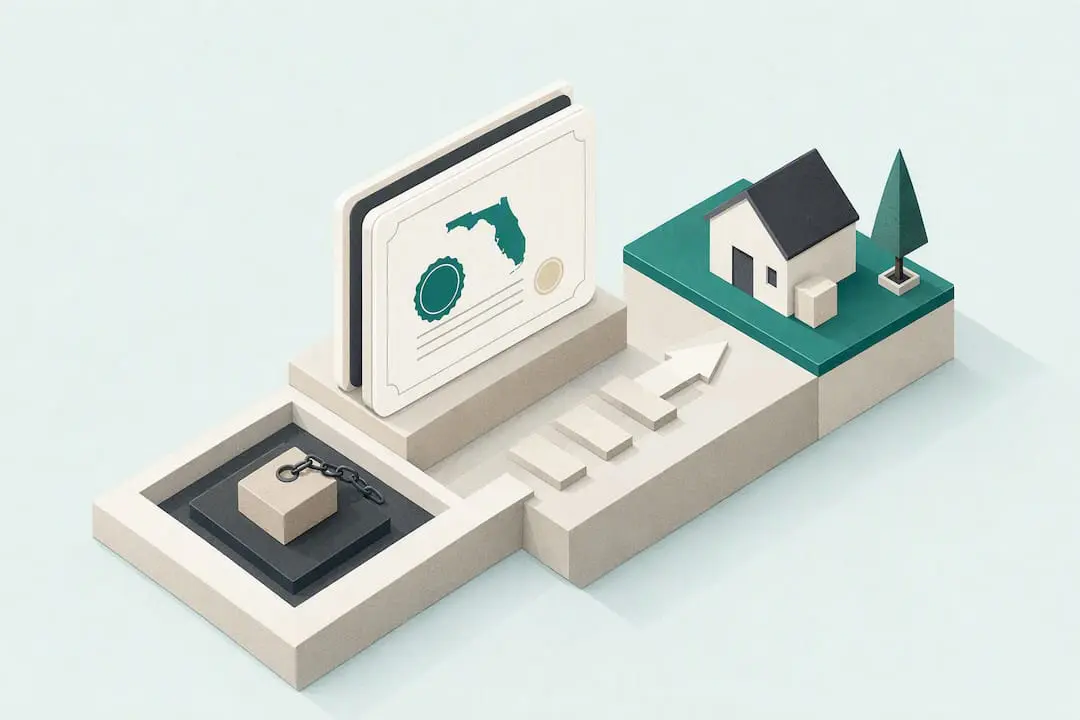
Florida does not seize your home the moment you miss a property tax payment. State law gives you a multi-stage process spanning years, but the costs climb fast and the clock never pauses. Taxes are due by March 31, become delinquent April 1, and a tax certificate sale follows later in the year. Your first move today: check your county tax collector’s website or call directly to confirm your exact balance and payment options.
TL;DR:
- Homeowners can still stop the tax process at each stage by paying the owed amount before the tax deed is filed, which typically occurs two years after delinquency.
- Tax certificates are liens, not property deeds, with interest rates capped at 18% but a minimum return of 5% often applies, affecting the payoff amount for redemption.
- Once a tax deed application is filed, the property can be sold at auction, but certain liens may persist, requiring a quiet title process for marketability.
- Quick cash sales through specialized companies can often settle back taxes and deed fees within days, providing a faster alternative to waiting for legal proceedings.
- The county tax collector’s website is the best resource to verify current balances and payment options before taking any action.
Table of Contents
- Back Taxes on a House in Florida: The Step-by-Step Timeline
- What a Tax Certificate Sale Actually Does to Your Property
- When a Tax Deed Application Can Force a Sale of the House
- How to Redeem Your Property and What It Costs
- Your Realistic Options Before the Deadline Hits
- Why a Direct Cash Sale Can Beat Waiting Out the Clock
- An Editor’s Take on the Real Risk Homeowners Miss
- Ready to Sell Fast? Here’s How Sunshine State Buyers Works
- Where to Verify Your County’s Exact Numbers
- Sources
- FAQ
Back Taxes on a House in Florida: The Step-by-Step Timeline
Florida runs this process on a strict statutory calendar, and knowing the dates matters more than almost anything else you’ll read here.
Your property tax bill covers the calendar year and is due by March 31. Payment is based on when your county receives it, not when you mailed it, so a check postmarked March 30 that arrives April 2 counts as late. Miss that deadline, and here’s what happens:
- April 1: Your account becomes officially delinquent. The county adds a mandatory 3% penalty, and interest starts accruing immediately.
- May: The county publishes your name and parcel in a local newspaper over several weeks, warning that a tax certificate sale is coming. Advertising costs get added to your bill.
- On or before June 1: The county holds its tax certificate sale, auctioning off the debt itself, not your house.
- Two years later: The certificate holder becomes eligible to apply for a tax deed, which can eventually force a public auction of the property if unpaid.
Each stage gives you a real opportunity to stop the process. None of them require you to lose the house.
What a Tax Certificate Sale Actually Does to Your Property
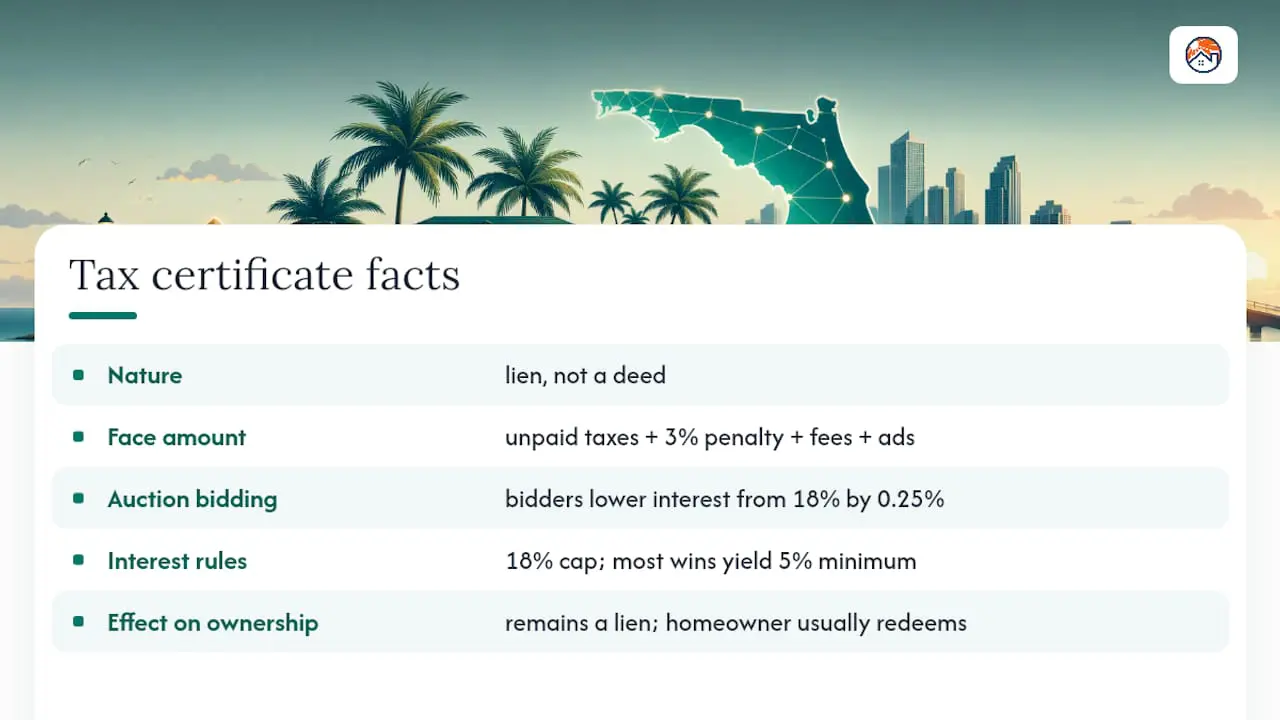
A tax certificate is not a deed. It’s a lien investors buy from the county, essentially paying your overdue tax bill in exchange for the right to collect it back from you, with interest.
The certificate’s face amount includes your unpaid taxes, the 3% penalty, tax collector fees, and advertising costs. At auction, investors don’t bid on price. They bid the interest rate down, starting at the state’s statutory maximum of 18% and dropping in quarter-percent increments. Whoever accepts the lowest rate wins the certificate.
Statistic Callout: Florida caps certificate interest at 18% annually, but a mandatory minimum of 5% applies whenever a certificate would otherwise earn less, so a low winning bid still costs you 5% at redemption. Certificates bid at 0% are the exception — Fla. Stat. §197.472(2) excludes them from that mandatory minimum.
If nobody bids on a certificate, the county itself holds it. County-held certificates behave differently: they can later be bundled and sold, and they still accrue interest, but there’s no private investor pushing for a faster resolution. Either way, the certificate does not transfer ownership of your home. It’s a lien, and most certificates get redeemed by the homeowner long before anything more serious happens.
When a Tax Deed Application Can Force a Sale of the House
Two years after your taxes first became delinquent on April 1, the certificate holder gains the legal right to apply for a tax deed under Florida Statute §197.502. This is the step that actually threatens ownership.
Filing the application doesn’t transfer the house immediately. It triggers a formal process:
- The certificate holder pays outstanding taxes on the property (if any accrued since the original certificate) plus an application fee and title search costs.
- The Clerk of the Circuit Court sets an auction date and the opening bid covers all back taxes, interest, and fees owed.
- The property sells to the highest bidder at public auction, and the certificate holder often bids the amount owed just to recoup their investment.
Winning a tax deed doesn’t always mean a clean title. Certain liens, including some federal tax liens and specific municipal assessments, can survive the sale. Anyone buying at a tax deed auction typically needs a quiet title action before the property is truly marketable.
How to Redeem Your Property and What It Costs
Redemption means paying off the certificate before a deed forces a sale, and it’s available at any point up until the clerk issues the tax deed. Here’s how the math works:
- Pay the face amount of the certificate, which covers your original delinquent taxes plus the 3% penalty and county fees.
- Add accrued interest at whatever rate won the auction, calculated from the certificate’s issue date.
- Cover the minimum return if the bid rate was low. Florida requires certificate holders to receive at least a 5% return in most cases, so a 1% winning bid still costs you 5%.
- Add deed-related costs if an application has already been filed: an application fee, title search charges, and clerk’s processing costs, which can run into several hundred dollars on top of the certificate amount.
A $3,000 certificate redeemed after 18 months at a 5% annual bid rate costs roughly $3,225 before any deed-stage fees appear. Wait until a deed application is filed, and that number climbs quickly.
Your Realistic Options Before the Deadline Hits
You have more choices than the statute lets on, and the right one depends entirely on how much time is left on your clock.
- Pay in full. The simplest fix if you have the cash on hand. Contact your county tax collector directly for the current payoff amount.
- Redeem before the deed sale. Even after a certificate is sold, you retain the right to redeem right up until the deed is issued.
- Ask about payment plans. Some counties offer installment programs or hardship provisions, particularly for homesteaded property, though availability varies by county.
- Sell voluntarily. Selling before a deed application often preserves far more equity than waiting, since application and legal fees escalate the closer you get to auction.
- File bankruptcy. An automatic stay can pause certain collection actions temporarily, but it does not erase the tax debt and has limited power to stop a deed sale already in motion.
Pro Tip: Before contacting anyone, pull your parcel number, current certificate status, and payoff quote from your county tax collector’s website. Having those three things ready cuts your first phone call from twenty minutes to five.
If you’ve inherited a property with back taxes attached, the equity-preservation math works the same way, and speed matters even more since inherited homes often carry unresolved liens alongside the tax debt.
Why a Direct Cash Sale Can Beat Waiting Out the Clock
Once a tax deed application is filed, costs escalate and your timeline shrinks to weeks rather than years. Certain local companies purchase Florida houses as-is, may deliver cash offers within 24 hours, and close sales within 7 to 14 days, potentially fast enough to settle with the county before an auction date arrives.
A direct sale beats waiting when the payoff amount plus deed fees would eat most of your remaining equity anyway. Before accepting any offer, require written proof the buyer will handle payoff directly with your county tax collector, get the closing timeline in writing, and confirm the offer accounts for the exact certificate balance owed.
An Editor’s Take on the Real Risk Homeowners Miss
Most articles on this topic focus on the tax certificate sale like it’s the dangerous moment. It isn’t. Redemption rates are high, and most certificates get paid off long before a deed application ever gets filed.
The real danger is complacency during the two-year gap. Owners assume silence means safety, then get blindsided when an application notice arrives, by which point legal fees have already stacked on top of the certificate balance. If you take one thing from this, check your county balance today. If a deed application already looks imminent, a quick sale often protects more of your equity than fighting the clock alone.
Ready to Sell Fast? Here’s How Sunshine State Buyers Works
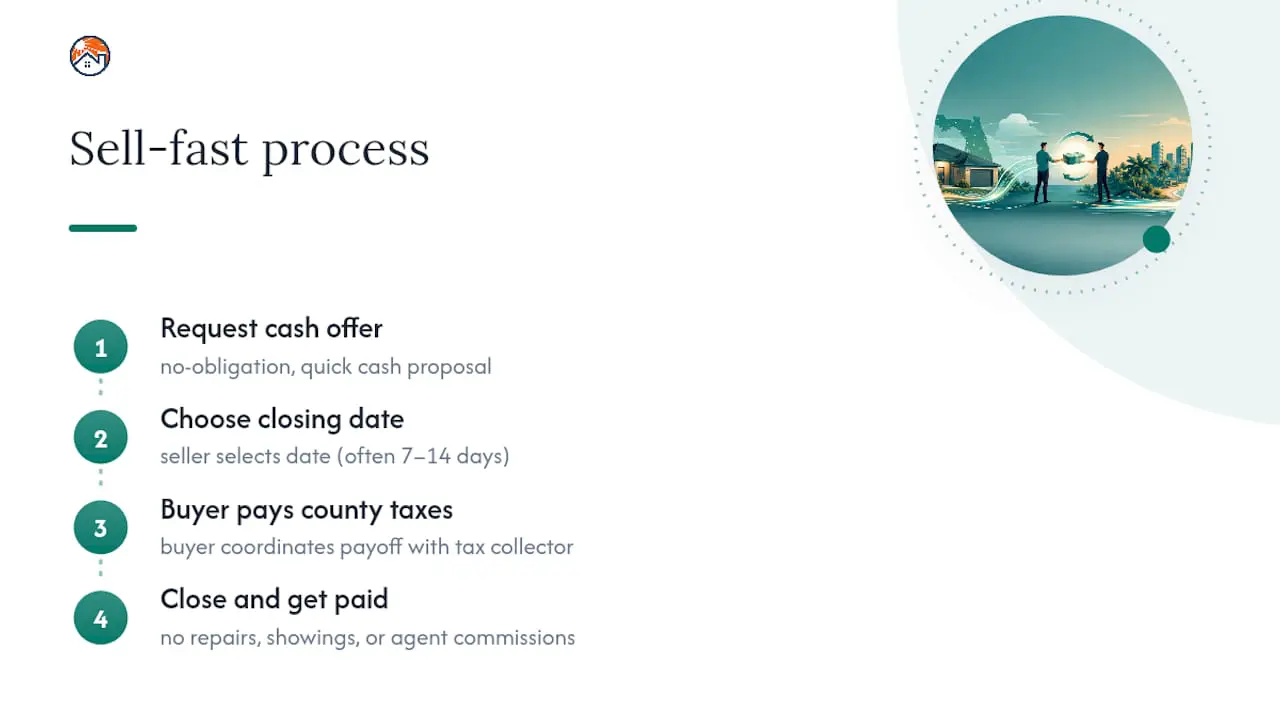
If your tax deed timeline is closing in, waiting for a traditional listing to sell isn’t realistic. Some companies offer Florida homeowners quick cash offers without requiring repairs, showings, or agent commissions, and allow sellers to select a closing date that fits their timeline, often within 7 to 14 days.
This works whether you’re behind on taxes, holding an inherited property you didn’t ask for, or dealing with a tenant situation that’s draining your patience. Learn exactly how the process works from offer to closing table, and if foreclosure is also part of your situation, our guide to stopping foreclosure in Florida walks through your parallel options.
Before closing with any buyer, confirm they’ll coordinate payoff directly with your county tax collector and get that commitment in writing. Ready to see your number? Request your no-obligation cash offer today and find out what your equity is actually worth before the deed clock runs out.
Where to Verify Your County’s Exact Numbers
Your county tax collector’s website is the only reliable source for your current balance, certificate status, and payment options. Florida’s statutory framework governing this entire process lives in Chapter 197 of the Florida Statutes, covering everything from the certificate sale to deed applications and the eventual escheat of unsold property to the county after three years on the lands-available list.
This article is general information, not a substitute for advice from a qualified financial advisor. Consult a qualified financial professional about your own circumstances before acting on anything here.
Sources
- Delinquent taxes — Sarasota County Tax Collector
- F.S. § 197.432 — Tax certificate sale timing and mechanics
- Delinquent Property Tax — Hillsborough County Tax Collector
- What happens if I don’t pay property taxes in Florida? — Nolo
FAQ
Can you buy a property in Florida for back taxes?
Yes. Investors buy tax certificates at the June auction, and if the homeowner never redeems, the certificate holder can eventually apply for a tax deed and bid at the resulting public auction.
How many years can you be behind on property taxes in Florida?
The certificate holder can apply for a tax deed two years after the April 1 delinquency date, so realistically you have roughly two years from your first missed payment before a deed application becomes possible.
How do I buy delinquent property taxes in Florida?
You register with your county tax collector’s certificate sale platform and bid down the interest rate at the annual auction held on or before June 1, with the lowest bidder winning the certificate.
What happens if you buy a house at a tax deed sale?
You may not get a clean title immediately. Some liens, including certain federal and municipal ones, can survive the sale, so most buyers pursue a quiet title action before reselling or financing the property.
Is selling to a cash buyer a good option if I owe back taxes?
It can be, especially once a tax deed application looks close. A company like Sunshine State Buyers can close in days and coordinate payoff with the county, often preserving more equity than waiting for a forced auction.
Recommended
- Stop Foreclosure Florida: Your Guide to Solutions
- Avoid Foreclosure Miami: Steps to Protect Your Home
- Stop Foreclosure Miami: Cash Sale Benefits
This article was produced with AI assistance and reviewed for accuracy. It is provided for general information only and is not professional advice.

Leave a Reply