Tag: Foreclosure

  • 7–14 Day Closings: Cash vs. Mediation Before Foreclosure in Florida

    7–14 Day Closings: Cash vs. Mediation Before Foreclosure in Florida

    Yes, selling your Florida home to a cash buyer can stop or resolve an impending foreclosure, as long as the sale closes before the auction date or the certificate of title is issued. Cash buyers typically close in 7 to 14 days, which makes this route faster than most loan modification talks with your servicer. You still have to meet court deadlines, especially the 20-day window to file an answer, and someone needs to coordinate the payoff with your lender before closing day arrives.


    TL;DR:

    • Selling your home quickly through a cash buyer is most effective if the sale closes within 7 to 14 days, preventing the auction or title issuance.
    • You must file an answer within 20 days of service to avoid default judgment and coordinate payoff details with your lender before closing.
    • Gathering all financial and property documents early, including proof of funds and clear title, is crucial to meet tight foreclosure timelines.
    • Cash offers generally range from 70 to 85 percent of market value, with red flags including upfront fees or lack of a named title company.
    • Consulting an attorney and securing written proof of deal terms are essential to avoid legal conflicts and obtain a possible continuance before auction.

    Sunshine State Buyers
    Explore A Faster Home Sale
    Sunshine State Buyers purchases Florida homes as-is, with cash offers within 24 hours and closing dates typically selected within 7, 14 days.

    Visit Sunshine State Buyers

    Table of Contents

    Quick Checklist: What To Do First When You Consider A Cash Sale

    Every day matters once a foreclosure complaint lands in your mailbox. Here’s the order that protects your options instead of closing them off:

    1. File an answer or call a foreclosure attorney within 20 days of being served. Missing this window risks a default judgment, which strips away your leverage to negotiate or sell on your own terms.
    2. Request an updated payoff statement from your servicer. Pull your deed, title records, property tax statements, HOA ledgers, and insurance documents while you wait.
    3. Get a fast market-value check. Compare that number against everything owed, mortgage balance, liens, back taxes, HOA dues, to see whether you have real equity or need a short sale instead.
    4. Reach out to vetted cash buyers and request written offers with firm closing dates. Never pay an upfront fee to get an offer; legitimate buyers don’t charge you to make one.
    5. Loop in your attorney. Have them handle sale documents and closing logistics alongside the court case.

    Pro Tip: Keep a dated folder, physical or digital, of every document you send or receive. If your closing needs to move fast to beat a sale date, having everything organized in one place can save you a full day of scrambling.

    If you’re behind on payments and unsure where to start, this step-by-step checklist for homeowners walks through the same priorities in more detail.

    Florida Foreclosure Timeline: Which Deadlines Actually Matter?

    Florida runs a judicial foreclosure process, meaning your lender has to sue you in court and win a judgment before your home can be sold at auction. That single fact changes everything about your timeline.

    • You generally have 20 days to file an answer after being served the complaint, under Florida Statutes Chapter 702.
    • An uncontested case can still take several months to over a year to resolve, but a default (failing to answer) accelerates everything toward judgment.
    • Once a judgment is entered, the sale is commonly scheduled within roughly 20 to 35 days, unless the court grants a continuance.

    Here’s the number that matters most: foreclosure practitioners report that a signed purchase agreement, presented promptly to lender’s counsel, can be enough to persuade them to postpone or cancel a scheduled auction when the sale will pay off the debt in full. Timing that request early, not the week of the sale, is what makes it work.

    If the auction is only days away, talk to your attorney about emergency options like a bankruptcy filing, which triggers an automatic stay that temporarily halts the sale, or a motion to continue. These are stopgaps, not solutions, but they can buy the days you need to close a sale properly.

    How Do You Sell Fast To A Cash Buyer, Day By Day?

    Selling during foreclosure isn’t complicated, but it is sequential. Skip a step and you lose days you don’t have.

    Days 0 to 2: Gather documents and get your numbers.
    Request the official payoff demand from your servicer. Collect your deed, most recent tax bill, HOA statements if applicable, and any insurance paperwork. At the same time, contact cash buyers and ask each one for a written offer along with proof of funds.

    Days 3 to 7: Vet buyers and sign.
    Confirm proof of funds and ask which title or escrow company will handle closing, this is a basic legitimacy check most sellers skip. Once you’re comfortable, sign a purchase agreement with a firm closing date. If the buyer’s title company needs to run a title search, provide access promptly so nothing stalls the file.

    Days 7 to 14: Clear title and close.
    The title company finalizes the payoff amount with your lender, resolves any outstanding liens, and prepares the closing statement. Funds move by wire or through escrow, and the deed gets recorded. At this point, an experienced buyer’s team can coordinate directly with the lender’s attorney to confirm the payoff amount and, when appropriate, request the sale be paused.
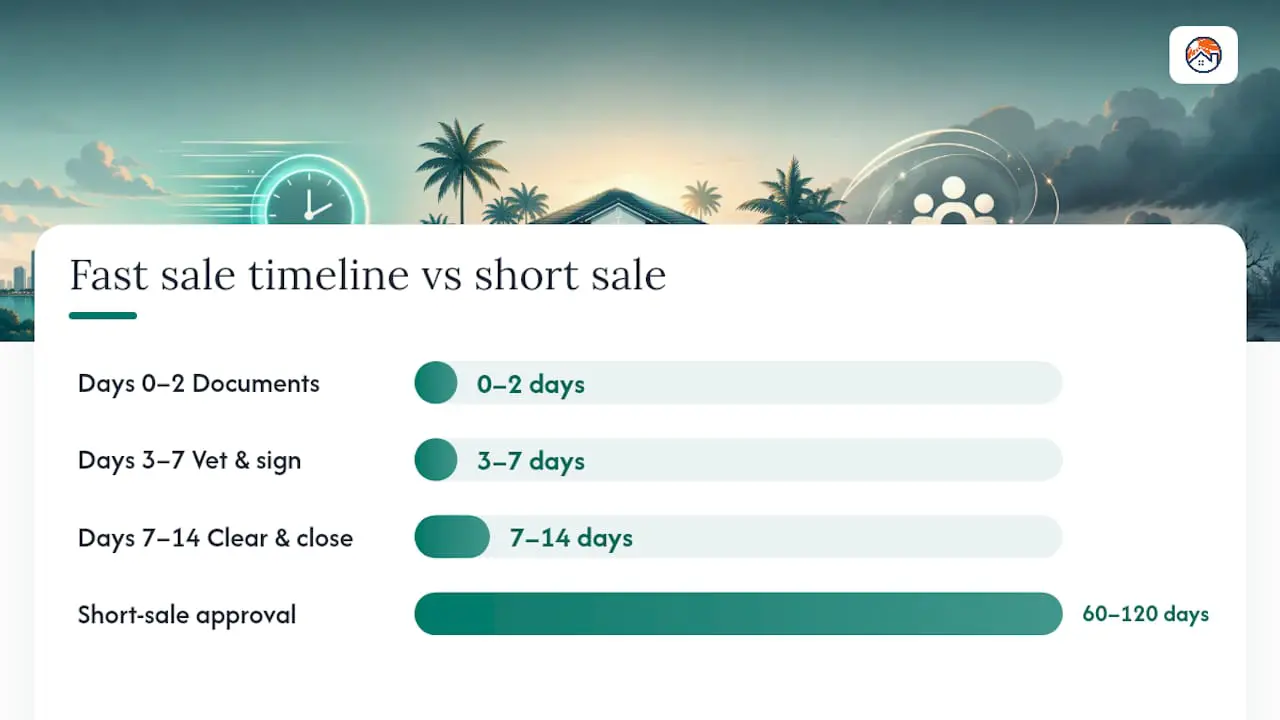
    Bar chart titled Fast sale timeline vs short sale: gathering documents 0 to 2 days, vetting buyers and signing 3 to 7 days, clearing title and closing 7 to 14 days, and short-sale approval 60 to 120 days

    If you owe more than the home is worth, expect a longer road. Short sales require lender approval and typically take 60 to 120 days to finalize, which is why cash buyers willing to work through short sale approval, rather than only buying homes with equity, are worth more to a homeowner racing a court date.

    Pro Tip: Ask any cash buyer point blank: “Have you closed a deal on a home in active foreclosure before?” Their answer, and how specific it is, tells you a lot about whether they can actually hit your deadline.

    How Do You Know If A Cash Offer Is Fair?

    An offer number by itself tells you very little. What matters is your net proceeds, the amount you actually walk away with after every deduction.

    • Ask for a written breakdown: offer price minus mortgage payoff, any liens, closing costs, and prorated taxes or HOA dues.
    • Understand the tradeoff going in. Cash offers for as-is sales often land in the 70 to 85 percent range of market value, and that discount is the price of speed, certainty, and skipping repairs entirely.
    • Watch for red flags: any request for an upfront fee, no named title or escrow company, pressure to sign a deed before closing, or a “sign today or the offer disappears” pitch.
    • Before you sign anything, ask for proof of funds, a firm closing date in writing, the title company’s name and contact, and a sample closing statement showing your estimated net.

    Pro Tip: If a buyer can’t name their title company or escrow agent within a day of asking, that’s not a paperwork delay, it’s a warning sign.

    Curious whether a specific offer holds up? This breakdown of common lowball tactics walks through exactly what a fair offer should look like on paper.

    What Should You Verify With An Attorney Before Selling?

    A cash sale doesn’t remove the legal case against you, it runs alongside it. A few checkpoints keep the two from colliding:

    • Confirm your answer was filed within the 20-day window; this alone can prevent a default judgment that undermines your ability to sell on your terms.
    • Ask your attorney to formally notify the court and opposing counsel about the pending sale, and to request a continuance if the closing date and the auction date are too close together.
    • Confirm the payoff procedure with your lender’s counsel, and ask whether a deficiency judgment (a court order requiring you to pay the difference if the sale doesn’t fully cover the debt) is possible in your case.
    • If the sale is set for days away, discuss emergency remedies like a bankruptcy stay with your attorney before you assume a private sale alone will stop it.

    Roughly 20 days is all Florida law gives you to respond once you’re served, which is why this conversation with counsel needs to happen in week one, not week three.

    Why A Fast Cash Sale Often Beats Waiting On Lender Talks
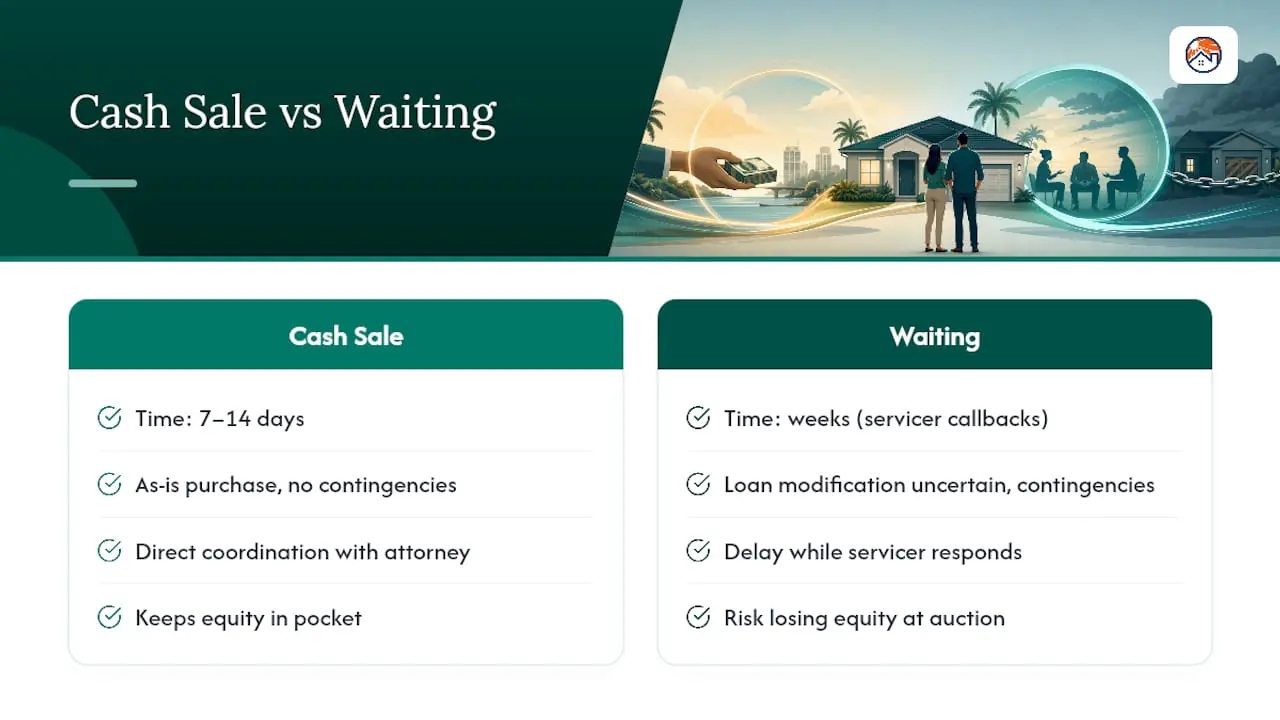
    Side-by-side comparison graphic, Cash Sale versus Waiting: a cash sale closes in 7 to 14 days as-is with no contingencies and direct coordination with your attorney, while waiting on a servicer means weeks of callbacks, an uncertain loan modification and the risk of losing equity at auction

    Homeowners spend weeks waiting on servicer callbacks, hoping for a loan modification that may never materialize. Sunshine State Buyers has watched that pattern play out across Florida for years, and the math rarely favors waiting. An A+ BBB rating and a track record of closings inside 7 to 14 days reflect a business built around one job: buying homes as-is, fast, without the contingencies that sink traditional sales. That speed, paired with direct coordination between the buyer’s team and your attorney, is often what keeps equity in your pocket instead of losing it at auction.

    None of that replaces legal advice. Always get attorney review before signing anything, and insist on written proof of funds and a firm closing timeline before you commit to any buyer.

    — David

    How Sunshine State Buyers Can Help You Move Fast

    If the deadlines above feel like they’re closing in, you don’t have to navigate them alone. Sunshine State Buyers gives Florida homeowners a direct path to a closed sale in days, not months, buying homes as-is, in any condition, with no repairs, no showings, and no commissions eating into your proceeds.
    Screenshot of the Sunshine State Buyers homepage, headlined Sell Your Florida House Fast for Cash, with a form to request a no-obligation cash offer within 24 hours

    You get a written cash offer within 24 hours of reaching out, and you pick the closing date, typically 7 to 14 days out, though the timeline flexes if your court date needs faster action. The next step is simple: call for a free, no-obligation consultation, gather the payoff and title documents from the checklist above, and let the team walk you through exactly how the process works from first call to closing table. There’s no pressure and no upfront cost to find out what your home is worth on your timeline, not the court’s.

    Sources

    This article is general information, not a substitute for advice from a qualified lawyer. Consult a qualified legal professional about your own circumstances before acting on anything here.

    FAQ

    Can I sell my house after a foreclosure lawsuit is filed?

    Yes. You can sell at any point before the sale is finalized, though you still need to answer the complaint within 20 days and coordinate the payoff with your lender before closing.

    How fast can a cash sale actually close in Florida?

    Most cash buyers, including Sunshine State Buyers, close in 7 to 14 days once a signed agreement and clear title are in place.

    Will selling for cash stop a scheduled auction?

    It can, if you present a signed purchase contract and proof of closing to your lender’s attorney early enough for them to request a continuance; waiting until days before the sale date makes this far less likely to work.

    What if I owe more than my home is worth?

    You’ll likely need a short sale, which requires lender approval and can take 60 to 120 days, so start that conversation with your servicer and a cash buyer as early as possible.

    Do cash buyers charge fees to make an offer?

    No legitimate cash buyer charges you an upfront fee for a written offer; if someone asks for money before closing, treat that as a serious red flag.

    This article was produced with AI assistance and reviewed for accuracy. It is provided for general information only and is not professional advice.

  • Act Fast: Florida Foreclosure Timeline and Cash Offers in 24 Hours

    Act Fast: Florida Foreclosure Timeline and Cash Offers in 24 Hours

    Florida judicial foreclosures typically run through circuit court and, in routine uncontested cases, the timeframe from first missed payment to certificate of title commonly takes about 12 to 18 months; contested or aggressively defended cases often take longer. The sale itself gets scheduled 20 to 35 days after final judgment, with a 10-day window to object before title transfers. Your most urgent move right now is contacting your servicer about loss mitigation, talking to a foreclosure attorney, or getting a cash offer on the table before a sale date locks in.


    TL;DR:

    • Most Florida foreclosures take about 12 to 18 months from missed payment to sale if uncontested, but heavily defended cases can extend beyond 24 months.
    • A 20 to 35-day window follows the final judgment for the sale, with a 10-day objection period before the certificate of title issues to the winning bidder.
    • Filing an answer within 20 days of service and acting early with loss mitigation or a quick sale significantly improves your chances to delay or stop a foreclosure.
    • The key deadlines are governed by statutes and rules such as Fla. Stat. § 45.031 for sale scheduling and Fla. R. Civ. P. 1.140 for answer timing.
    • Factors like court backlog, case complexity, contesting, and lender efficiency influence the case duration, with proactive homeowners gaining more options.

    Sunshine State Buyers
    Explore a Faster Way to Sell
    Sunshine State Buyers helps Florida homeowners sell as-is, receive a cash offer within 24 hours, and choose a closing date.

    Learn about selling your home

    Table of Contents

    How Long Is the Foreclosure Timeline in Florida?

    Florida is a judicial foreclosure state, which means your lender cannot simply take your house. Every case has to go through circuit court, and that court process is what creates the calendar you’re trying to understand. Here’s how the stages typically unfold, from the first missed mortgage payment to the day a new owner holds the certificate of title.

    1. Missed payment and servicer contact. Federal servicing rules generally require your servicer to reach out and provide loss-mitigation information within about 36 to 45 days of a missed payment, and most servicers cannot legally start foreclosure until you’re more than 120 days delinquent.

    2. Breach letter and acceleration. Your lender sends a formal notice of default, often called a breach or acceleration letter giving you a cure period commonly of 30 days to catch up before the loan is called due in full.

    3. Complaint filed and lis pendens recorded. The lender files a lawsuit in circuit court and records a lis pendens, a public notice attached to your property’s title that alerts anyone doing a title search that foreclosure is pending.

    4. Service of process and your 20-day answer window. Once you’re formally served, you have 20 days to file a response under Florida Rule of Civil Procedure 1.140. Missing this deadline is the single fastest way to lose your case by default.

    5. Discovery, mediation, and summary judgment. Contested cases move into discovery and sometimes court-ordered mediation, a phase that commonly adds 3 to 9 months. Many cases end here through a summary judgment motion rather than a full trial.

    6. Final judgment and sale. Once the court enters final judgment, Florida law sets the sale date between 20 and 35 days later. The clerk conducts the auction, and the winning bidder typically posts a 5% deposit that day, according to DefaultResearch’s overview of Florida foreclosure auctions.

    7. Certificate of sale, objection period, certificate of title. After the auction, there’s a 10-day window to object to the sale. If nobody successfully objects, the clerk issues the certificate of title, and ownership officially transfers.

    What Statutes and Court Rules Actually Set These Deadlines?

    Every date in your foreclosure case traces back to a specific statute or rule, and knowing them lets you check whether the notices you’ve received are actually on schedule.

    • Fla. Stat. § 45.031 governs the sale itself: the 20 to 35 day scheduling window, publication requirements, deposit rules, and the 10-day post-sale objection period before a certificate of title issues.
    • Chapter 702 covers the broader foreclosure procedure, including order-to-show-cause hearings and, in certain uncontested cases, expedited final judgment within 90 days from the close of pleadings.
    • Fla. R. Civ. P. 1.140 sets your 20-day answer deadline once you’re served.
    • Federal Regulation X requires servicer contact and loss-mitigation notices generally within 36 to 45 days of default, and bars foreclosure filing before 120 days delinquent in most cases.

    Statutory snapshot: A homeowner who is served on a Monday has until the following third Monday to file an answer. Miss it, and the court can enter a default judgment without ever hearing your side.

    Which Factors Make a Florida Foreclosure Faster or Slower?

    Four things drive how long your specific case takes, and understanding them helps you predict where you’ll land on the timeline.

    • Court backlog. Circuit courts in high-volume counties move slower than courts with lighter dockets, and this alone can add months regardless of anything you do.
    • Case complexity. Multiple liens, HOA disputes, or title defects require extra legal steps and extra time to resolve.
    • Whether you contest the case. Filing an answer, requesting discovery, and attending mediation all add time, but they also add leverage.
    • Lender and servicer efficiency. Some servicers move through paperwork quickly and have clean standing to foreclose; others get delayed by their own documentation gaps.

    Based on these factors, routine uncontested cases often wrap up in roughly 12 to 18 months, routine contested cases run similarly at 12 to 18 months, and heavily defended or legally complex cases commonly stretch past 24 months.

    Pro Tip: Your own responsiveness often matters more than how aggressive your lender is. A homeowner who files an answer, negotiates in mediation, and shows up to hearings usually gets more time and more options than one who ignores the mail.

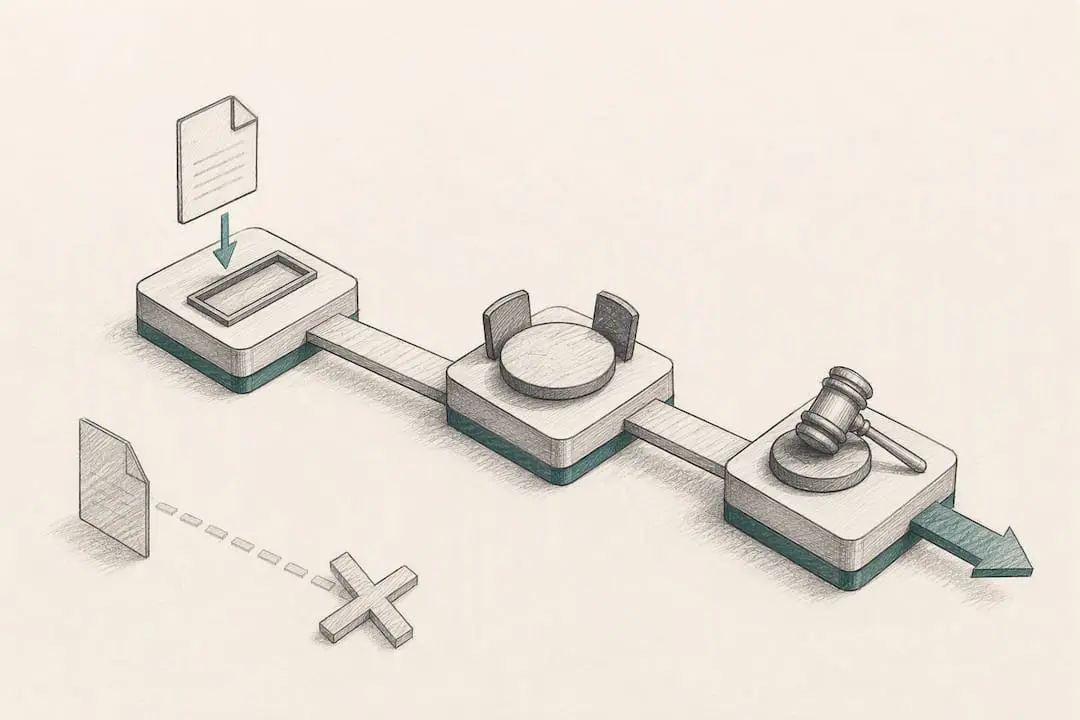
    Isometric sketch of a foreclosure response pathway: a filed document moves along a track from an intake tray to a round mediation table to a judge's gavel and out the far side, while a second document branches off on a dashed line to a large X

    What Are Your Options for Stopping or Delaying a Sale?

    You have real choices at nearly every stage, and the earlier you act, the more of them stay open.

    1. Apply for loss mitigation. Ask your servicer about a loan modification or forbearance as soon as you miss a payment. You’ll need proof of income, a hardship letter, and recent bank statements.
    2. Use mediation and consider a short sale. Court-ordered mediation, when available, is often where loan modifications and short sales actually get worked out, according to foreclosure defense timeline research.
    3. File bankruptcy if it fits your situation. Chapter 7 typically pauses a sale for a few months through the automatic stay; Chapter 13 can delay it considerably longer while you catch up on payments through a repayment plan, though both carry credit and cost tradeoffs worth discussing with an attorney.
    4. Sell to a cash buyer. If you’re close to a sale date, don’t have the time or money for repairs, or you’re dealing with a rental property with tenants, selling directly for cash can close before the auction ever happens.

    What to gather now, regardless of which path you choose:

    • Your mortgage statement and loan number
    • Any breach letters or court papers you’ve received
    • Recent tax and homeowners insurance statements
    • Government-issued ID and proof of ownership

    Why Most Homeowners Lose Time They Didn’t Have to Lose

    The biggest mistake isn’t falling behind on payments. It’s what happens after: letting breach letters and court summonses pile up unopened, or assuming there’s more time than the calendar actually allows. A missed 20-day answer deadline can end your case before you’ve made a single decision.

    Acting early, whether that means answering the lawsuit, applying for loss mitigation, or lining up a fast sale, keeps every option on the table. Waiting closes them one by one. Verify your actual deadlines against the statutes, talk to a foreclosure attorney or housing counselor, and if a quick sale makes sense for your situation, talk to a buyer you trust before the court sets your date.

    How Sunshine State Buyers Can Help You Beat the Clock

    Some cash home buyers provide fast offers often within 24 hours, instead of leaving you guessing while your court date approaches. That speed matters when a sale is already scheduled and every week counts.

    Sunshine State Buyers

    Cash home buyers purchase homes as-is, including houses needing repairs, rentals with tenants, or inherited properties that you don’t want to manage. Selling as-is to a cash buyer can avoid showings, agent commissions, and financing delays. Closings can often occur quickly, sometimes within one to two weeks, with sellers able to choose their closing date. Some companies hold high ratings with the Better Business Bureau and operate statewide, with experience assisting homeowners facing tight deadlines.

    If your sale date is approaching or you need to explore options before the court moves forward, consider obtaining a no-obligation cash offer. Start by visiting the Stop Foreclosure Florida guide to see what a direct sale could look like for your specific timeline, and have your mortgage statement and any court paperwork ready when you call.

    Where to Verify These Deadlines Yourself

    This article is general information, not a substitute for advice from a qualified financial advisor. Consult a qualified financial professional about your own circumstances before acting on anything here.

    Sources

    FAQ

    What is the 120-day rule for foreclosure?

    Federal servicing rules generally prohibit your mortgage servicer from starting foreclosure until you’re more than 120 days past due, giving you a window to pursue loss mitigation before legal proceedings begin.

    How long can you go without paying your mortgage before foreclosure starts in Florida?

    Most servicers wait until you’re past the 120-day mark before filing, though the breach letter and cure period notices typically start showing up much earlier, often around 36 to 45 days after your first missed payment.

    How long after foreclosure do I have to move in Florida?

    Once the clerk issues the certificate of title, the new owner can begin eviction proceedings, which commonly gives occupants a matter of weeks rather than months to vacate, depending on how quickly the new owner files.

    Do I still owe money after a foreclosure in Florida?

    Possibly. If the sale price doesn’t cover your full loan balance, the lender can pursue a deficiency judgment for the difference, though selling before the sale date, such as through a direct cash sale, avoids that risk entirely.

    This article was produced with AI assistance and reviewed for accuracy. It is provided for general information only and is not professional advice.

  • Avoid a Tax Deed for Florida Back Taxes: Dates, Costs, Fast Cash

    Avoid a Tax Deed for Florida Back Taxes: Dates, Costs, Fast Cash

    Florida does not seize your home the moment you miss a property tax payment. State law gives you a multi-stage process spanning years, but the costs climb fast and the clock never pauses. Taxes are due by March 31, become delinquent April 1, and a tax certificate sale follows later in the year. Your first move today: check your county tax collector’s website or call directly to confirm your exact balance and payment options.


    TL;DR:

    • Homeowners can still stop the tax process at each stage by paying the owed amount before the tax deed is filed, which typically occurs two years after delinquency.
    • Tax certificates are liens, not property deeds, with interest rates capped at 18% but a minimum return of 5% often applies, affecting the payoff amount for redemption.
    • Once a tax deed application is filed, the property can be sold at auction, but certain liens may persist, requiring a quiet title process for marketability.
    • Quick cash sales through specialized companies can often settle back taxes and deed fees within days, providing a faster alternative to waiting for legal proceedings.
    • The county tax collector’s website is the best resource to verify current balances and payment options before taking any action.

    Sunshine State Buyers
    Need to Sell Before the Deadline?
    Sunshine State Buyers purchases Florida homes as-is, with cash offers within 24 hours and closing dates typically within 7, 14 days.

    Table of Contents

    Back Taxes on a House in Florida: The Step-by-Step Timeline

    Florida runs this process on a strict statutory calendar, and knowing the dates matters more than almost anything else you’ll read here.

    Your property tax bill covers the calendar year and is due by March 31. Payment is based on when your county receives it, not when you mailed it, so a check postmarked March 30 that arrives April 2 counts as late. Miss that deadline, and here’s what happens:

    • April 1: Your account becomes officially delinquent. The county adds a mandatory 3% penalty, and interest starts accruing immediately.
    • May: The county publishes your name and parcel in a local newspaper over several weeks, warning that a tax certificate sale is coming. Advertising costs get added to your bill.
    • On or before June 1: The county holds its tax certificate sale, auctioning off the debt itself, not your house.
    • Two years later: The certificate holder becomes eligible to apply for a tax deed, which can eventually force a public auction of the property if unpaid.

    Each stage gives you a real opportunity to stop the process. None of them require you to lose the house.

    What a Tax Certificate Sale Actually Does to Your Property

    A tax certificate is not a deed. It’s a lien investors buy from the county, essentially paying your overdue tax bill in exchange for the right to collect it back from you, with interest.

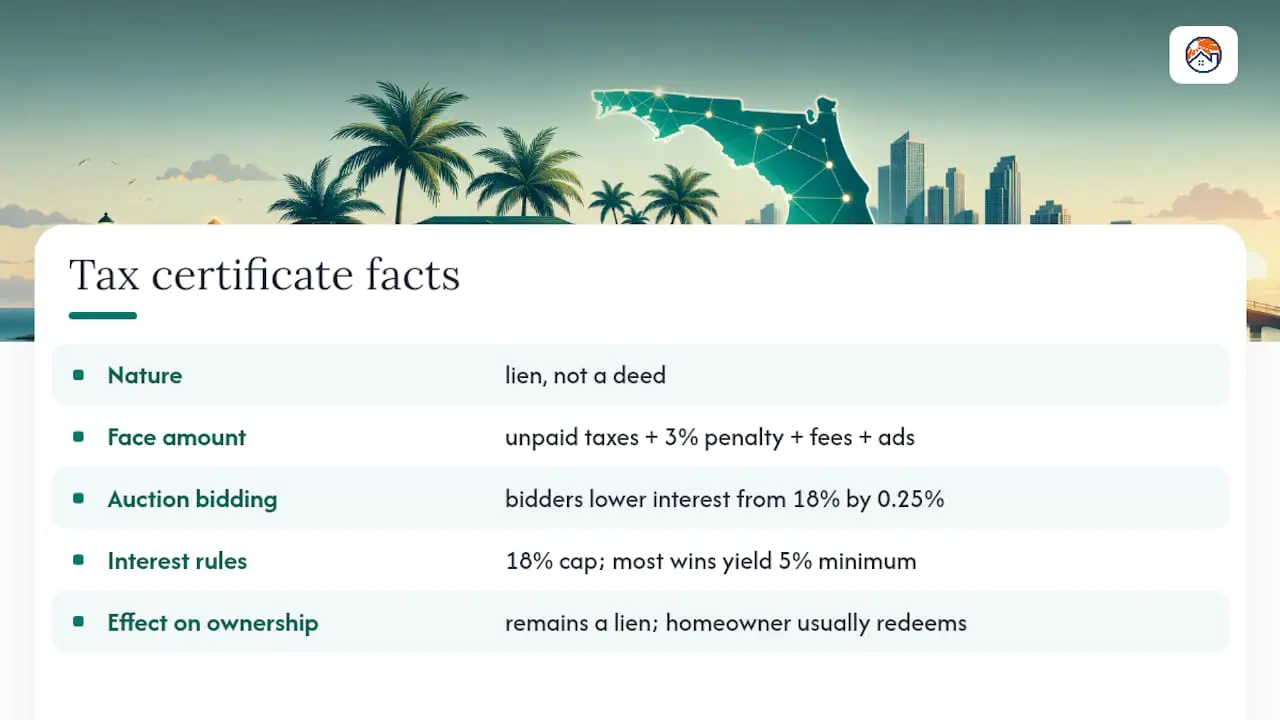
    The certificate’s face amount includes your unpaid taxes, the 3% penalty, tax collector fees, and advertising costs. At auction, investors don’t bid on price. They bid the interest rate down, starting at the state’s statutory maximum of 18% and dropping in quarter-percent increments. Whoever accepts the lowest rate wins the certificate.

    Statistic Callout: Florida caps certificate interest at 18% annually, but a mandatory minimum of 5% applies whenever a certificate would otherwise earn less, so a low winning bid still costs you 5% at redemption. Certificates bid at 0% are the exception — Fla. Stat. §197.472(2) excludes them from that mandatory minimum.

    If nobody bids on a certificate, the county itself holds it. County-held certificates behave differently: they can later be bundled and sold, and they still accrue interest, but there’s no private investor pushing for a faster resolution. Either way, the certificate does not transfer ownership of your home. It’s a lien, and most certificates get redeemed by the homeowner long before anything more serious happens.

    Illustration of a tax certificate facts table: the certificate is a lien rather than a deed, its face amount covers unpaid taxes plus a 3% penalty, fees and advertising, bidders lower the interest rate from 18% in 0.25% steps, and ownership is unaffected because most homeowners redeem

    When a Tax Deed Application Can Force a Sale of the House

    Two years after your taxes first became delinquent on April 1, the certificate holder gains the legal right to apply for a tax deed under Florida Statute §197.502. This is the step that actually threatens ownership.

    Filing the application doesn’t transfer the house immediately. It triggers a formal process:

    • The certificate holder pays outstanding taxes on the property (if any accrued since the original certificate) plus an application fee and title search costs.
    • The Clerk of the Circuit Court sets an auction date and the opening bid covers all back taxes, interest, and fees owed.
    • The property sells to the highest bidder at public auction, and the certificate holder often bids the amount owed just to recoup their investment.

    Winning a tax deed doesn’t always mean a clean title. Certain liens, including some federal tax liens and specific municipal assessments, can survive the sale. Anyone buying at a tax deed auction typically needs a quiet title action before the property is truly marketable.

    How to Redeem Your Property and What It Costs

    Redemption means paying off the certificate before a deed forces a sale, and it’s available at any point up until the clerk issues the tax deed. Here’s how the math works:

    1. Pay the face amount of the certificate, which covers your original delinquent taxes plus the 3% penalty and county fees.
    2. Add accrued interest at whatever rate won the auction, calculated from the certificate’s issue date.
    3. Cover the minimum return if the bid rate was low. Florida requires certificate holders to receive at least a 5% return in most cases, so a 1% winning bid still costs you 5%.
    4. Add deed-related costs if an application has already been filed: an application fee, title search charges, and clerk’s processing costs, which can run into several hundred dollars on top of the certificate amount.

    A $3,000 certificate redeemed after 18 months at a 5% annual bid rate costs roughly $3,225 before any deed-stage fees appear. Wait until a deed application is filed, and that number climbs quickly.

    Your Realistic Options Before the Deadline Hits

    You have more choices than the statute lets on, and the right one depends entirely on how much time is left on your clock.

    • Pay in full. The simplest fix if you have the cash on hand. Contact your county tax collector directly for the current payoff amount.
    • Redeem before the deed sale. Even after a certificate is sold, you retain the right to redeem right up until the deed is issued.
    • Ask about payment plans. Some counties offer installment programs or hardship provisions, particularly for homesteaded property, though availability varies by county.
    • Sell voluntarily. Selling before a deed application often preserves far more equity than waiting, since application and legal fees escalate the closer you get to auction.
    • File bankruptcy. An automatic stay can pause certain collection actions temporarily, but it does not erase the tax debt and has limited power to stop a deed sale already in motion.

    Pro Tip: Before contacting anyone, pull your parcel number, current certificate status, and payoff quote from your county tax collector’s website. Having those three things ready cuts your first phone call from twenty minutes to five.

    If you’ve inherited a property with back taxes attached, the equity-preservation math works the same way, and speed matters even more since inherited homes often carry unresolved liens alongside the tax debt.

    Why a Direct Cash Sale Can Beat Waiting Out the Clock

    Once a tax deed application is filed, costs escalate and your timeline shrinks to weeks rather than years. Certain local companies purchase Florida houses as-is, may deliver cash offers within 24 hours, and close sales within 7 to 14 days, potentially fast enough to settle with the county before an auction date arrives.

    A direct sale beats waiting when the payoff amount plus deed fees would eat most of your remaining equity anyway. Before accepting any offer, require written proof the buyer will handle payoff directly with your county tax collector, get the closing timeline in writing, and confirm the offer accounts for the exact certificate balance owed.

    An Editor’s Take on the Real Risk Homeowners Miss

    Most articles on this topic focus on the tax certificate sale like it’s the dangerous moment. It isn’t. Redemption rates are high, and most certificates get paid off long before a deed application ever gets filed.

    The real danger is complacency during the two-year gap. Owners assume silence means safety, then get blindsided when an application notice arrives, by which point legal fees have already stacked on top of the certificate balance. If you take one thing from this, check your county balance today. If a deed application already looks imminent, a quick sale often protects more of your equity than fighting the clock alone.

    Ready to Sell Fast? Here’s How Sunshine State Buyers Works

    If your tax deed timeline is closing in, waiting for a traditional listing to sell isn’t realistic. Some companies offer Florida homeowners quick cash offers without requiring repairs, showings, or agent commissions, and allow sellers to select a closing date that fits their timeline, often within 7 to 14 days.

    Sunshine State Buyers

    This works whether you’re behind on taxes, holding an inherited property you didn’t ask for, or dealing with a tenant situation that’s draining your patience. Learn exactly how the process works from offer to closing table, and if foreclosure is also part of your situation, our guide to stopping foreclosure in Florida walks through your parallel options.

    Before closing with any buyer, confirm they’ll coordinate payoff directly with your county tax collector and get that commitment in writing. Ready to see your number? Request your no-obligation cash offer today and find out what your equity is actually worth before the deed clock runs out.

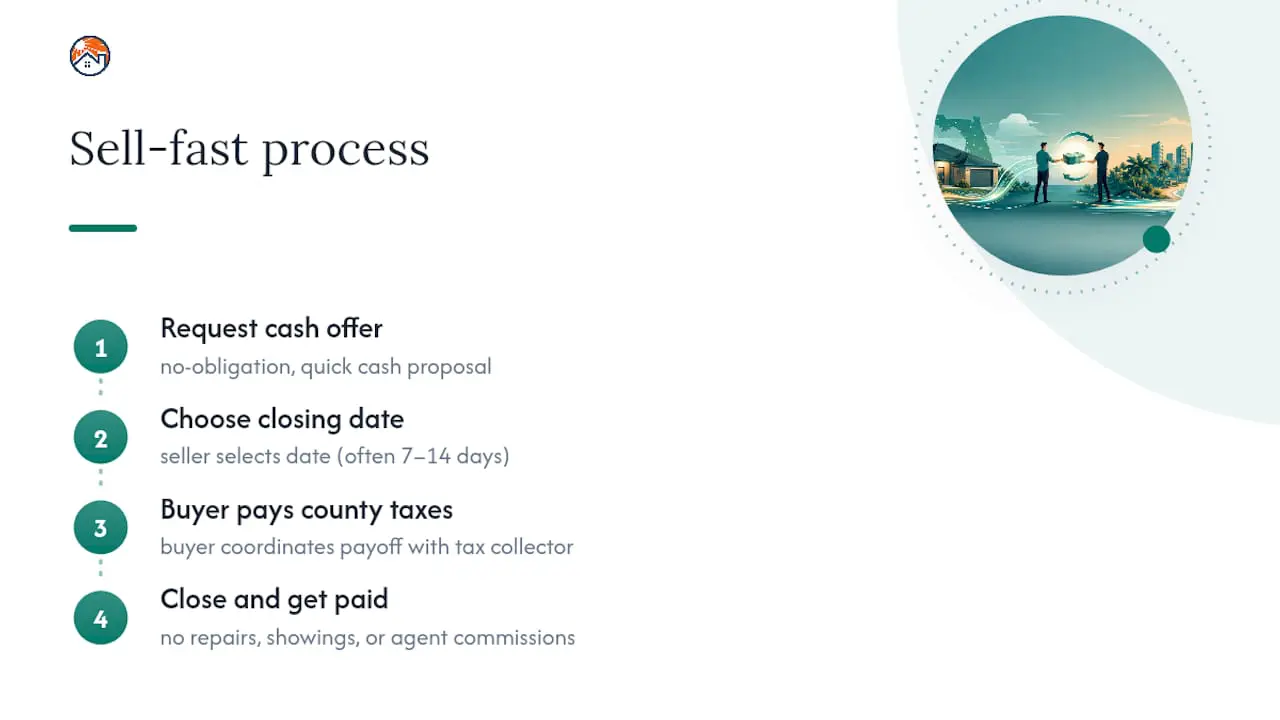
    Illustration of a four-step sell-fast process: request a no-obligation cash offer, choose a closing date often 7 to 14 days out, the buyer coordinates the tax payoff with the county tax collector, then close with no repairs, showings or agent commissions

    Where to Verify Your County’s Exact Numbers

    Your county tax collector’s website is the only reliable source for your current balance, certificate status, and payment options. Florida’s statutory framework governing this entire process lives in Chapter 197 of the Florida Statutes, covering everything from the certificate sale to deed applications and the eventual escheat of unsold property to the county after three years on the lands-available list.

    This article is general information, not a substitute for advice from a qualified financial advisor. Consult a qualified financial professional about your own circumstances before acting on anything here.

    Sources

    FAQ

    Can you buy a property in Florida for back taxes?

    Yes. Investors buy tax certificates at the June auction, and if the homeowner never redeems, the certificate holder can eventually apply for a tax deed and bid at the resulting public auction.

    How many years can you be behind on property taxes in Florida?

    The certificate holder can apply for a tax deed two years after the April 1 delinquency date, so realistically you have roughly two years from your first missed payment before a deed application becomes possible.

    How do I buy delinquent property taxes in Florida?

    You register with your county tax collector’s certificate sale platform and bid down the interest rate at the annual auction held on or before June 1, with the lowest bidder winning the certificate.

    What happens if you buy a house at a tax deed sale?

    You may not get a clean title immediately. Some liens, including certain federal and municipal ones, can survive the sale, so most buyers pursue a quiet title action before reselling or financing the property.

    Is selling to a cash buyer a good option if I owe back taxes?

    It can be, especially once a tax deed application looks close. A company like Sunshine State Buyers can close in days and coordinate payoff with the county, often preserving more equity than waiting for a forced auction.

    This article was produced with AI assistance and reviewed for accuracy. It is provided for general information only and is not professional advice.
  • Florida Lis Pendens: Clear Title Faster or Sell for Cash in 7–14 Days

    Florida Lis Pendens: Clear Title Faster or Sell for Cash in 7–14 Days

    A lis pendens in Florida is a notice recorded under Florida Statute §48.23 that tells the world a lawsuit affecting your property is pending. It does not create a lien, but in practice it clouds your title and stops most sales, refinances, and closings cold. You typically get it removed through a court-ordered discharge, a transfer to bond, or by resolving the underlying lawsuit.


    TL;DR:

    • Lis pendens does not create a lien but significantly clouds title, often halting sales, refinancing, and closings due to practical risks for buyers and lenders.
    • Recorded notices must include specific party, case, and property details; failure to comply or expiration can lead to legal challenges and removal.
    • The notice’s effect is limited to recorded interests; unrecorded claims generally remain unaffected, especially in foreclosure or lien cases.
    • Challenging or expediting the removal of a lis pendens relies on court motions, bonds, or waiting for the one-year expiration unless based on recorded documents.
    • Buyers should consider cash purchases or legal review before acquiring property affected by a lis pendens, due to the high risk of losing full ownership or financing options.

    Sunshine State Buyers
    Explore a Faster Way to Sell
    Sunshine State Buyers purchases Florida homes as-is, with cash offers within 24 hours and closing dates you choose, typically within 7, 14 days.

    Table of Contents

    What Does Florida Statute §48.23 Require for a Lis Pendens Notice?

    Section 48.23 is the entire legal foundation for this notice. It lets a party involved in a lawsuit touching real property record a notice in the county where that property sits, warning anyone who checks the title that litigation is pending. Once recorded, that notice becomes part of the public record, and any title search will flag it immediately.

    The statute is specific about what the notice must contain. Leave one of these out, and the notice can be challenged on its face:

    • The names of the parties involved in the lawsuit
    • The date the action was filed or the case number
    • The name of the court where the case is pending
    • A legal description of the property (not just a street address)
    • A statement of the relief being sought

    The one-year rule trips up a lot of filers. If the lawsuit isn’t based on a recorded instrument, like a mortgage or deed, or a construction lien under Chapter 713, the lis pendens expires one year after the case was filed unless a court extends it for good cause. Courts consider extensions carefully before granting them. A plaintiff who lets the clock run out without asking for an extension loses the notice’s protective effect, even if the underlying lawsuit is still very much alive.

    There’s a narrower but important provision buried in §48.23(1)(d): the recorded notice doesn’t reach back and affect interests that were never recorded. If someone had an unrecorded claim to the property before the lis pendens went on record, that claim generally doesn’t get swept into the litigation’s shadow just because the notice exists. This matters most in disputes over unrecorded contracts or handshake agreements involving the same parcel.

    If the underlying claim is based on a mortgage, a recorded deed, or a construction lien, the one-year clock doesn’t apply at all. Those lis pendens filings stay in effect for as long as the case is active, which is one reason foreclosure-related notices can sit on a title for years while litigation drags through the courts.

    How a Lis Pendens Clouds Title, Scares Off Buyers, and Stalls Closings

    A lis pendens is not a lien. That distinction confuses a lot of homeowners, and it’s worth getting straight before anything else. A lien attaches a debt to your property. A lis pendens simply announces that a lawsuit exists that could change who owns the property, or what it’s worth, once a judge rules. No money is owed because of the notice itself. But the practical effect on your ability to sell is often worse than an actual lien, because it introduces uncertainty that most buyers and every lender want no part of.

    Here’s the mechanism: once a lis pendens is recorded, any buyer who closes on the property takes it “subject to” the lawsuit. That means if the plaintiff wins, the new owner could lose the property or face other consequences tied to the judgment, regardless of what the purchase contract says. Buyers lose their bona fide purchaser protection, the legal shield that normally lets an innocent buyer keep clean title even if problems surface later. The Florida Bar Journal has documented how this single fact drives almost all of the practical fallout from a recorded notice.

    Title insurance underwriters respond predictably. Most will not issue a policy while a lis pendens sits on the title, because insuring the buyer would mean absorbing the exact risk the lawsuit created. Lenders follow the same logic. A bank isn’t going to fund a mortgage on collateral that might belong to someone else in six months. In practice, this means:

    • Cash buyers may still close, but often at a steep discount to offset the risk
    • Financed buyers almost always walk away or the lender denies the loan
    • Refinancing is effectively impossible until the notice clears
    • Even after a discharge order, some insurers wait for the appeal period to lapse before underwriting a policy

    Where lis pendens shows up most often: mortgage foreclosures, specific-performance suits (where a buyer sues to force a seller to complete a contracted sale), partition actions between co-owners, and construction lien disputes under Chapter 713.

    A lis pendens can create significant practical obstacles to selling or insuring title, and industry commentary consistently notes that lenders and title insurers commonly decline to close while the notice remains active, regardless of how the underlying case eventually turns out.

    Is Every Lis Pendens Valid? The Fair Nexus Test Explained

    Not every lis pendens carries the same legal weight, and knowing which type you’re dealing with tells you a lot about how vulnerable it is to challenge.

    A lis pendens of right applies when the lawsuit is founded on a recorded instrument, a mortgage foreclosure, or a Chapter 713 construction lien. These get strong statutory protection. The one-year expiration rule doesn’t apply to them, and courts give the filer wide latitude because the underlying claim is already documented in the public record.

    A garden-variety lis pendens is everything else, disputes over property ownership, partition suits, fraud claims tied to a piece of real estate, and similar actions that aren’t anchored to a recorded document. These face real scrutiny. Florida courts apply what’s known as the fair nexus test, asking whether there’s a genuine, direct connection between the lawsuit and the specific property named in the notice.

    Courts have grown less tolerant of plaintiffs who record a lis pendens as a pressure tactic rather than a genuine legal necessity. Case law reviewed by Zoecklein Law shows judges looking past how a complaint is labeled and examining what the lawsuit actually seeks. If the claim is really about money damages and only tangentially mentions the property, the fair nexus test tends to fail.

    The consequences of failing that test are immediate. A judge can discharge or expunge the lis pendens outright, which strips its legal effect and clears the title as though the notice never existed. That’s a significant loss of leverage for a plaintiff who was hoping the recorded notice alone would pressure a settlement, and it’s exactly the outcome a property owner facing a bad-faith filing should be pushing for.

    Chart comparing two types of Florida lis pendens: "of right" (founded on a recorded instrument or mortgage, strong statutory protection, one-year rule does not apply) and "garden-variety" (other property disputes such as ownership, partition or fraud, subject to scrutiny, one-year rule can apply)

    How Do You Discharge or Expunge a Lis Pendens in Florida?

    If you’re the property owner and a lis pendens just landed on your title, you have real procedural options. None of them are instant, but all of them are worth pursuing quickly.

    1. File a motion to discharge or expunge. This asks the court to remove the notice, either because it fails the fair nexus test, because the notice itself is defective under §48.23, or because the underlying lawsuit lacks merit. The burden generally falls on the party who recorded the lis pendens to justify it once it’s challenged, particularly for garden-variety filings.
    2. Request an expedited hearing. Because a lis pendens actively blocks a pending sale, Florida courts often treat discharge motions with some urgency, especially when a closing date is on the calendar and documented.
    3. Ask the court to transfer the lis pendens to a bond. Instead of discharging the notice outright, a judge can order the plaintiff, or sometimes the property owner, to post a bond that covers potential damages. Once the bond is in place, the lis pendens comes off the title and the sale can proceed while the underlying lawsuit continues. Jimerson’s overview of Florida lis pendens practice describes this as one of the more common negotiated outcomes when neither side wants to litigate the discharge motion to the end.
    4. Track the one-year deadline religiously. For lawsuits not based on a recorded instrument, mark the filing date and count forward. If the plaintiff hasn’t sought an extension by the anniversary, the lis pendens should lapse automatically, though you may still need a court order confirming that lapse for title purposes.
    5. Watch the appeal window even after a win. Getting a discharge order isn’t necessarily the finish line. Title insurers sometimes wait out the appeal period before they’ll underwrite a policy, since a successful appeal could reinstate the notice.

    Bond amounts and conditions vary significantly by court and case, and a judge weighing a bond transfer typically wants some assurance the amount reasonably reflects what the property owner stands to lose if the sale falls through.

    Pro Tip: If you’re facing a hard closing deadline, ask your attorney to request the discharge hearing on an expedited basis and mention the closing date explicitly in the motion. Judges respond to concrete deadlines far more than to general urgency.

    What Should You Do First After a Lis Pendens Is Recorded?

    The first 72 hours matter more than most owners realize, because documentation gaps become expensive later.

    1. Pull a certified copy of the recorded notice and the underlying complaint or motion. You need to know exactly what’s being alleged and whether the notice meets the statutory requirements under §48.23.
    2. Order a full title search immediately, even if you already have one from when you bought the property. You want to see the lis pendens exactly as it appears to a buyer or lender running a search today.
    3. Log every date and communication. When the notice was recorded, when you learned about it, and any contact with the opposing party or their attorney all matter if you end up arguing bad faith or seeking damages later.
    4. If the case involves a construction lien claimant, consider whether a statutory demand requiring them to commence foreclosure within the required period applies. Some lienors let their lis pendens lapse simply because they miss that deadline.
    5. File your motion to discharge or explore a bond transfer before you invest more time marketing the property to buyers who will walk the moment a title search turns up the notice.

    Pro Tip: Pause active showings and new offers until you understand exactly why the lis pendens was filed. Continuing to market a property under a cloud you haven’t diagnosed usually wastes everyone’s time, including yours.

    If code violations or deferred maintenance are also tangled up in the situation, a property with existing code violations often faces compounding title problems that are worth untangling separately from the lawsuit itself.

    Should You Buy Property With a Recorded Lis Pendens?

    Buying a property with an active lis pendens is a calculated risk, and most retail buyers should avoid it without serious legal review first.

    The core problem is that you lose bona fide purchaser protection. If the plaintiff in the underlying lawsuit wins, you could end up with a property that’s subject to a judgment, a forced sale, or even a reversal of the transfer that got you the deed. Financing is the other wall: lenders almost never fund a purchase while the notice is active, and title insurers, per the Florida Bar Journal’s underwriting analysis, frequently decline coverage until the case resolves or the appeal window closes.

    That doesn’t mean nobody buys these properties. Experienced investors sometimes do, but they build in specific protections:

    • Independent legal review of the underlying complaint before making an offer
    • Escrowed sale proceeds tied to resolution of the litigation
    • Indemnity agreements with the seller covering losses if the lawsuit turns unfavorable
    • Purchase prices discounted enough to absorb the risk if the deal goes sideways

    If none of those safeguards are on the table, walking away is usually the smarter move.

    When Should You Hire a Lis Pendens Attorney in Florida?

    Certain moments call for a Florida real estate lawsuit attorney immediately, not after you’ve tried to handle it yourself. If a title insurer denies coverage, a closing is days away, or foreclosure is bearing down on the same property, the clock is working against you and self-help research only goes so far.

    Owners who prove a lis pendens was recorded in bad faith, without a legitimate connection to the underlying claim, have real remedies. Courts can award attorney’s fees, and Florida recognizes slander of title claims where a wrongful filing damaged the owner’s ability to sell or finance the property. A bond requirement can also shift leverage fast, since it forces the filer to put real money behind the claim instead of just parking a notice on the title.

    • Immediate counsel: title insurer denial, closing days away, foreclosure exposure
    • Remedies for wrongful filings: attorney’s fees, damages, slander of title claims
    • Bond posting shifts financial risk onto the filer, not just the owner
    • Realistic timeline: discharge motions can take weeks; appeals add months

    Set expectations early. Even a strong case rarely resolves overnight.

    What If Litigation Is Blocking Your Sale and You Need Out Fast?

    When a title insurer won’t insure and a lender won’t fund, a traditional buyer is largely off the table no matter how good your price is. That’s the exact gap a direct cash sale is built to fill, because the transaction doesn’t depend on a mortgage underwriter or a title policy in the same way a retail sale does.

    Sunshine State Buyers purchases Florida properties as-is, including homes tangled up in foreclosure, inherited or probate situations, or tenant disputes that often accompany litigation. Offers typically come within 24 hours, and closings can happen in 7 to 14 days once title issues are cleared enough to transfer. The company holds an A+ BBB rating and covers properties statewide, with familiarity in the local legal and landlord issues that tend to surface alongside a lis pendens.

    Be clear-eyed about the tradeoff: a cash sale like this usually comes at a discount compared to what you might get on the open market with clean title and no time pressure. This path makes the most sense when foreclosure is imminent, when you need cash quickly regardless of litigation timelines, or when the legal process to clear title could take longer than you can afford to wait. It is not the right move if you have time to fight a bad-faith filing and preserve full market value.

    Florida courts have spent years refining the fair nexus test precisely because lis pendens is powerful enough to freeze a sale on the strength of an allegation alone. That balance, protecting legitimate plaintiffs while screening out pressure-tactic filings, means the system generally works, but only for owners who move fast and document everything from day one.

    What I’d tell any homeowner staring at a freshly recorded notice: get certified copies immediately, talk to a real estate lawsuit attorney before you do anything else, and don’t assume the notice will just expire on its own. Waiting costs you leverage every single day. The owners who come out ahead are the ones who treat the first week after recording as the most important week of the entire dispute, not an afterthought while they wait for a court date.

    — David

    Get a Fast, Certain Cash Offer While the Lis Pendens Gets Sorted Out

    Some companies offer an option for Florida owners who can’t wait on a title insurer or a lender when a lis pendens has already scared off traditional buyers. Instead of chasing a financed buyer through months of underwriting delays, they provide cash offers quickly—often within 24 hours—with closings on a date selected by the seller, typically within 1 to 2 weeks.

    This approach works especially well if foreclosure is closing in, if the property is tied up in probate or an inherited estate, or if a tenant dispute is part of what triggered the litigation in the first place. Certain buyers purchase homes as-is statewide, requiring no repairs, no showings, and no agent commissions eating into what the seller walks away with. If financing collapsed on a deal or your closing fell through because of a title problem, the foreclosure guidance page walks through your options in more detail, and you can also see how a cash offer stacks up against a traditional sale before deciding. Request your no-obligation offer today and get a real number in hand while you sort out the legal side.

    Where to Verify Florida Lis Pendens Law and Practice

    This article is general information, not a substitute for advice from a qualified lawyer. Consult a qualified legal professional about your own circumstances before acting on anything here.

    Sources

    FAQ

    What Is a Lis Pendens in Florida?

    It’s a notice recorded under Florida Statute §48.23 warning that a lawsuit affecting the property is pending, which clouds title and typically halts sales or refinancing until it’s resolved.

    What Is the Difference Between a Lien and a Lis Pendens?

    A lien is a direct financial claim attached to the property for a debt owed, while a lis pendens carries no debt at all, it simply warns that a lawsuit could change ownership or rights to the property.

    What Is the Purpose of Lis Pendens?

    It protects a plaintiff’s claim to real property by warning any future buyer or lender that they’ll take the property subject to the outcome of pending litigation, preventing a defendant from selling the property to an innocent third party while the case is unresolved.

    Can I Buy a Property With a Lis Pendens?

    You can, but financing is rarely available and title insurance is often denied until the case resolves, so most buyers who proceed do so with cash, discounted pricing, and independent legal review of the underlying lawsuit. Owners in this position sometimes find that a direct cash sale through a buyer like Sunshine State Buyers is more workable than waiting on a traditional financed transaction.

    This article was produced with Al assistance and reviewed for accuracy. It is provided for general information only and is not professional advice.
  • 4 Steps to Avoid Foreclosure in Florida During the 120 Days Before Suit

    4 Steps to Avoid Foreclosure in Florida During the 120 Days Before Suit

    Do these four things right now to avoid foreclosure in Florida: contact your loan servicer’s loss mitigation department today, call a HUD-approved housing counselor at 1-800-569-4287, file a written answer within 20 days if you’ve already been served, and talk to an attorney. If selling is your best option, a fast cash sale through a company like Sunshine State Buyers can close in days, not months, before a courthouse auction ever happens.


    TL;DR:

    • Actively pursuing loss mitigation options within the first 120 days of delinquency can often prevent a foreclosure lawsuit altogether.
    • Filing a complete application and working with HUD-approved counselors or attorneys increases your chances of delaying or stopping foreclosure proceedings.
    • Responding within 20 days after being served with a complaint preserves your defenses and can delay a sale, but ignoring the deadline often results in a default judgment.
    • Utilizing Florida’s legal processes, including court-connected mediations and challenging procedural errors, can extend the timeline and provide negotiation leverage.
    • Selling directly to a cash buyer like Sunshine State Buyers can close in 7 to 14 days, offering a faster alternative if keeping the house becomes unrealistic.

    Table of Contents

    Why Florida’s Judicial Foreclosure Timeline Works in Your Favor

    Florida requires lenders to sue you in court before taking your home, unlike the “non-judicial” states where a servicer can foreclose through a simple notice process. That courtroom requirement is the reason Florida foreclosures move slower than most people expect, and slower means you have more room to act.

    Uncontested cases typically run 6 to 18 months from the first missed payment to the auction date. Contested cases, where a homeowner raises legal defenses or negotiates actively, often stretch to 18 to 36 months or longer. Federal rules add another layer of protection: servicers generally must wait about 120 days of delinquency before they can even file a foreclosure lawsuit.

    Here’s the checkpoint sequence you should track on a calendar the day you miss a payment:

    • First missed payment starts the delinquency clock.
    • The 120-day pre-suit window opens, during which loss mitigation options must be considered.
    • The lender files a formal complaint in circuit court.
    • You’re served with the summons and complaint.
    • You have 20 days from service to file a written answer.
    • If you don’t respond, the court can enter a default judgment quickly.
    • A final judgment sets a sale date, typically weeks out.

    Every one of those checkpoints is a chance to slow things down, negotiate, or change course entirely.

    What To Do Before a Foreclosure Lawsuit Is Filed

    The 120 days before a lawsuit gets filed is the single most valuable stretch of time you’ll have. Use it well and you can often avoid court altogether.

    1. Call your servicer’s loss mitigation department, not the general customer service line. Ask specifically about forbearance, a repayment plan, a loan modification, or reinstatement. Write down the name of every representative you speak with and the date of the call.
    2. Schedule a session with a HUD-approved housing counselor. These counselors offer free, unbiased guidance and know exactly what a servicer needs to approve relief. Find one through HUD’s counselor directory or by calling 1-800-569-4287.
    3. Assemble a complete loss mitigation packet before you submit anything. That means recent pay stubs or proof of income, bank statements, a written hardship letter explaining what happened, and your most recent mortgage statement.
    4. Check Florida-specific and federal assistance programs, including resources listed through HUD’s Florida homeownership page.

    A partial application is often worse than no application. Missing documentation is one of the most common reasons servicers deny relief, so double-check every page before you hit submit.

    Pro Tip: Resubmitting a fully documented application, complete with income proof and a hardship letter, can force your servicer to pause active foreclosure steps under federal review rules while they evaluate it.

    Steer clear of any company that promises to “stop your foreclosure” for an upfront fee. Legitimate help, whether from a HUD counselor or a licensed attorney, never asks you to pay before doing the work.

    What Happens After You’re Served With a Foreclosure Complaint

    Once a lender files suit and you’re formally served, the clock changes. You now have exactly 20 days to file a written answer with the court. Miss that deadline and the lender can move for a default judgment, which fast-tracks the case straight to a sale date with almost no further chance to raise defenses.

    Filing an answer, even a basic one, preserves your right to challenge the case. It also buys time. Common defenses attorneys raise in Florida foreclosure cases include:

    • Lack of standing, meaning the plaintiff can’t prove it actually owns or has the right to enforce the note.
    • Improper notice, when the lender failed to follow required pre-suit notification steps.
    • RESPA or TILA violations, where the servicer mishandled loss mitigation requests or disclosure requirements.
    • Errors in the loan’s assignment history, which can happen when a mortgage has been sold or transferred multiple times.

    Florida’s courts also have the authority under Chapter 702 of the Florida Statutes to set aside a foreclosure judgment even after it’s entered, as long as the sale hasn’t happened yet. Many circuits also offer court-connected mediation programs, giving you a structured chance to negotiate directly with the lender’s attorney before trial.

    A foreclosure defense strategy built around these procedural issues rarely erases the debt outright, but it buys the time needed to negotiate a real solution, whether that’s a modification, a short sale, or a cash sale on your own terms.

    Alternatives When Keeping the House Isn’t Realistic

    Sometimes the math doesn’t work no matter how much time you buy. If keeping the home isn’t realistic, you still have options that are far better than letting a foreclosure run its full course.

    • Short sale. Your lender agrees to accept less than the full loan balance from a buyer. It requires lender approval and can take weeks to negotiate, but it avoids a foreclosure judgment on your record.
    • Deed in lieu of foreclosure. You hand the property title back to the lender voluntarily. Lenders often require the home to be in decent condition and free of other liens, so this option works better for some homeowners than others.
    • Chapter 13 bankruptcy. This lets you catch up on missed payments through a court-approved repayment plan over three to five years, often stopping a foreclosure sale immediately through an automatic stay.
    • Chapter 7 bankruptcy. This discharges qualifying debts but doesn’t erase the mortgage lien, so it typically only delays foreclosure rather than preventing it.
    • A fast cash sale. Selling directly to a local cash buyer like Sunshine State Buyers can close in as little as 7 to 14 days, often faster than a lender can even get through the loss mitigation review.

    Many of the best outcomes homeowners see combine a legal defense with a practical exit plan rather than betting everything on winning in court. A short sale or cash sale used alongside active litigation can protect your credit far more than riding a foreclosure all the way to auction.

    How To Vet Housing Counselors, Attorneys, and Cash Buyers

    Not every “helper” who contacts you during a foreclosure has your interests in mind, so a quick vetting checklist saves you from real damage.

    • Confirm any housing counselor appears on HUD’s official approved list. Legitimate counselors never charge for basic foreclosure guidance.
    • Verify an attorney’s Florida Bar status and ask directly how many foreclosure cases they’ve handled in the past year.
    • Check a cash buyer’s Better Business Bureau rating and ask for a written, no-obligation offer with a clear closing timeline before you sign anything.
    • Walk away from anyone who asks for money upfront, pressures you to sign paperwork same-day, or asks you to sign over your deed “temporarily.”

    Pro Tip: If a company promises to “erase your debt” or guarantees they can stop a sale that’s already scheduled without any legal filing, that’s a scam. Report it to the Florida Attorney General’s consumer protection office or the Florida Office of Financial Regulation.

    What Sunshine State Buyers Sees on the Ground Every Week

    Homeowners reach out to Sunshine State Buyers in every stage of foreclosure: a few months behind and hoping to avoid the process entirely, already served with a complaint and racing the clock, or holding an inherited property with a mortgage nobody in the family can afford to keep current.

    Sunshine State Buyers typically provides a cash offer within 24 hours of a homeowner reaching out, with closings arranged in 7 to 14 days depending on the situation. That speed matters most when a sale date is already on the calendar and there isn’t time left for a traditional listing. Sunshine State Buyers carries an A+ Better Business Bureau rating, and every offer is presented in writing with no obligation to accept.

    When a homeowner still has months of runway and a real shot at a modification, we say so plainly. A cash sale isn’t the right move for everyone, and an honest conversation upfront saves both of us time.

    The Playbook Nobody Tells You About

    Most foreclosure advice treats legal defense and selling the house as opposite strategies, as if fighting in court and getting out fast are somehow in tension. They aren’t. The homeowners who fare best in Florida’s system usually do both at once: file the answer, raise a legitimate defense to slow the case down under Chapter 702, and use that extra time to explore every exit, including a cash sale, without the pressure of a sale date staring them down.

    Two-track foreclosure strategy diagram

    The conventional wisdom oversells litigation as a permanent fix. Winning a procedural defense rarely erases the mortgage. It buys months. What you do with those months determines whether you keep the house, walk away with equity intact, or lose everything to a courthouse auction. Too many homeowners spend that time paralyzed instead of negotiating.

    If you’re going to prioritize one thing first, make it this: get your paperwork in order and talk to someone, whether that’s a HUD counselor, an attorney, or a cash buyer, before you decide anything. The worst outcome in Florida foreclosure isn’t picking the “wrong” option. It’s picking none of them until the choice gets made for you.

    — David

    Get a Cash Offer From Sunshine State Buyers Before Your Sale Date Arrives

    Sunshine State Buyers gives you a way to control the outcome instead of waiting on a court calendar. Where a short sale needs lender sign-off and a traditional listing needs repairs, showings, and months of uncertainty, a direct cash sale skips all three and closes on your schedule.

    Sunshine State Buyers

    The process is simple: submit basic property information, receive a written cash offer within about 24 hours, and pick a closing date that works for you, usually 7 to 14 days out. There are no repairs to make, no commissions to pay, and no showings to schedule around a court deadline. You’ll need proof of ownership and any mortgage or foreclosure paperwork you’ve received, but that’s about it.

    Compare that timeline to a contested foreclosure case running 18 months or more, and the appeal of a fixed, fast closing date becomes obvious for anyone racing a sale notice. Visit the Stop Foreclosure Florida page to see how the process works for your specific situation, or reach out directly for a no-obligation cash offer today.

    Get a Cash Offer From Sunshine State Buyers Before Your Sale Date Arrives — overview diagram

    This article is general information, not a substitute for advice from a qualified financial advisor. Consult a qualified financial professional about your own circumstances before acting on anything here.

    Sources

    FAQ

    How long does it take for a house to go into foreclosure in Florida?

    Uncontested foreclosures in Florida typically take 6 to 18 months from the first missed payment to the auction, while contested cases with active legal defenses often run 18 to 36 months or longer.

    What is the best way to avoid foreclosure in Florida?

    Contact your servicer’s loss mitigation department immediately, work with a free HUD-approved housing counselor, submit a complete documentation packet, and consult an attorney if you’ve been served with a complaint.

    How many months can you miss a mortgage payment before foreclosure in Florida?

    Federal rules generally require servicers to wait about 120 days of delinquency before filing a foreclosure lawsuit, giving homeowners roughly four months to pursue loss mitigation before a case even reaches court.

    What can you do instead of going through foreclosure?

    Options include a short sale, a deed in lieu of foreclosure, Chapter 13 bankruptcy to catch up on payments over time, or a fast cash sale through a buyer like Sunshine State Buyers, which can close in 7 to 14 days.

    What happens if I don’t respond after being served with a foreclosure complaint?

    You have 20 days to file a written answer; missing that deadline typically leads to a default judgment, which allows the case to move to a final sale date much faster than a contested case would.

    This article was produced with Al assistance and reviewed for accuracy. It is provided for general information only and is not professional advice.

    Past the point where these steps help?

    If the 120 days have run out, or a sale date is already set, selling before the auction is often the option that protects the most equity. Our stop foreclosure in Florida page walks through how that works statewide, and the Miami foreclosure page covers the local timeline. Both explain the routes that are not a sale, too — we will tell you honestly if one of those serves you better.

  • Stop a Florida Deficiency Judgment Under §702.06 in 14 Days

    Stop a Florida Deficiency Judgment Under §702.06 in 14 Days

    Yes, Florida lenders can seek a deficiency judgment after foreclosure, but the court decides whether to grant one under Florida Statute §702.06, and for owner-occupied residences, the amount is capped at the gap between your debt and the home’s fair market value at the sale date. Miss the filing deadline, and the lender can lose the right to pursue the deficiency. That combination of court discretion, a value cap, and hard deadlines is what determines whether you owe anything at all.


    TL;DR:

    • Florida lenders can seek deficiency judgments only if the court grants it, with the amount capped at the difference between the debt and property’s fair market value for owner-occupied homes.
    • Courts consider the property’s appraisal more than the auction price when calculating the deficiency, and credible evidence often reduces the lender’s claim.
    • Deficiency lawsuits must be filed within one year of the certificate of title; missing this deadline generally prevents recovery.
    • Borrowers can defend against deficiency claims with valuations, procedural errors, offsets, or exemptions, and should gather relevant documents early.
    • Selling the property via a fast cash sale or negotiating a waiver before foreclosure can eliminate deficiency exposure entirely.

    Table of Contents

    What Florida’s Deficiency Judgment Law Actually Says

    Florida Statute §702.06 gives judges discretion, not an automatic right, to enter a deficiency decree against a foreclosed borrower. That single word, “discretion,” matters more than most homeowners realize. A lender doesn’t get a deficiency judgment just by asking for one; the court weighs the request and can deny it outright.

    For owner-occupied residential property, the statute caps the deficiency at the difference between what you owed and the home’s fair market value on the date of the foreclosure sale, not the debt balance in full. There’s also a rebuttable presumption tied to homestead status as it appears on county property appraiser rolls, which usually works in the homeowner’s favor if the lender tries to argue the home wasn’t your primary residence.

    Lenders generally pursue a deficiency in one of two ways:

    • Reserved within the foreclosure case — the lender asks the court to retain jurisdiction over a possible deficiency claim as part of the original foreclosure judgment.
    • Filed as a separate lawsuit — the lender brings an independent action after the sale, subject to its own filing deadline.

    The Florida Senate’s current codification of §702.06 confirms this right to sue at common law survives unless a court has already granted or denied the deficiency claim in the foreclosure itself.

    How Courts Calculate a Deficiency

    The math is simpler than most homeowners expect: total debt owed minus the property’s fair market value at the time of sale equals the deficiency. Courts don’t automatically treat the auction price as that fair market value, which surprises a lot of people who assume whatever the property sold for at the courthouse steps is the final word.

    Lenders typically submit an appraisal to support their FMV number. You’re allowed to counter with your own appraisal or comparable sales data, and judges regularly adjust the deficiency downward when a borrower presents credible valuation evidence.

    Here’s the sequence a court works through:

    1. You owed a substantial amount on your mortgage at the time of the foreclosure sale.
    2. The home sold at auction for significantly less, but an independent appraisal puts its fair market value higher than the auction price.
    3. The court uses the fair market value figure, not the auction price, leading to a lower deficiency amount than the raw auction gap.

    Pro Tip: Post-judgment interest accrues on whatever deficiency amount the court enters, so a $50,000 judgment left unpaid for several years can grow substantially. Address it early rather than letting it sit.

    Who Can Be Sued and When the Clock Runs Out

    A deficiency lawsuit can reach more people than just the primary borrower. Depending on how your loan was structured, the following parties may face exposure:

    • The borrower named on the original note and mortgage.
    • Any guarantor who co-signed or personally guaranteed the debt.
    • In some cases, an assignee who took over loan obligations.

    Timing is where lenders most often lose this fight. For many residential foreclosures, the lender has one year from the clerk’s issuance of the certificate of title to file a deficiency action. Miss that window, and the lender typically forfeits the right to pursue you for the difference at all. This is one of the most consequential deadlines in Florida foreclosure law, and some lenders never file within it, simply because the recoverable amount doesn’t justify the legal cost of chasing it.

    Defenses That Can Reduce or Defeat a Deficiency Claim

    You have more leverage here than you might think. Florida courts recognize several defenses, and a well-prepared homeowner can often shrink or eliminate a deficiency claim before it ever reaches a judgment.

    The strongest defenses tend to fall into these categories:

    • Fair market value challenge — an independent appraisal or recent comparable sales that contradict the lender’s valuation.
    • Statute-of-limitations defense — proof the lender filed after the one-year window (or applicable deadline) closed.
    • Procedural defects — improper service of process, missing notice requirements, or errors in how the foreclosure itself was handled.
    • Offsets — amounts the lender owes you, such as security deposits, insurance proceeds, or escrow overages, that reduce the net balance.
    • Exemption strategies — homestead protections and wage garnishment exemptions that limit what the lender can actually collect even after judgment.

    Attorneys handling these cases frequently find that a competent appraisal alone shifts negotiations meaningfully, since lenders would rather settle for less than litigate a contested valuation in front of a judge.

    Pro Tip: Gather your loan documents, the certificate of title, any appraisal you can obtain, and records of property condition before you talk to an attorney. Walking in prepared saves you money on the front end.

    Ways to Avoid Deficiency Exposure Before It Happens

    You don’t have to wait for a lawsuit to protect yourself. Several paths can eliminate or sharply limit deficiency risk if you act before or during the foreclosure process.

    1. Negotiate a written deficiency waiver in a short sale. Insist on explicit waiver language in the settlement agreement; a verbal understanding or vague clause won’t protect you later.
    2. Pursue a deed in lieu of foreclosure with a negotiated release. Lenders sometimes agree to cancel the deficiency in exchange for a clean, voluntary transfer of the property.
    3. Consider bankruptcy timing carefully. A Chapter 7 filing can discharge deficiency debt entirely, while Chapter 13 restructures it, but the timing relative to your foreclosure matters and should involve a bankruptcy attorney.
    4. Sell the property for cash before the foreclosure sale. A fast cash sale stops the foreclosure process outright and removes the deficiency question entirely, since there’s no foreclosure sale to calculate FMV against.

    Each option carries different timing requirements, so the earlier you explore them, the more choices you have.

    A 14-Day Checklist If You’re Facing Deficiency Exposure

    Illustration of a 14-day deficiency checklist: check the certificate of title date, gather loan documents, order an independent appraisal, respond to the summons, contact a Florida foreclosure attorney, and weigh negotiation against a fast cash sale

    If you’re staring down a possible deficiency claim, here’s where to start. First, check the date on your certificate of title. That single date determines whether you’re inside or outside the lender’s filing window.

    Next, pull together your loan documents, closing paperwork, and any records of the property’s condition at sale. Order an independent appraisal if you can, since it becomes your primary tool for challenging the lender’s FMV number. If you’re served with a lawsuit, respond by the deadline listed in the summons; a default judgment forfeits defenses you’d otherwise have. Contact a Florida foreclosure attorney as soon as possible, and weigh negotiation or a rapid cash sale against fighting the case in court. Speed protects your options here more than almost anything else.

    How Sunshine State Buyers Helps You Stop Foreclosure Before Deficiency Becomes an Issue

    Sunshine State Buyers gives you a faster off-ramp than negotiating a short sale on your own timeline, which is often the difference between avoiding a deficiency claim entirely and gambling on a court’s discretion months later. Selling your home for cash stops the foreclosure clock before a sale ever happens, which means there’s no auction price, no fair market value dispute, and no deficiency calculation to worry about.

    Screenshot of the Sunshine State Buyers homepage headlined Sell Your Florida House Fast for Cash, listing any condition, no fees, and closing in 7 to 14 days

    Sunshine State Buyers provides written cash offers within 24 hours and can close in as little as 7 to 14 days, letting you sell your house fast without repairs, showings, or agent commissions eating into your proceeds. The company holds an A+ BBB rating and works directly with homeowners facing foreclosure, inherited property, or tenant complications across the state. If a short sale route makes more sense for your situation, Sunshine State Buyers can help structure that conversation with your lender, including insisting on a written deficiency waiver as part of the deal. Get your no-obligation cash offer today and find out your closing date before your foreclosure deadline arrives.

    This article is general information, not a substitute for advice from a qualified lawyer. Consult a qualified legal professional about your own circumstances before acting on anything here.

    Sources

    FAQ

    What happens after a deficiency judgment is entered in Florida?

    The lender can record the judgment, which creates a lien against your non-homestead real property, and pursue wage garnishment or bank account levies subject to Florida’s exemption rules. Collection efforts can continue for years unless the debt is settled, discharged in bankruptcy, or the judgment expires.

    What is the purpose of a deficiency judgment?

    It lets a lender recover the gap between what you owed and what the foreclosed property was actually worth, since a foreclosure sale alone doesn’t always satisfy the full debt. Florida law limits that recovery for owner-occupied homes through the fair market value cap in §702.06.

    How can you avoid a deficiency judgment during foreclosure?

    Negotiate a written deficiency waiver in a short sale or deed in lieu, explore bankruptcy timing with an attorney, or sell the property for cash before the foreclosure sale happens. A fast cash sale removes the deficiency question entirely because there’s no foreclosure auction to calculate against.

    Can you give an example of how a deficiency judgment is calculated?

    If you owed a substantial amount and the home’s fair market value at sale was appraised lower, the court would generally set the deficiency based on that appraisal rather than the auction price. Courts rely on fair market value, not the auction sale price, to set that number.

    Who can be held responsible for a Florida deficiency judgment?

    The primary borrower is the most common target, but guarantors who co-signed the loan and certain assignees can also face liability depending on the loan documents. Most residential deficiency suits must be filed within one year of the certificate of title’s issuance, or the lender loses that right.

    This article was produced with AI assistance and reviewed for accuracy. It is provided for general information only and is not professional advice.

  • Miami Foreclosure Timeline and Your Options

    Miami Foreclosure Timeline and Your Options

    If you are trying to understand the miami foreclosure timeline, you are probably feeling a mix of fear and confusion.

    • Maybe you have already missed a few payments.
    • Maybe the letters from the bank are starting to sound more serious.
    • Maybe you have seen the word foreclosure in writing and it made your stomach drop.

    You are not the only one in this position. Every month, homeowners in Miami Dade fall behind for reasons that are often outside their control. Job loss, medical bills, divorce or rental problems can hit anyone.

    At Sunshine State Buyers, we talk to owners in this situation every week. Our goal in this guide is to explain the foreclosure process in Miami in plain language, show you what usually happens at each stage, and walk through real options, including how you can sell house to avoid foreclosure miami if that turns out to be the best path.

    What Foreclosure Really Means In Miami

    Foreclosure is the legal process that allows a lender to take back a property when the borrower stops making payments. It sounds harsh, and it can be, but there are steps along the way where you still have choices.

    Understanding the miami foreclosure timeline is important because:

    • It shows you where you are right now
    • It helps you see what options are still open
    • It reminds you that doing nothing is the worst plan

    The exact timing can vary from case to case, so think of this as a general road map, not a strict calendar. If you are unsure about your specific situation, you should always speak with a local attorney or housing counselor.

    The Miami Foreclosure Timeline In Simple Steps

    Every lender is a little different, but most follow a similar pattern. Here is what often happens once payments are missed.

    1. One missed payment

    At this stage you may:

    • Pay a late fee
    • Start getting reminder letters or calls

    Your credit may already be affected, but the bank usually sees this as a warning sign, not a crisis, especially if you get back on track quickly.

    2. Several missed payments

    After a few months of missed payments:

    • Collection calls and letters become more serious
    • The lender may assign your loan to a loss mitigation department
    • You may start seeing notices about possible foreclosure

    This is often the best time to reach out, ask for help and explore options like payment plans or temporary relief.

    3. Filing of the foreclosure lawsuit

    In Florida, foreclosure is a court process. At this stage:

    • The lender files a lawsuit
    • You are served with legal papers
    • You have a limited time to respond

    This is where many owners really start to search for how long does foreclosure take in miami and what, if anything, they can still do. You still have options, but the clock feels tighter.

    4. Court process and judgment

    If the case moves forward:

    • The court reviews the file
    • You may have hearings or deadlines to meet
    • The judge can enter a final judgment of foreclosure

    Once judgment is entered, the property can be scheduled for a foreclosure sale.

    5. Foreclosure sale date

    At this point:

    • The property is set for auction on a specific date
    • If nothing changes, the home will be sold and you will lose ownership

    Even here, some options remain, but they are harder to use. That is why acting earlier in the foreclosure process in Miami is almost always better.

    Your Main Options At Different Stages

    No two situations are identical, but most owners who want to stop foreclosure miami end up looking at a few common paths.

    Try to catch up or modify the loan

    If you are early in the process and your income is stable again, you might:

    • Set up a repayment plan for missed payments
    • Request a temporary forbearance
    • Apply for a loan modification

    These options can work if the gap between what you owe and what you can pay is small enough and if you start early. Your lender can explain what is available for your specific loan.

    Refinance the property

    If you still have good credit and enough equity, refinancing might:

    • Lower your payment
    • Extend your term
    • Help you catch up

    For many owners in trouble, refinancing is not realistic, but it is still worth asking about if your situation has improved.

    Sell house to avoid foreclosure Miami on the open market

    If you have equity and a little time, you can list the house with an agent:

    • The property sells
    • The mortgage is paid off at closing
    • You keep whatever is left after costs

    This can work, but you still need:

    • Enough time before the foreclosure sale
    • A house that can qualify for buyer financing
    • Money for repairs and holding costs while you wait

    If your home needs work or you are already deep into the miami foreclosure timeline, this option can be hard to pull off.

    Sell directly to a local cash buyer

    If you want a quicker, more certain path, you can sell house to avoid foreclosure miami directly to a cash buyer like us at Sunshine State Buyers.

    In that case:

    • You sell in as is condition
    • We pay cash, so there is no lender delay
    • The mortgage is usually paid off from the sale at closing

    This route can fit when:

    • You do not have money for repairs
    • You cannot carry the house for much longer
    • You want a clear closing date and a fresh start

    You can read more about how we buy on our We Buy Houses in Miami page and how we compare options on our Stop Foreclosure Miami page.

    When Selling Fast Makes The Most Sense

    There is no shame in deciding that selling is the best way to stop foreclosure miami and protect your future.

    Selling quickly, especially to a cash buyer, may be the right move if:

    • Your income has dropped and is not likely to bounce back soon
    • You are several months behind and cannot catch up
    • The home needs major repairs you cannot afford
    • The stress is affecting your health, sleep or relationships

    In these cases, holding on at all costs can actually make things worse. A clean sale can:

    • Protect your credit from a completed foreclosure
    • Remove a big monthly bill
    • Give you some breathing room to regroup

    We see many owners in Miami Dade who wish they had talked to us earlier in the miami foreclosure timeline, before interest, fees and stress stacked up.

    FAQs About The Foreclosure Process In Miami

    How long does foreclosure take in Miami?

    The answer to how long does foreclosure take in miami depends on the court, the lender and your situation. It is not overnight, but it also does not take forever. You usually have some months between the first missed payment and a foreclosure sale, but the exact timing varies.

    Can I really sell my house once foreclosure has started?

    In many cases yes, as long as the foreclosure sale has not happened yet. If you sell and close before the auction date, the mortgage is usually paid off from the closing proceeds and the foreclosure action is resolved.

    Will I owe money after foreclosure?

    If the house sells for less than what you owe, there can sometimes be a deficiency. The rules are complex, so you should talk with a local attorney about how this might apply to you. Selling before the foreclosure sale can sometimes help you avoid or reduce this risk.

    Do I have to fix my house before selling to a cash buyer?

    No. When you sell house to avoid foreclosure miami to us, we buy in as is condition. You do not need to repair, update or even fully clean the property. We factor its condition into our offer and take care of the work later.

    What if I have very little equity?

    Even with limited equity, a sale can sometimes make more sense than letting foreclosure run its course. We look at each property and loan individually and give you an honest answer about what is possible. In some cases, other options like a short sale or working directly with your lender may be better, and we will tell you that.

    How We Help You Through Foreclosure In Miami

    At Sunshine State Buyers, we understand that reading about the miami foreclosure timeline is not just about dates and steps. It is about your home, your credit and your peace of mind.

    Our role is to give you a simple, local option that respects your situation and your time. Here is how we usually work with homeowners who are behind on payments:

    • You contact our team and tell us what is happening with your mortgage
    • We review your property, your area and your payoff amount
    • We give you a clear, written cash offer
    • You decide if selling to us is the right move
    • If you say yes, you choose the closing date and we handle the details with the title company and your lender

    We buy houses in as is condition across Miami and Miami Dade County, in the neighborhoods listed on our Service Areas page, including Miami, Hialeah, Doral, Homestead, Miami Gardens, Coral Gables and more.

    If you are somewhere on the foreclosure process in Miami and you want to know what a real offer would look like, you can read more about our approach on our We Buy Houses in Miami page, then request a free, no obligation offer through our Stop Foreclosure Miami page.

    You do not have to wait for the bank to make the next move. With clear information and a concrete option in front of you, you can decide what is best for your future and take that step on your own terms.

  • Stop Foreclosure in Miami Beach: What Homeowners Need to Know

    Stop Foreclosure in Miami Beach: What Homeowners Need to Know

    Facing foreclosure is one of the most overwhelming challenges a homeowner can experience. If you live in Miami Beach and have fallen behind on your mortgage, you might feel like you’re out of time and options. But here’s the truth: you do have choices.

    At Sunshine State Buyers, we work with homeowners across Miami Beach—including South Beach, Mid-Beach, and North Beach—who need a fast solution to stop foreclosure and move forward with peace of mind.

    👉 The fastest way to get help is by filling out our simple online form right now. It only takes a minute, and we’ll send you a fair cash offer within 24 hours.


    Why Do Miami Beach Homeowners Face Foreclosure?

    Life in Miami Beach isn’t cheap, and many families experience unexpected challenges that make it hard to keep up with mortgage payments. Common reasons include:

    • Sudden job loss or reduced income

    • Divorce or family changes

    • Medical bills and emergencies

    • Adjustable-rate mortgages with rising payments

    • Inherited property with existing debt

    • Tenant issues in rental homes

    Whatever the cause, foreclosure doesn’t have to be the end of the story.


    Understanding the Florida Foreclosure Process

    In Florida, foreclosure is judicial, meaning the lender must go through the court system. Here’s a simplified timeline for Miami Beach homeowners:

    1. Missed Payments – Most lenders begin foreclosure after 90+ days of missed payments.

    2. Notice of Default – You’ll receive written notice from your lender.

    3. Lis Pendens – The foreclosure lawsuit is filed in county court (Miami-Dade).

    4. Court Proceedings – If no resolution is reached, the lender requests a judgment.

    5. Auction Sale – The property is scheduled for auction to recover the debt.

    6. Eviction – If sold, the new owner can proceed with eviction.

    The process can take 6–12 months or more, depending on the case. That means there’s time to act—but the earlier you start, the more solutions you’ll have.


    Options to Stop Foreclosure in Miami Beach

    1. Work with Your Lender

    Many homeowners ignore calls from their bank, but communication can open the door to options such as:

    • Loan modifications

    • Forbearance agreements

    • Repayment plans

    2. Refinance Your Mortgage

    If your credit is still in good standing, refinancing may give you a fresh start with lower payments.

    3. Sell Your House Fast

    When staying in the home isn’t realistic, selling may be the best way to avoid foreclosure. Traditional listings in Miami Beach often take months, and buyers may request repairs or inspections. If time isn’t on your side, this may not work.

    4. Short Sale

    Some lenders allow a short sale, where the home is sold for less than what’s owed. This still affects your credit but is less damaging than foreclosure.

    5. Sell to a Local Cash Buyer

    One of the fastest and most reliable options is selling to a local cash buyer like Sunshine State Buyers. We buy houses in Miami Beach in as-is condition—no repairs, no agents, no commissions. You can stop foreclosure, get cash in your pocket, and move forward without the stress of the auction process.

    👉 Fill out our quick form today to get a no-obligation cash offer before the foreclosure process goes any further.


    How Sunshine State Buyers Helps Miami Beach Homeowners

    We understand the urgency that comes with foreclosure. That’s why our process is designed to be simple and fast:

    1. Fill out our online form – It only takes a minute, and it’s the fastest way to get started.

    2. Get a Cash Offer – Receive a fair, no-obligation offer within 24 hours.

    3. Close Quickly – We can close in days, not months, so you stop foreclosure before it’s finalized.

    Prefer to talk to someone directly? You can also call us at (305) 676-9384, but filling out the form will get your offer started right away.


    Frequently Asked Questions About Stopping Foreclosure in Miami Beach

    How long does foreclosure take in Florida?

    On average, the process takes 6–12 months, but it can be faster depending on the court’s schedule.

    Will foreclosure ruin my credit?

    Yes, but selling your home before foreclosure finalizes can reduce the long-term impact. A cash sale or short sale is less damaging than foreclosure.

    Can I stop foreclosure at the last minute?

    In some cases, yes. A quick cash sale can stop foreclosure even if the auction date is near. But the sooner you act, the more options you’ll have.

    Do I need to make repairs before selling?

    No. At Sunshine State Buyers, we purchase homes as-is. You don’t need to spend time or money fixing anything.


    Take Action Now to Stop Foreclosure in Miami Beach

    Every day you wait brings foreclosure closer to completion. Protect your credit, relieve stress, and take control of your future by acting now.

    👉 Fill out the form on this page today and get a free cash offer in 24 hours.

    📞 Or call us at (305) 676-9384 if you prefer to speak with our team directly.

    Either way, Sunshine State Buyers is here to help Miami Beach homeowners stop foreclosure fast.

Call Now For A Cash Offer