

An off market house sale means the home changes hands without a public MLS listing. You keep the deal private, move faster, and skip staging and showings, but you also lose broad buyer exposure and the built-in price validation a listed sale provides. Whether that trade favors you depends on your priorities, and the sections below break down exactly when it does.
TL;DR:
- Off-market sales historically brought a small price premium — about 1.7% on average across two decades of Dallas-Fort Worth sales — but that edge fell to roughly 0.9%, statistically indistinguishable from zero, after the Clear Cooperation Policy took effect in 2020.
- Buyers face challenges such as limited comparable sales, appraisal issues, and increased disclosure risks in private deals.
- The fastest off-market closings happen with direct cash offers, sometimes completing within one to two weeks, especially for seller profiles like heirs or distressed owners.
- Sellers prioritize privacy, speed, and dealing with property issues, which explains recent increases in delistings and private sales.
- Buyers should have proof of funds or preapproval, conduct thorough due diligence, and be prepared for a less transparent negotiation process.
Table of Contents
- What Does “Off-Market” Actually Mean?
- Why Do Sellers Choose to Sell Off-Market?
- How Do Buyers Actually Find Off-Market Homes?
- Is It Cheaper to Buy a House Off-Market?
- How Does an Off-Market Sale Actually Work?
- When Should You Sell or Buy Off-Market?
- Publisher Perspective: When a Direct Cash Offer Beats a Private Listing
- Get a No-Obligation Cash Offer Instead
- Sources
- FAQ
What Does “Off-Market” Actually Mean?
“Off-market” gets used loosely, and that’s where confusion starts. In real estate, it generally means a property isn’t listed on the Multiple Listing Service, the shared database agents use to broadcast listings to the widest possible buyer pool. But “not on the MLS” covers several distinct situations, and they aren’t interchangeable.
- Pocket listing: an agent markets the home privately to their own contacts, deliberately keeping it off the MLS.
- Office exclusive: shared only within one brokerage before (or instead of) a public listing.
- Withdrawn or delisted: the home was on the MLS, then pulled, and now shows as inactive on portals like Zillow or Realtor.com.
- Direct private sale: the owner sells to a known buyer or investor with no agent, no MLS, no portal footprint at all.
The National Association of Realtors’ Clear Cooperation policy complicates the pocket listing route. Under Clear Cooperation, once an agent publicly markets a home (yard sign, social post, syndicated ad), most MLS rules require it be submitted to the MLS within a short window, typically one business day. That closes the loophole where an agent quietly advertises a home to the world while calling it “off-market.” Genuinely private sales now tend to happen through direct outreach or tight personal networks, not public-facing pocket listings.
Why Do Sellers Choose to Sell Off-Market?
Sellers skip the public listing for reasons that have little to do with getting the highest possible number. Privacy tops the list. Someone recovering from a divorce, dealing with a public profile, or simply uncomfortable with strangers walking through their kitchen will often trade some upside for control over who sees the home and when.
Speed matters just as much. A seller facing a job relocation, a foreclosure deadline, or a probate timeline often can’t wait through weeks of showings and open houses. Others simply want to avoid the work: no repairs to stage around, no photographer, no lockbox, no constant scheduling.
Certain seller profiles show up again and again in off-market deals:
- Landlords with tenant-occupied units who don’t want showings disrupting a lease.
- Heirs managing an inherited property through probate, where fiduciary duty requires documenting that any private sale still reflects fair value.
- Owners of homes needing significant repairs who’d rather sell as-is than fund a renovation before listing.
- High-net-worth or public-facing sellers who prioritize discretion.
Market conditions push more sellers this direction too. Delistings have accelerated recently, with reporting showing sellers pulling homes off the market at the fastest pace in years as some owners test private buyers or wait out unfavorable rate environments instead of sitting exposed on the MLS with a stale listing.
How Do Buyers Actually Find Off-Market Homes?
Finding a home that isn’t publicly listed takes more legwork than scrolling a portal, but the methods below work in a roughly descending order of effectiveness.
- Build agent relationships. Top-producing agents often hear about a seller’s intent to sell before anything goes public. Register with a few well-connected agents in your target area and ask directly whether they have pocket or office-exclusive listings.
- Go straight to owners. Direct outreach through letters, postcards, or targeted digital ads to owners of specific properties remains one of the most reliable off-market channels. Keep the message short, state your interest plainly, and give the owner an easy way to respond.
- Mine public records. County tax and deed records reveal owners who’ve held a property a long time, inherited it recently, or fallen behind on taxes: strong signals of a motivated seller.
- Use lead-generation software. Platforms built for this, like DealMachine, automate owner lookups and outreach so you can scale beyond a handful of manual mailers.
Pro Tip: Before you approach any owner, have proof of funds or a preapproval letter ready. Off-market sellers rarely entertain a buyer who can’t prove they can actually close, and a serious offer without that backup usually gets ignored.
Whatever channel gets you in the door, insist on the same due diligence you’d do with an MLS purchase: a title search, a professional inspection, and a comparable-sales review, since none of that happens automatically outside the public system.
Is It Cheaper to Buy a House Off-Market?
Not necessarily, and the number usually quoted needs a date attached to it. A University of Georgia working paper by Darren Hayunga examined roughly 700,000 Dallas-Fort Worth sales from 2002 to 2022 and found pocket sales went for about 1.7% more on average than comparable MLS sales, with the premium reaching roughly 8% in the highest price tiers. That average is historical, though. After NAR’s Clear Cooperation Policy took effect in May 2020, the same paper measured the premium falling to about 0.9%, statistically indistinguishable from zero, which the author attributes to the one-business-day filing rule truncating the search for a premium buyer. In today’s market, expect a private sale to match a listed one on price rather than beat it.
What that means for each side:
- Buyers often face fewer comparable sales to justify their offer, which can complicate the appraisal if you’re financing. Limited exposure creates real friction with lenders, so budget extra time for that step and consider a larger down payment cushion.
- Buyers also inherit more disclosure risk. Without the standardized paperwork a listing agent typically assembles, you need to ask directly about known defects, past repairs, and permit history.
- Sellers may leave money on the table by skipping a bidding war among multiple offers, and since 2020 the off-market premium has been too small to count on as an offset.
- Sellers gain certainty and speed in exchange, which matters more than an extra percentage point when the deadline is a foreclosure sale date or a probate court filing.
Negotiation on an off-market deal tends to move faster and with fewer competing signals, so both sides should lean on inspection contingencies and a clear appraisal gap clause rather than assuming urgency alone will smooth things over.
How Does an Off-Market Sale Actually Work?
The mechanics differ from a listed sale mainly in who initiates contact and how quickly things move once both sides agree on terms.
- Initial contact. A buyer, agent, or investor reaches out directly, or the seller quietly signals intent to a trusted network.
- Property review. The buyer (or their agent) requests basic details: condition, occupancy status, any liens, and a general price range.
- Offer and counter. Terms get negotiated privately, often over days rather than the multi-week bidding window of a listed sale.
- Due diligence. Title search, inspection, and appraisal (if financed) proceed much as they would with any purchase agreement.
- Closing. A cash sale can close in as little as 7 to 14 days; a financed deal typically takes 30 to 45 days because of underwriting.
Costs shift slightly compared to a traditional sale. Sellers still generally cover closing costs and, if an agent is involved on either side, a commission, though a direct sale with no agents can eliminate that expense entirely. Buyers save on nothing structural but often skip competitive bidding premiums.
Special cases need extra documentation. A tenant-occupied sale requires the lease and any security deposit records. A probate sale needs court approval documentation and, often, an independent valuation to satisfy fiduciary requirements. A short-notice closing, common with foreclosure timelines, requires confirming payoff amounts with the lender early so nothing stalls at the closing table.
When Should You Sell or Buy Off-Market?
Run through this before committing either direction.
For sellers, off-market makes sense when:
- Privacy matters more than maximizing your buyer pool.
- You need to close in weeks, not months.
- The property has issues (tenants, repairs, code violations) that complicate a public listing.
- You have, or your agent has, real access to qualified buyers already.
For buyers, pursue a private deal when:
- You have proof of funds or financing preapproval ready to show immediately.
- You’re comfortable with a leaner inspection and negotiation timeline.
- You have a solid valuation method that doesn’t depend on abundant comps.
Walk away if a seller refuses any inspection, can’t produce clear title documentation, or pressures you to skip contingencies entirely. Those are red flags in any transaction, private or public.
Pro Tip: If a seller can’t explain why they’re avoiding the MLS, ask directly. A reasonable answer (privacy, timeline, tenant issues) is normal. A vague or evasive one is worth walking away from.
Publisher Perspective: When a Direct Cash Offer Beats a Private Listing
Not every off-market situation calls for finding a private buyer through networking or direct mail. Sunshine State Buyers exists for the sellers who need the process itself simplified, not just kept quiet. That means an offer typically within a short timeframe and a closing date the seller picks, often within a couple of weeks, with no repairs, no showings, and no agent commission eating into the proceeds.
We see this fit best with three seller profiles: homeowners racing a foreclosure deadline, heirs managing an inherited property they’d rather not renovate or list, and landlords stuck with a tenant situation that makes traditional showings impractical.
Before accepting any cash offer, whether from Sunshine State Buyers or anyone else, verify proof of funds, review the title yourself or with an attorney, and ask how the offer number was calculated against comparable local sales.
— David
Get a No-Obligation Cash Offer Instead
If the off-market route sounds appealing mainly because you want speed and fewer moving parts, a direct cash sale might solve that more completely than hunting for a private buyer yourself. They buy homes as-is, in any condition, with no repairs, no showings, and no commission taken off the top, which sets it apart from the private-network approach covered above where you still have to negotiate, market, and manage the deal yourself.
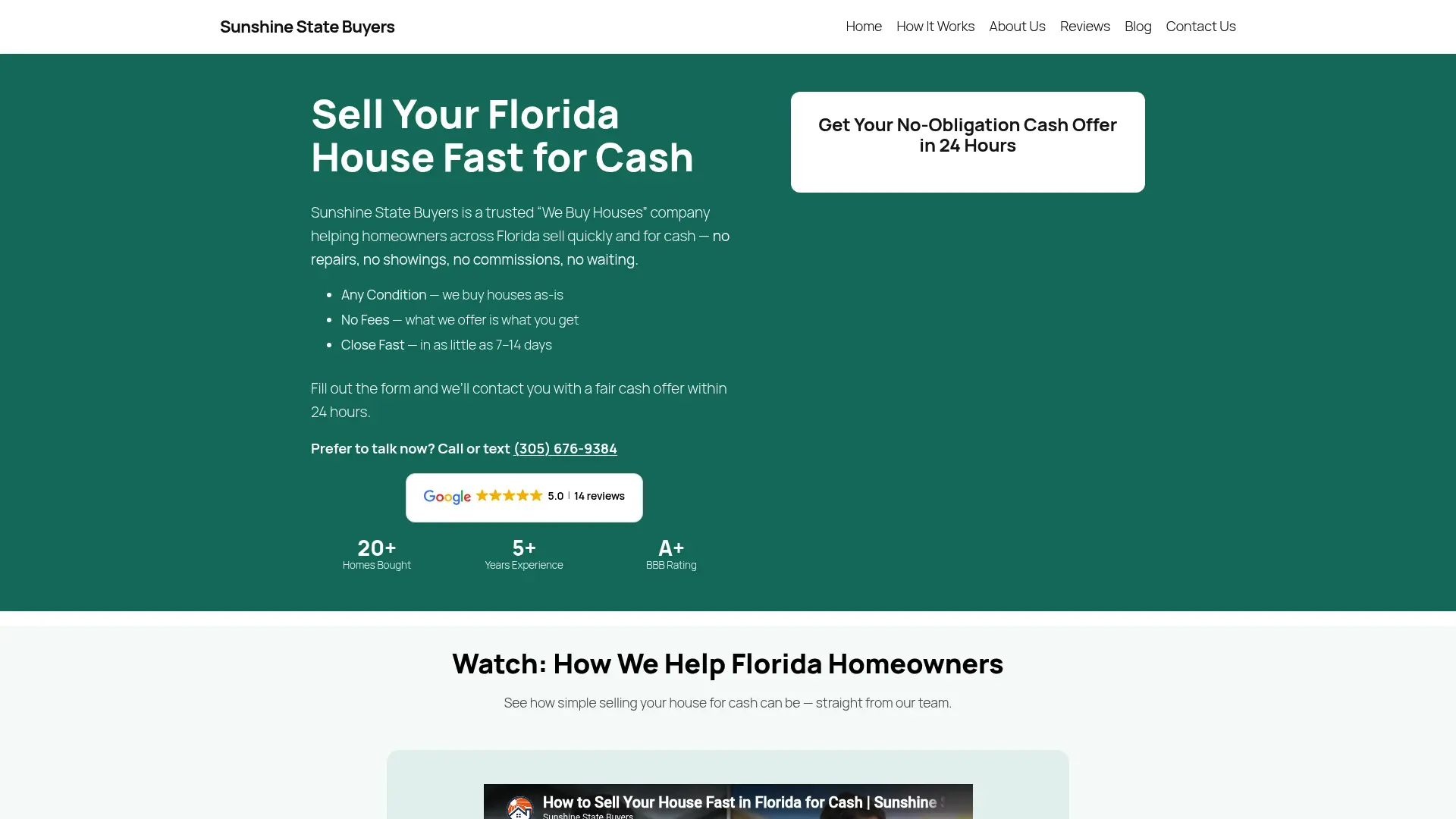
Getting started is simple. Request an offer and Sunshine State Buyers responds within 24 hours; if you accept, you pick a closing date that works for your timeline, often in as little as a week. If you’re weighing whether a cash offer will feel fair compared to a traditional sale, this breakdown walks through how offers get calculated. You can also verify the company’s standing through third-party review sites before moving forward. Start by requesting your no-obligation cash offer today.
This article is general information, not a substitute for advice from a qualified financial advisor. Consult a qualified financial professional about your own circumstances before acting on anything here.
Sources
- What Does Off-Market Mean In Real Estate? — Redfin
- What Is an Off Market Home Sale? How It Works for You — DealMachine
- Do Off-Market Home Sales Net Sellers More? | Imagine Marin
- Pocket listings really do sell for more — at least in Dallas — Real Estate News
- Sellers are pulling homes off market at fastest pace in years. Here’s why — ABC News
FAQ
Is It Cheaper to Buy a House Off-Market?
Not typically. Research on pocket sales found sellers netted about 1.7% more on average than comparable MLS sales, so buyers shouldn’t assume a private deal means a discount.
If a House Is “Off-Market,” Does That Mean It’s Sold?
No. “Off-market” just means the home isn’t publicly listed on the MLS right now; it could be sold, temporarily withdrawn, or being marketed privately to a select group of buyers.
Why Are Sellers Pulling Their Houses Off the Market?
Many are testing a lower interest-rate environment, avoiding a stale listing, or simply changing plans, and delistings have recently hit their fastest pace in years. Others withdraw to pursue a private buyer or a direct cash sale instead.
What Are the Cons of Off-Market Deals?
Buyers face fewer comparable sales for appraisal purposes and less certainty about disclosures. Sellers risk missing a bidding war that could have pushed the price higher, even though the average pocket-sale outcome tends to favor them.
How Fast Can a Cash Sale Close Compared to a Private Listing Sale?
A cash sale through a buyer like Sunshine State Buyers can close in 7 to 14 days once you accept an offer, while a privately negotiated financed sale usually takes 30 to 45 days for underwriting.
Recommended
- How Fast Can You Close in Miami Real Estate?
- Sell House With Tenants Miami: A Complete Guide
- How to Sell Your House Fast in Miami
This article was produced with AI assistance and reviewed for accuracy. It is provided for general information only and is not professional advice.

Leave a Reply