
Sell Your House Fast in Homestead — As-Is, For Cash
Storm-damaged home, an acreage or agricultural property, an inherited house, or one you’re behind on? We buy across Homestead, Florida City, Naranja, and the Redland as-is, for cash — no repairs, no fees, and we can work around an open insurance claim.
- Any condition — hurricane damage, acreage, or fixer-upper, we buy anyway
- Se habla español — talk to a real local person in your language
- Close fast — in as little as 7–14 days, on your timeline
Prefer to talk? Call or text (305) 676-9384


20+
Homes Bought
5+
Years Experience
A+
BBB Rating
Get a No-Obligation Cash Offer in 24 Hours
Watch: How We Help Florida Homeowners
See how simple selling your house for cash can be — straight from our team.
The Local Cash Buyer Who Knows Homestead
Almost everything written about selling a house in South Florida assumes an old house. Homestead is the exception, and it matters. The typical owner-occupied home here was built in 2004. More than half of the city’s housing — 55% of it — went up in 2000 or later, and only about a fifth of it predates 1980. Hurricane Andrew came ashore just east of here on August 24, 1992, and what you see today is largely what got built afterward: 10,505 homes in the decade 2000–2009 alone, roughly 38% of everything standing now. The city went from about 32,000 people in 2000 to more than 80,000 by 2020.
Which means the Homestead seller who calls us usually isn’t sitting on a 1960s fixer. They’re sitting on a twenty-year-old house that has just hit all of its firsts at once — first roof replacement, first AC replacement, first insurance company that doesn’t want to renew. Around that, the older realities still hold: this is the part of Florida that takes hurricanes head-on, and it’s a place of bigger lots, acreage, and agricultural land out toward the Redland — properties the typical financed buyer and their lender don’t quite know what to do with.
That’s exactly where a cash sale helps. We buy the homes the traditional market struggles with — storm-damaged, on acreage, needing work, or tied up in an insurance claim. We’re local to South Florida, we understand Homestead’s mix of homes and land, and we’ll give you a straight, honest answer about whether selling to us is really your best move.
Why Homestead Sales Stall — and How Cash Skips It
It’s rarely the house itself. It’s the paperwork behind it, and Homestead has its own rules that catch people out.
Homestead runs its own building department — not the county
This is the single most common mix-up we see, and it costs people weeks. Miami-Dade County’s building department serves unincorporated areas only. Homestead is an incorporated city with its own building official at 100 Civic Court, its own inspectors, and its own fee schedule adopted by City Council. So the county’s rules you found online may not be the rules that apply to your address — while a house a few minutes away in Leisure City, Naranja, Princeton or the Redland genuinely is under the county.
Work done without a permit gets expensive to legalize
An enclosed carport, a converted garage, a back bedroom that isn’t on the plans, a shed with power run to it — all extremely common here, and all of it surfaces the moment a buyer’s lender orders an appraisal. Under Homestead’s adopted fee schedule, when work started before the permit was pulled the city charges two times the normal permit fee plus $110 on a Homestead residential property. Expired permits have their own ladder: $100 to extend before expiration, 50% of the original permit fee if you’re within 180 days after, and the full fee again beyond that. Re-inspections run $75 the first time and $150 after.
None of that is the real problem. The real problem is time: closing the permit means drawings, a submittal, corrections, inspections that may require opening up finished work, and a certificate at the end. A financed buyer with a rate lock will not wait for it.
A code lien follows the owner, not just the lot
Florida law caps code enforcement fines at $250 a day for a first violation and $500 a day for a repeat, with up to $5,000 where a board finds the violation irreparable. Once an order is recorded it becomes a lien on the property — and, in the statute’s own words, on any other real or personal property owned by the violator. After three months unpaid, the local government may move to foreclose or sue for a money judgment. That is why waiting it out is usually the worst option: the number grows every single day, and the exposure isn’t limited to the house you were trying to sell.
On a 2004 house, the roof now decides whether your buyer can get insured
Florida law says an insurer cannot refuse to write or renew a homeowner’s policy solely because of roof age when the roof is under 15 years old. Past 15 years, the insurer has to let the owner pay for an inspection first, and still cannot refuse on age alone if that inspection finds five or more years of useful life left. Read it the other way round and you have Homestead’s problem: a roof past 15 that doesn’t pass can be declined — and a house built around 2004 on an original or first-replacement roof is sitting exactly on that line right now. No insurance means no mortgage. No mortgage means your buyer walks, usually late, after you’ve already made plans.
Flood sits on top of that. Homestead’s own flood page says it plainly: a homeowner’s policy does not cover flood damage. The city holds a CRS Class 7 rating, which earns a 15% discount on flood policies inside its Special Flood Hazard Areas, and new or substantially improved buildings have to sit a foot above base flood elevation. Whether your specific parcel is in a flood zone is a parcel-level question worth checking before you list.
Cash removes the whole chain
We buy with our own funds. No lender means no appraisal to come in low, no underwriter reading an inspection report, and no insurance binder that has to exist before anyone can close. The open permit, the roof, the code case — those become ours the day we take title. That’s the whole difference, and it’s why a Homestead house that has already lost two financed buyers can still close with us in a couple of weeks.
Homestead Situations We Buy Around
Whatever’s making the property hard to sell the normal way, we’ve probably handled it before.
Storm & Hurricane Damage
Roof damage, flooding, or an open insurance claim after a storm? We buy damaged homes as-is and can work around the claim. See our damaged house page.
Acreage & Agricultural Land
A property on acreage in the Redland, ag-zoned land, or a home on a large lot? These are hard to finance and slow to list — we understand them and buy as-is.
Inherited & Family Homes
A home passed down through the family, maybe in probate and full of belongings? We handle the cleanout and the timeline. See our inherited house page.
Facing Foreclosure
Behind on payments? You may still be able to sell before the auction and protect your equity and credit. See our stop foreclosure page.
Tired Landlords
Done with tenants, repairs, and thin margins on a Homestead rental? We buy occupied, tenants and all. See our rental property page.
Relocation or Just Ready
Moving out of the area, done with the commute, or simply ready to move on from a property that’s become a burden? We make it quick and simple.
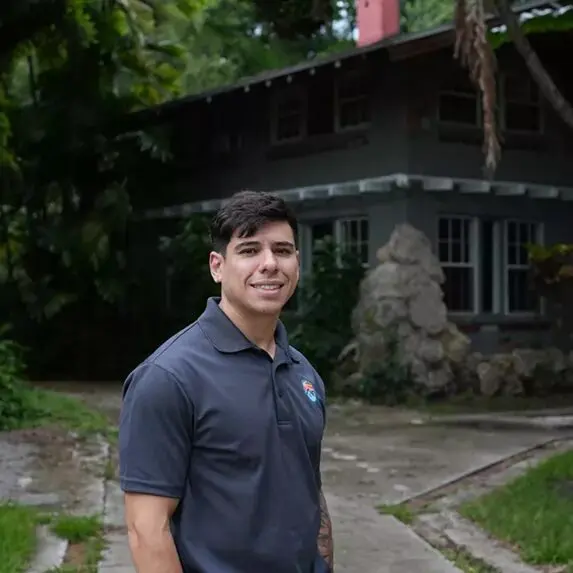
Meet David — A Local Who Knows South Dade
Hi, I’m David, founder of Sunshine State Buyers. I’m local to South Florida, and I know Homestead and South Dade — the storm seasons, the homes still carrying damage from the last big one, the acreage out in the Redland that a regular buyer can’t get financed. I’ve walked plenty of these properties, and I understand what makes them hard to sell the usual way.
When you call, you get a real local person — in English or Spanish. My promise is simple: a fair offer, explained honestly — and if listing with an agent or waiting out your insurance claim would net you more, I’ll tell you that instead of pushing you to sell.
As Featured In
“I try to be honest with people and tell them if there might be better routes to sell their house.”
— David Veras, featured in Miami New Times
What Local Homeowners Say
Real reviews from Florida sellers who chose Sunshine State Buyers for a fast, fair cash offer.


100%
Transparency
10+
Five-Star Reviews
20+
Homes Bought
5+
Years Experience
How It Works — Simple as 1-2-3
1
Tell Us About the Property
Share the property and your situation — in English or Spanish. No need to clean, repair, or fix a thing first.
2
Get Your Cash Offer
We look at the property honestly — damage, acreage, and all — and send a fair, no-obligation offer within 24 hours.
3
You Pick the Closing Date
Close in as little as 7 days, or take more time if you need it. We handle the paperwork and any claim details at closing.
Selling Acreage in the Redland or Outside the UDB
This is the transaction nobody outside South Dade understands — and the one where the wrong move costs real money.
First, the good news, because it’s the opposite of what most people are told: putting agricultural land on the market does not endanger its agricultural classification. Florida’s greenbelt statute says so in as many words — offering property for sale is not a use of the land, and it can’t be the basis for denying the classification, as long as the land is still genuinely being farmed while it’s listed.
What does end it is the deed. The Miami-Dade Property Appraiser removes the agricultural classification from any property whose ownership changed by recorded deed during the prior calendar year — and their guidance is explicit that this includes simply adding someone to the deed or moving the property into a trust. The new owner has to file a fresh application, and the deadline is March 1, measured against a January 1 assessment date with actual agricultural use in place by then. Miss that window and the classification is gone for the year. It also ends if the land is diverted to a non-agricultural use, or simply stops being farmed.
Then there’s the ceiling on what a buyer could ever do with it. Land outside Miami-Dade’s Urban Development Boundary can only be used as its Agriculture or Open Land designation allows until the county formally amends the boundary — and roughly 53,000 acres sit out there, averaging about 6.6 acres a parcel in the band Homestead falls into. A buyer who doesn’t farm and can’t build is a very small pool of people. That, honestly, is the argument for a cash sale on this kind of property: not that we’ll pay more than a developer would, but that the developer isn’t coming.
We’re buyers, not your tax adviser or attorney. Before you sign anything on a classified parcel, confirm where you stand with the Miami-Dade Property Appraiser’s office — the details are parcel-specific and the deadlines are unforgiving.
What We Buy in Homestead
- 2000s-built houses hitting their firsts — original roof, original AC, and an insurer that’s stopped renewing
- Homes with unpermitted or expired-permit work — enclosed carports, converted garages, additions that were never closed out
- Houses with an open code case or a recorded lien — we deal with it at closing rather than asking you to clear it first
- Acreage, groves, nurseries and classified agricultural land in the Redland and Silver Palm area
- Storm-damaged homes and open insurance claims — we can structure around the claim either way
- Inherited and probate properties, including ones still full of a lifetime of belongings
- Tenant-occupied rentals — existing leases honored, no eviction required
- Vacant houses that have been sitting, and homes that already lost a financed buyer
We buy inside Homestead city limits and across the unincorporated areas around it — Florida City, Leisure City, Naranja, Princeton, Goulds and the Redland. Worth knowing: those unincorporated addresses are under Miami-Dade County’s building department rather than the city’s, which changes the permit rules that apply to them.
What a Homestead Cash Sale Can Look Like
A simplified example for a Homestead home with storm damage and deferred repairs.
Value if fully repaired & move-in ready
$385,000
Storm repairs + roof + interior restoration
−$50,000
Closing, holding costs & our margin
−$35,000
Your cash offer, as-is
≈ $300,000
Illustrative only — every home is different. And if you have an insurance payout coming, that can change the picture in your favor. We’ll walk through your real numbers honestly.
Selling in Homestead — FAQs
Can I sell if my house still has storm damage or an open claim?
Yes. You don’t have to wait for the claim to settle or repair the damage first. We buy as-is and can structure the sale so the insurance proceeds go to you or are assigned to us — whichever nets you more. Our damaged house page explains exactly how we handle open claims.
Do you buy properties on acreage or agricultural land?
Yes. Homes on large lots, acreage in the Redland, and ag-zoned properties are exactly the kind of thing traditional financed buyers struggle with. We understand these properties and buy them as-is, land and all.
There’s work on the house that was never permitted. Is that a dealbreaker?
Not for us. Enclosed carports, converted garages, added rooms and powered sheds are everywhere in Homestead, and they’re one of the most common reasons a financed sale collapses. If you wanted to legalize it yourself, the city charges two times the normal permit fee plus $110 for work that started before the permit was pulled — but the bigger cost is the months of drawings, corrections and inspections. We buy the house with the work as it stands and take that on ourselves.
Will listing my Redland property for sale cost me its agricultural classification?
No — Florida’s greenbelt statute says offering land for sale is not a use of the land and can’t be the basis for denying the classification, as long as it’s still genuinely being farmed. What ends it is the recorded deed: Miami-Dade removes the classification when ownership changes, and the new owner has to reapply by March 1 against a January 1 assessment date. It’s parcel-specific, so confirm your own situation with the Property Appraiser’s office before you sign anything — we’re buyers, not tax advisers.
My insurer won’t renew because of the roof. Can I still sell?
Yes, and this is one of the clearest cases for a cash sale. Once a roof passes 15 years, an insurer can decline it if an inspection doesn’t find at least five more years of useful life — and a buyer who can’t get insured can’t get a mortgage. That chain doesn’t exist for us. We pay cash, so there’s no lender and no insurance binder standing between you and closing. The roof becomes ours the day we take title.
There’s a code enforcement lien on the property. Can you still buy it?
Usually, yes, and waiting rarely helps. Florida caps these fines at $250 a day for a first violation and $500 a day for a repeat, so the balance grows while you decide — and a recorded order can attach to other property you own, not only the house in question. Tell us what the case is and we’ll be straight with you about whether the numbers still work.
Do you buy in Florida City, Naranja, and the Redland too?
Yes. We buy throughout Homestead, Florida City, Naranja, the Redland, and the surrounding South Miami-Dade communities. Wherever your property is down here, we’ll take a look and make a fair offer.
¿Puedo vender mi casa si no hablo inglés?
Claro que sí. Puede manejar todo el proceso en español, de principio a fin. Hablará con una persona local que entiende su situación, y nos encargamos de la oferta, el papeleo y el cierre — sin traductores ni complicaciones.
How fast can you close?
Often in 7 to 14 days, or on a later date if you need more time. Because we pay cash, there’s no lender, no appraisal, and no financing to fall through — which is what makes fast, certain closings possible, even on damaged or acreage properties.
Nearby Areas We Buy In
We buy across Miami-Dade and the rest of Florida. Nearby: Miami · Hialeah · Doral · Miami Beach · Miami Gardens — plus Florida City, Naranja and Princeton. We also have dedicated pages for Cutler Bay, Coral Gables, Little Havana North Miami and Pembroke Pines. See every area on our service areas page.
How We Calculate Your Cash Offer
The number doesn’t come out of thin air. Every offer we make comes from the same four inputs, and we’ll walk you through all of them.
1. After-Repair Value
What the house would be worth fully repaired and updated — based on what comparable homes near you have actually sold for, not what they were listed at. This is the ceiling, and everything else comes out of it.
2. Repair Costs
What it will genuinely take to get the house there — roof, AC, plumbing, electrical, permits, cosmetics. We price it off real contractor quotes for the work your house actually needs, not a blanket percentage.
3. Selling & Holding Costs
Closing costs and title on both ends, plus taxes, insurance and utilities for every month we own it — and the agent commission we pay when we resell. These are the costs you avoid entirely by selling to us.
4. Our Margin
What’s left is what we make, and it has to cover the risk of buying a house as-is with our own money. It’s a thinner slice than most people expect — we’d rather do more deals at a fair number than a few at a bad one.
Add those together, subtract them from the after-repair value, and what remains is your offer. That’s the whole formula. It’s also why we can buy houses a lender won’t finance — and why, if listing with an agent would genuinely put more in your pocket, we’ll tell you so.
Want to check our math? Pull up three recently sold, renovated homes near you, get a repair estimate, and run the numbers yourself. If our offer doesn’t line up, we’ll say so.
Get a Fair Cash Offer on Your Homestead Home
Any condition, any situation — storm damage, acreage, an inherited property, or a house you’re behind on. Get a fair, no-obligation offer in 24 hours, in English or Spanish. And if another route would serve you better, we’ll tell you honestly.
