Tag: Selling Timeline

  • 7–14 Day Closings: Cash vs. Mediation Before Foreclosure in Florida

    7–14 Day Closings: Cash vs. Mediation Before Foreclosure in Florida

    Yes, selling your Florida home to a cash buyer can stop or resolve an impending foreclosure, as long as the sale closes before the auction date or the certificate of title is issued. Cash buyers typically close in 7 to 14 days, which makes this route faster than most loan modification talks with your servicer. You still have to meet court deadlines, especially the 20-day window to file an answer, and someone needs to coordinate the payoff with your lender before closing day arrives.


    TL;DR:

    • Selling your home quickly through a cash buyer is most effective if the sale closes within 7 to 14 days, preventing the auction or title issuance.
    • You must file an answer within 20 days of service to avoid default judgment and coordinate payoff details with your lender before closing.
    • Gathering all financial and property documents early, including proof of funds and clear title, is crucial to meet tight foreclosure timelines.
    • Cash offers generally range from 70 to 85 percent of market value, with red flags including upfront fees or lack of a named title company.
    • Consulting an attorney and securing written proof of deal terms are essential to avoid legal conflicts and obtain a possible continuance before auction.

    Sunshine State Buyers
    Explore A Faster Home Sale
    Sunshine State Buyers purchases Florida homes as-is, with cash offers within 24 hours and closing dates typically selected within 7, 14 days.

    Visit Sunshine State Buyers

    Table of Contents

    Quick Checklist: What To Do First When You Consider A Cash Sale

    Every day matters once a foreclosure complaint lands in your mailbox. Here’s the order that protects your options instead of closing them off:

    1. File an answer or call a foreclosure attorney within 20 days of being served. Missing this window risks a default judgment, which strips away your leverage to negotiate or sell on your own terms.
    2. Request an updated payoff statement from your servicer. Pull your deed, title records, property tax statements, HOA ledgers, and insurance documents while you wait.
    3. Get a fast market-value check. Compare that number against everything owed, mortgage balance, liens, back taxes, HOA dues, to see whether you have real equity or need a short sale instead.
    4. Reach out to vetted cash buyers and request written offers with firm closing dates. Never pay an upfront fee to get an offer; legitimate buyers don’t charge you to make one.
    5. Loop in your attorney. Have them handle sale documents and closing logistics alongside the court case.

    Pro Tip: Keep a dated folder, physical or digital, of every document you send or receive. If your closing needs to move fast to beat a sale date, having everything organized in one place can save you a full day of scrambling.

    If you’re behind on payments and unsure where to start, this step-by-step checklist for homeowners walks through the same priorities in more detail.

    Florida Foreclosure Timeline: Which Deadlines Actually Matter?

    Florida runs a judicial foreclosure process, meaning your lender has to sue you in court and win a judgment before your home can be sold at auction. That single fact changes everything about your timeline.

    • You generally have 20 days to file an answer after being served the complaint, under Florida Statutes Chapter 702.
    • An uncontested case can still take several months to over a year to resolve, but a default (failing to answer) accelerates everything toward judgment.
    • Once a judgment is entered, the sale is commonly scheduled within roughly 20 to 35 days, unless the court grants a continuance.

    Here’s the number that matters most: foreclosure practitioners report that a signed purchase agreement, presented promptly to lender’s counsel, can be enough to persuade them to postpone or cancel a scheduled auction when the sale will pay off the debt in full. Timing that request early, not the week of the sale, is what makes it work.

    If the auction is only days away, talk to your attorney about emergency options like a bankruptcy filing, which triggers an automatic stay that temporarily halts the sale, or a motion to continue. These are stopgaps, not solutions, but they can buy the days you need to close a sale properly.

    How Do You Sell Fast To A Cash Buyer, Day By Day?

    Selling during foreclosure isn’t complicated, but it is sequential. Skip a step and you lose days you don’t have.

    Days 0 to 2: Gather documents and get your numbers.
    Request the official payoff demand from your servicer. Collect your deed, most recent tax bill, HOA statements if applicable, and any insurance paperwork. At the same time, contact cash buyers and ask each one for a written offer along with proof of funds.

    Days 3 to 7: Vet buyers and sign.
    Confirm proof of funds and ask which title or escrow company will handle closing, this is a basic legitimacy check most sellers skip. Once you’re comfortable, sign a purchase agreement with a firm closing date. If the buyer’s title company needs to run a title search, provide access promptly so nothing stalls the file.

    Days 7 to 14: Clear title and close.
    The title company finalizes the payoff amount with your lender, resolves any outstanding liens, and prepares the closing statement. Funds move by wire or through escrow, and the deed gets recorded. At this point, an experienced buyer’s team can coordinate directly with the lender’s attorney to confirm the payoff amount and, when appropriate, request the sale be paused.
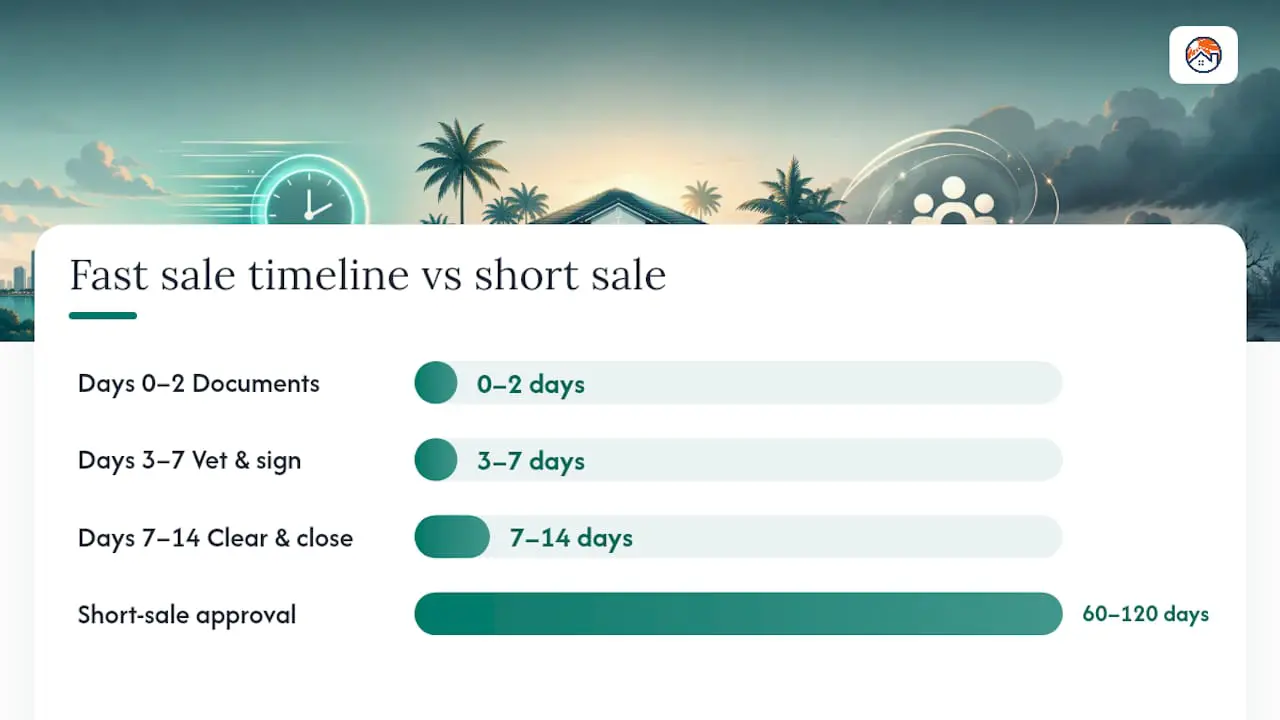
    Bar chart titled Fast sale timeline vs short sale: gathering documents 0 to 2 days, vetting buyers and signing 3 to 7 days, clearing title and closing 7 to 14 days, and short-sale approval 60 to 120 days

    If you owe more than the home is worth, expect a longer road. Short sales require lender approval and typically take 60 to 120 days to finalize, which is why cash buyers willing to work through short sale approval, rather than only buying homes with equity, are worth more to a homeowner racing a court date.

    Pro Tip: Ask any cash buyer point blank: “Have you closed a deal on a home in active foreclosure before?” Their answer, and how specific it is, tells you a lot about whether they can actually hit your deadline.

    How Do You Know If A Cash Offer Is Fair?

    An offer number by itself tells you very little. What matters is your net proceeds, the amount you actually walk away with after every deduction.

    • Ask for a written breakdown: offer price minus mortgage payoff, any liens, closing costs, and prorated taxes or HOA dues.
    • Understand the tradeoff going in. Cash offers for as-is sales often land in the 70 to 85 percent range of market value, and that discount is the price of speed, certainty, and skipping repairs entirely.
    • Watch for red flags: any request for an upfront fee, no named title or escrow company, pressure to sign a deed before closing, or a “sign today or the offer disappears” pitch.
    • Before you sign anything, ask for proof of funds, a firm closing date in writing, the title company’s name and contact, and a sample closing statement showing your estimated net.

    Pro Tip: If a buyer can’t name their title company or escrow agent within a day of asking, that’s not a paperwork delay, it’s a warning sign.

    Curious whether a specific offer holds up? This breakdown of common lowball tactics walks through exactly what a fair offer should look like on paper.

    What Should You Verify With An Attorney Before Selling?

    A cash sale doesn’t remove the legal case against you, it runs alongside it. A few checkpoints keep the two from colliding:

    • Confirm your answer was filed within the 20-day window; this alone can prevent a default judgment that undermines your ability to sell on your terms.
    • Ask your attorney to formally notify the court and opposing counsel about the pending sale, and to request a continuance if the closing date and the auction date are too close together.
    • Confirm the payoff procedure with your lender’s counsel, and ask whether a deficiency judgment (a court order requiring you to pay the difference if the sale doesn’t fully cover the debt) is possible in your case.
    • If the sale is set for days away, discuss emergency remedies like a bankruptcy stay with your attorney before you assume a private sale alone will stop it.

    Roughly 20 days is all Florida law gives you to respond once you’re served, which is why this conversation with counsel needs to happen in week one, not week three.

    Why A Fast Cash Sale Often Beats Waiting On Lender Talks
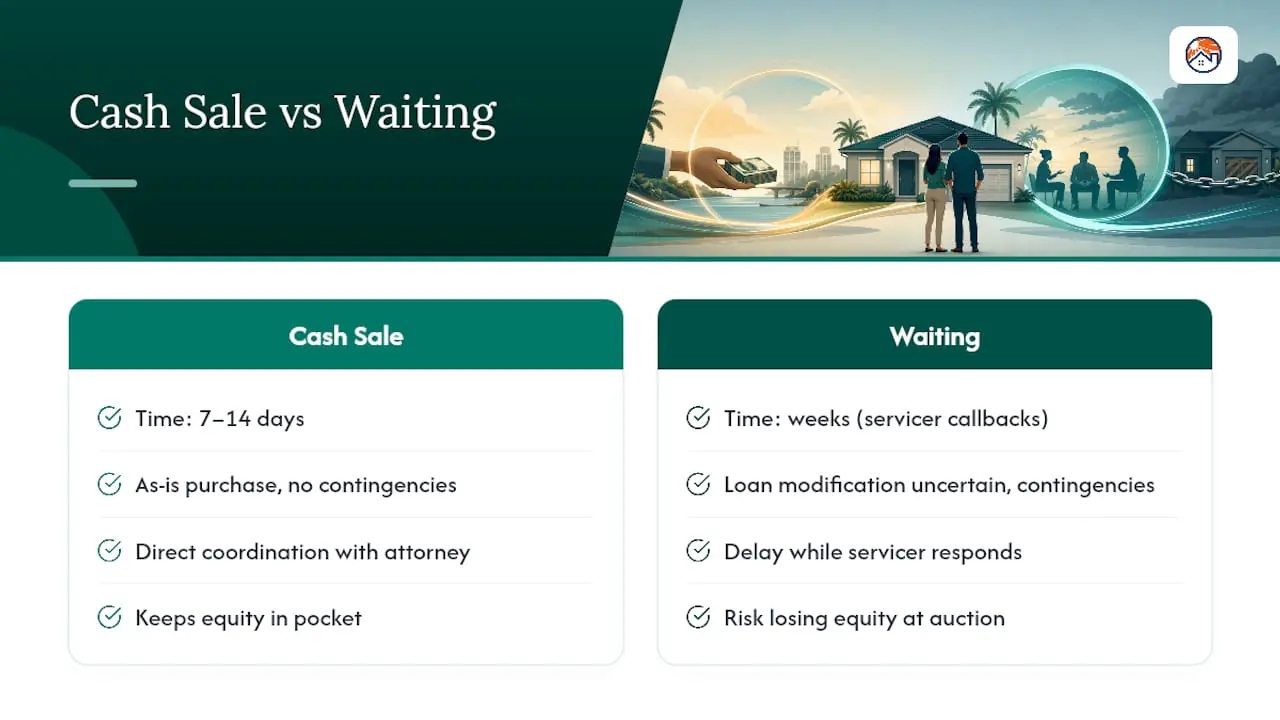
    Side-by-side comparison graphic, Cash Sale versus Waiting: a cash sale closes in 7 to 14 days as-is with no contingencies and direct coordination with your attorney, while waiting on a servicer means weeks of callbacks, an uncertain loan modification and the risk of losing equity at auction

    Homeowners spend weeks waiting on servicer callbacks, hoping for a loan modification that may never materialize. Sunshine State Buyers has watched that pattern play out across Florida for years, and the math rarely favors waiting. An A+ BBB rating and a track record of closings inside 7 to 14 days reflect a business built around one job: buying homes as-is, fast, without the contingencies that sink traditional sales. That speed, paired with direct coordination between the buyer’s team and your attorney, is often what keeps equity in your pocket instead of losing it at auction.

    None of that replaces legal advice. Always get attorney review before signing anything, and insist on written proof of funds and a firm closing timeline before you commit to any buyer.

    — David

    How Sunshine State Buyers Can Help You Move Fast

    If the deadlines above feel like they’re closing in, you don’t have to navigate them alone. Sunshine State Buyers gives Florida homeowners a direct path to a closed sale in days, not months, buying homes as-is, in any condition, with no repairs, no showings, and no commissions eating into your proceeds.
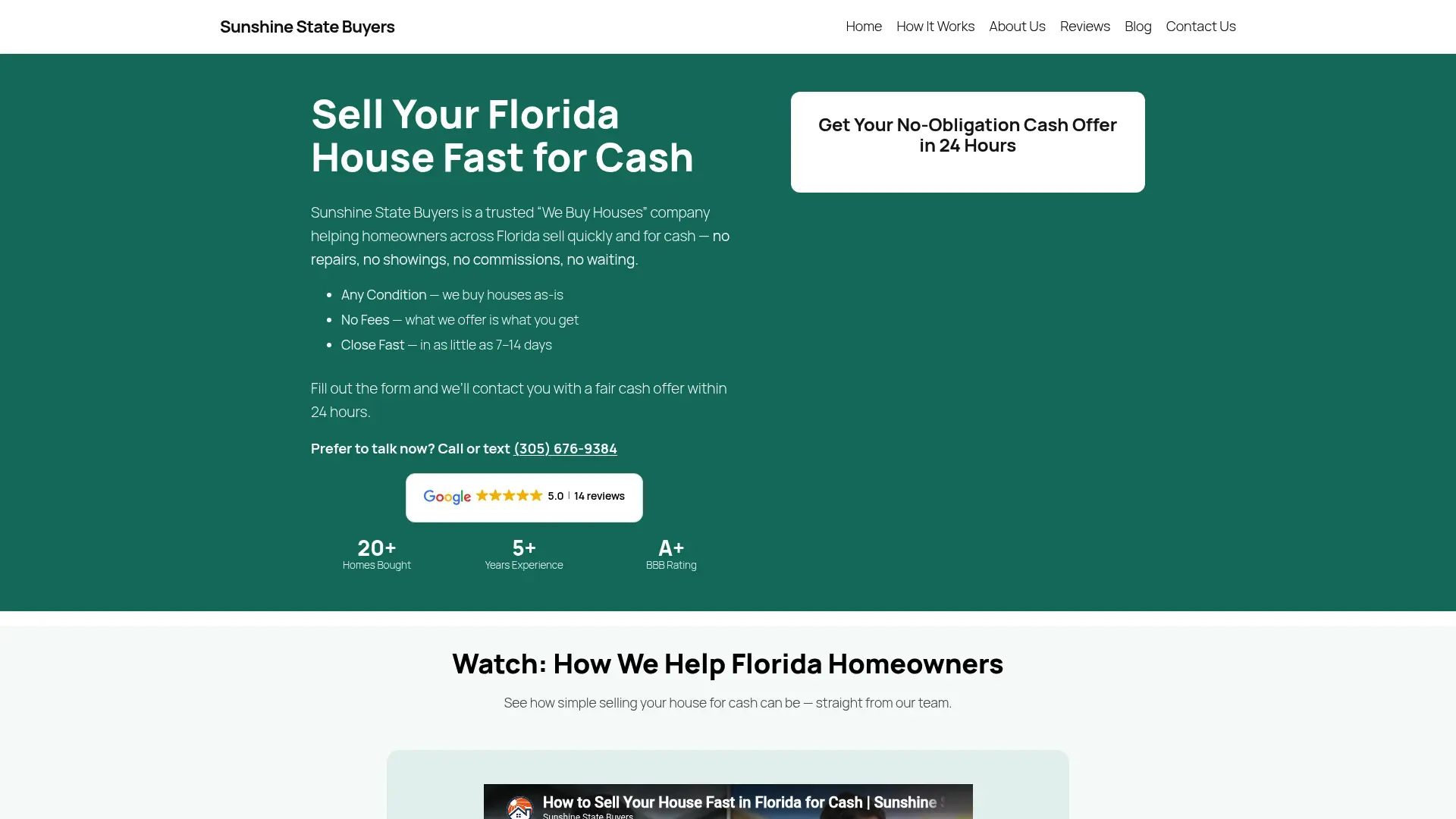
    Screenshot of the Sunshine State Buyers homepage, headlined Sell Your Florida House Fast for Cash, with a form to request a no-obligation cash offer within 24 hours

    You get a written cash offer within 24 hours of reaching out, and you pick the closing date, typically 7 to 14 days out, though the timeline flexes if your court date needs faster action. The next step is simple: call for a free, no-obligation consultation, gather the payoff and title documents from the checklist above, and let the team walk you through exactly how the process works from first call to closing table. There’s no pressure and no upfront cost to find out what your home is worth on your timeline, not the court’s.

    Sources

    This article is general information, not a substitute for advice from a qualified lawyer. Consult a qualified legal professional about your own circumstances before acting on anything here.

    FAQ

    Can I sell my house after a foreclosure lawsuit is filed?

    Yes. You can sell at any point before the sale is finalized, though you still need to answer the complaint within 20 days and coordinate the payoff with your lender before closing.

    How fast can a cash sale actually close in Florida?

    Most cash buyers, including Sunshine State Buyers, close in 7 to 14 days once a signed agreement and clear title are in place.

    Will selling for cash stop a scheduled auction?

    It can, if you present a signed purchase contract and proof of closing to your lender’s attorney early enough for them to request a continuance; waiting until days before the sale date makes this far less likely to work.

    What if I owe more than my home is worth?

    You’ll likely need a short sale, which requires lender approval and can take 60 to 120 days, so start that conversation with your servicer and a cash buyer as early as possible.

    Do cash buyers charge fees to make an offer?

    No legitimate cash buyer charges you an upfront fee for a written offer; if someone asks for money before closing, treat that as a serious red flag.

    This article was produced with AI assistance and reviewed for accuracy. It is provided for general information only and is not professional advice.

  • Act Fast: Florida Foreclosure Timeline and Cash Offers in 24 Hours

    Act Fast: Florida Foreclosure Timeline and Cash Offers in 24 Hours

    Florida judicial foreclosures typically run through circuit court and, in routine uncontested cases, the timeframe from first missed payment to certificate of title commonly takes about 12 to 18 months; contested or aggressively defended cases often take longer. The sale itself gets scheduled 20 to 35 days after final judgment, with a 10-day window to object before title transfers. Your most urgent move right now is contacting your servicer about loss mitigation, talking to a foreclosure attorney, or getting a cash offer on the table before a sale date locks in.


    TL;DR:

    • Most Florida foreclosures take about 12 to 18 months from missed payment to sale if uncontested, but heavily defended cases can extend beyond 24 months.
    • A 20 to 35-day window follows the final judgment for the sale, with a 10-day objection period before the certificate of title issues to the winning bidder.
    • Filing an answer within 20 days of service and acting early with loss mitigation or a quick sale significantly improves your chances to delay or stop a foreclosure.
    • The key deadlines are governed by statutes and rules such as Fla. Stat. § 45.031 for sale scheduling and Fla. R. Civ. P. 1.140 for answer timing.
    • Factors like court backlog, case complexity, contesting, and lender efficiency influence the case duration, with proactive homeowners gaining more options.

    Sunshine State Buyers
    Explore a Faster Way to Sell
    Sunshine State Buyers helps Florida homeowners sell as-is, receive a cash offer within 24 hours, and choose a closing date.

    Learn about selling your home

    Table of Contents

    How Long Is the Foreclosure Timeline in Florida?

    Florida is a judicial foreclosure state, which means your lender cannot simply take your house. Every case has to go through circuit court, and that court process is what creates the calendar you’re trying to understand. Here’s how the stages typically unfold, from the first missed mortgage payment to the day a new owner holds the certificate of title.

    1. Missed payment and servicer contact. Federal servicing rules generally require your servicer to reach out and provide loss-mitigation information within about 36 to 45 days of a missed payment, and most servicers cannot legally start foreclosure until you’re more than 120 days delinquent.

    2. Breach letter and acceleration. Your lender sends a formal notice of default, often called a breach or acceleration letter giving you a cure period commonly of 30 days to catch up before the loan is called due in full.

    3. Complaint filed and lis pendens recorded. The lender files a lawsuit in circuit court and records a lis pendens, a public notice attached to your property’s title that alerts anyone doing a title search that foreclosure is pending.

    4. Service of process and your 20-day answer window. Once you’re formally served, you have 20 days to file a response under Florida Rule of Civil Procedure 1.140. Missing this deadline is the single fastest way to lose your case by default.

    5. Discovery, mediation, and summary judgment. Contested cases move into discovery and sometimes court-ordered mediation, a phase that commonly adds 3 to 9 months. Many cases end here through a summary judgment motion rather than a full trial.

    6. Final judgment and sale. Once the court enters final judgment, Florida law sets the sale date between 20 and 35 days later. The clerk conducts the auction, and the winning bidder typically posts a 5% deposit that day, according to DefaultResearch’s overview of Florida foreclosure auctions.

    7. Certificate of sale, objection period, certificate of title. After the auction, there’s a 10-day window to object to the sale. If nobody successfully objects, the clerk issues the certificate of title, and ownership officially transfers.

    What Statutes and Court Rules Actually Set These Deadlines?

    Every date in your foreclosure case traces back to a specific statute or rule, and knowing them lets you check whether the notices you’ve received are actually on schedule.

    • Fla. Stat. § 45.031 governs the sale itself: the 20 to 35 day scheduling window, publication requirements, deposit rules, and the 10-day post-sale objection period before a certificate of title issues.
    • Chapter 702 covers the broader foreclosure procedure, including order-to-show-cause hearings and, in certain uncontested cases, expedited final judgment within 90 days from the close of pleadings.
    • Fla. R. Civ. P. 1.140 sets your 20-day answer deadline once you’re served.
    • Federal Regulation X requires servicer contact and loss-mitigation notices generally within 36 to 45 days of default, and bars foreclosure filing before 120 days delinquent in most cases.

    Statutory snapshot: A homeowner who is served on a Monday has until the following third Monday to file an answer. Miss it, and the court can enter a default judgment without ever hearing your side.

    Which Factors Make a Florida Foreclosure Faster or Slower?

    Four things drive how long your specific case takes, and understanding them helps you predict where you’ll land on the timeline.

    • Court backlog. Circuit courts in high-volume counties move slower than courts with lighter dockets, and this alone can add months regardless of anything you do.
    • Case complexity. Multiple liens, HOA disputes, or title defects require extra legal steps and extra time to resolve.
    • Whether you contest the case. Filing an answer, requesting discovery, and attending mediation all add time, but they also add leverage.
    • Lender and servicer efficiency. Some servicers move through paperwork quickly and have clean standing to foreclose; others get delayed by their own documentation gaps.

    Based on these factors, routine uncontested cases often wrap up in roughly 12 to 18 months, routine contested cases run similarly at 12 to 18 months, and heavily defended or legally complex cases commonly stretch past 24 months.

    Pro Tip: Your own responsiveness often matters more than how aggressive your lender is. A homeowner who files an answer, negotiates in mediation, and shows up to hearings usually gets more time and more options than one who ignores the mail.

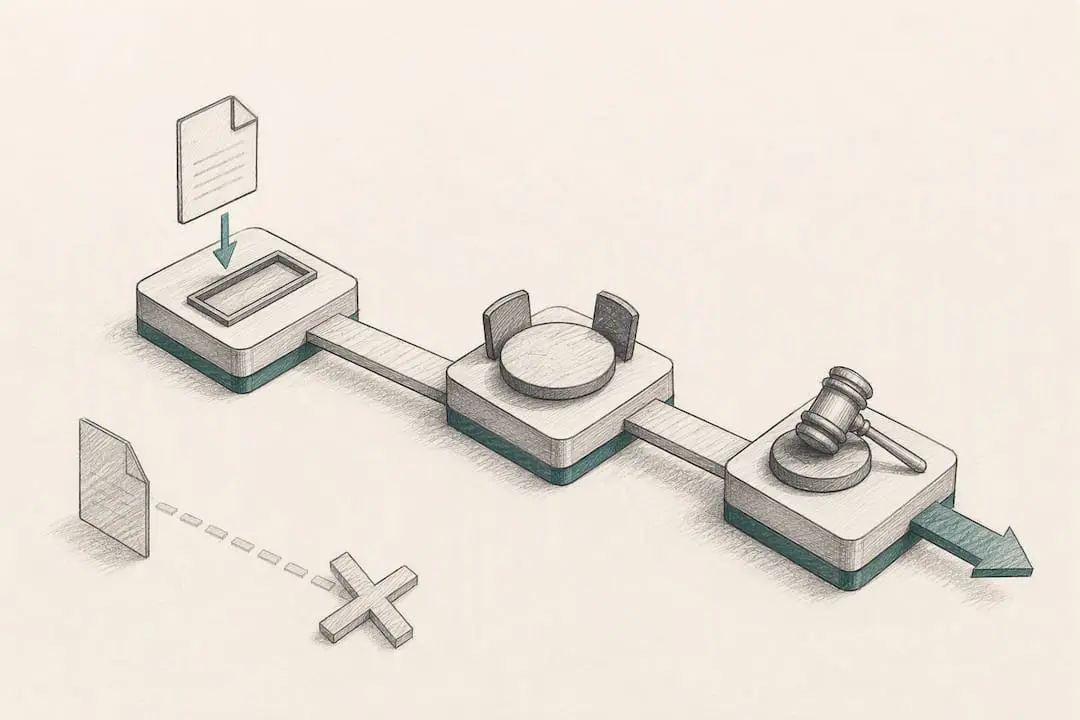
    Isometric sketch of a foreclosure response pathway: a filed document moves along a track from an intake tray to a round mediation table to a judge's gavel and out the far side, while a second document branches off on a dashed line to a large X

    What Are Your Options for Stopping or Delaying a Sale?

    You have real choices at nearly every stage, and the earlier you act, the more of them stay open.

    1. Apply for loss mitigation. Ask your servicer about a loan modification or forbearance as soon as you miss a payment. You’ll need proof of income, a hardship letter, and recent bank statements.
    2. Use mediation and consider a short sale. Court-ordered mediation, when available, is often where loan modifications and short sales actually get worked out, according to foreclosure defense timeline research.
    3. File bankruptcy if it fits your situation. Chapter 7 typically pauses a sale for a few months through the automatic stay; Chapter 13 can delay it considerably longer while you catch up on payments through a repayment plan, though both carry credit and cost tradeoffs worth discussing with an attorney.
    4. Sell to a cash buyer. If you’re close to a sale date, don’t have the time or money for repairs, or you’re dealing with a rental property with tenants, selling directly for cash can close before the auction ever happens.

    What to gather now, regardless of which path you choose:

    • Your mortgage statement and loan number
    • Any breach letters or court papers you’ve received
    • Recent tax and homeowners insurance statements
    • Government-issued ID and proof of ownership

    Why Most Homeowners Lose Time They Didn’t Have to Lose

    The biggest mistake isn’t falling behind on payments. It’s what happens after: letting breach letters and court summonses pile up unopened, or assuming there’s more time than the calendar actually allows. A missed 20-day answer deadline can end your case before you’ve made a single decision.

    Acting early, whether that means answering the lawsuit, applying for loss mitigation, or lining up a fast sale, keeps every option on the table. Waiting closes them one by one. Verify your actual deadlines against the statutes, talk to a foreclosure attorney or housing counselor, and if a quick sale makes sense for your situation, talk to a buyer you trust before the court sets your date.

    How Sunshine State Buyers Can Help You Beat the Clock

    Some cash home buyers provide fast offers often within 24 hours, instead of leaving you guessing while your court date approaches. That speed matters when a sale is already scheduled and every week counts.

    Sunshine State Buyers

    Cash home buyers purchase homes as-is, including houses needing repairs, rentals with tenants, or inherited properties that you don’t want to manage. Selling as-is to a cash buyer can avoid showings, agent commissions, and financing delays. Closings can often occur quickly, sometimes within one to two weeks, with sellers able to choose their closing date. Some companies hold high ratings with the Better Business Bureau and operate statewide, with experience assisting homeowners facing tight deadlines.

    If your sale date is approaching or you need to explore options before the court moves forward, consider obtaining a no-obligation cash offer. Start by visiting the Stop Foreclosure Florida guide to see what a direct sale could look like for your specific timeline, and have your mortgage statement and any court paperwork ready when you call.

    Where to Verify These Deadlines Yourself

    This article is general information, not a substitute for advice from a qualified financial advisor. Consult a qualified financial professional about your own circumstances before acting on anything here.

    Sources

    FAQ

    What is the 120-day rule for foreclosure?

    Federal servicing rules generally prohibit your mortgage servicer from starting foreclosure until you’re more than 120 days past due, giving you a window to pursue loss mitigation before legal proceedings begin.

    How long can you go without paying your mortgage before foreclosure starts in Florida?

    Most servicers wait until you’re past the 120-day mark before filing, though the breach letter and cure period notices typically start showing up much earlier, often around 36 to 45 days after your first missed payment.

    How long after foreclosure do I have to move in Florida?

    Once the clerk issues the certificate of title, the new owner can begin eviction proceedings, which commonly gives occupants a matter of weeks rather than months to vacate, depending on how quickly the new owner files.

    Do I still owe money after a foreclosure in Florida?

    Possibly. If the sale price doesn’t cover your full loan balance, the lender can pursue a deficiency judgment for the difference, though selling before the sale date, such as through a direct cash sale, avoids that risk entirely.

    This article was produced with AI assistance and reviewed for accuracy. It is provided for general information only and is not professional advice.

  • 1031 Timing in Florida: Why 7–14 Day Cash Sales Break 45/180 Rules

    1031 Timing in Florida: Why 7–14 Day Cash Sales Break 45/180 Rules

    Yes, you can sell a Florida property fast for cash, and the numbers back it up. Most cash buyers respond with an offer within 24 to 48 hours of a request, and when the title is clean, closings typically wrap up in 7 to 14 days. This path fits homeowners facing foreclosure, heirs sorting out an inherited estate, landlords stuck with difficult tenants, and anyone who needs to relocate on short notice.


    TL;DR:

    • Cash offers in Florida typically range from 70% to 95% of market value, depending on property condition and urgency of the sale.
    • A 7 to 14 day closing is achievable with a clean title and immediate documentation, while delays often stem from title issues or probate.
    • Preparing documents early, using electronic signatures, and coordinating timelines can significantly reduce closing times by up to a week.
    • The 45-day identification and 180-day closing rules for 1031 exchanges require proactive planning, especially when sales close in 7 to 14 days.
    • Verifying proof of funds and the title company’s track record before signing ensures a smoother, faster transaction.

    Sunshine State Buyers
    Explore a Faster Florida Sale
    Sunshine State Buyers purchases Florida homes as-is, with cash offers within 24 hours and closing dates selected around your needs.

    Visit Sunshine State Buyers

    Table of Contents

    How Fast Is a Florida Cash Home Sale, Really?

    Not every sale moves at the same speed, and knowing which bucket your property falls into helps you set realistic expectations before you start.

    A 7 to 14 day close is the fast lane, and it’s achievable more often than sellers assume. It requires a clean title, no outstanding liens, and a seller who can produce mortgage payoff details and ownership documents right away. Cash buyers can skip the appraisal and mortgage underwriting steps that typically stall traditional sales, which is the main reason this window is realistic at all.

    14 to 21 days is the more common range for a “smooth” cash deal, and title company scheduling is usually the reason. Title searches typically take about two weeks to complete, and if the title company handling your closing has a backlog, that timeline stretches even when nothing is wrong with the property itself.

    More than a month is common when there’s a real complication. That includes:

    • Probate proceedings that haven’t cleared yet
    • Existing liens or judgments attached to the property
    • Out-of-state heirs or co-owners who need to sign remotely
    • Title defects that require a formal cure before closing

    Even in these cases, a cash buyer can still help. They just need extra lead time to coordinate signatures, verify legal standing, and resolve outstanding claims before the deed transfers.

    What Actually Happens During a Florida Cash Sale?

    The process is more linear than most sellers expect, and knowing the sequence helps you avoid surprises.

    1. Submit your property information. You’ll typically provide the address, a general description of the home’s condition, your remaining mortgage balance (if any), and any known title issues, like a lien or an open permit.
    2. Receive a written offer. Most cash buyers respond within 24 to 48 hours, often using Florida’s standard As-Is Residential Contract for Sale and Purchase. You pick the closing date; there’s no financing contingency to negotiate around.
    3. Inspection period (if included). Some contracts include a short inspection window, but As-Is deals rarely require repairs. The buyer is agreeing to purchase the home in its current condition.
    4. Title search and escrow. The title company confirms ownership, checks for liens or judgments, and prepares the closing documents. This step is where most of the timeline variability comes from.
    5. Closing. You sign the deed, the buyer wires funds, and ownership transfers. Many title companies now support remote online notarization, which matters if you live out of state or can’t make it in person.

    Pro Tip: Gather your mortgage payoff statement, property tax bill, and HOA contact information before you request an offer. Handing this over on day one instead of day ten can shave a full week off your closing.

    Cash Offer or Full Market Price? What You’re Really Trading

    Speed has a cost, and it’s worth seeing the number before you decide it’s worth it.

    Cash offers in Florida commonly land between 70% and 95% of market value, depending on the buyer, the property’s condition, and how quickly you need to close. A home in good shape with a clean title tends toward the higher end. A property with deferred maintenance, code violations, or a complicated title sits lower, because the buyer is pricing in the work and risk they’re taking on.

    What you save by skipping the traditional route:

    • No real estate agent commission.
    • No repair costs or staging expenses before showings
    • No mortgage contingency risk, meaning the deal doesn’t collapse over an appraisal gap
    • No weeks of open houses and buyer negotiations

    What you still pay, even in a cash deal, includes documentary stamp tax required under Florida law, prorated property taxes, and payoff of any existing liens.

    Quick math: on a home worth $300,000, a cash offer at 80% of value is $240,000. Skip a 6% commission ($18,000) and $8,000 in typical repairs, and your net proceeds gap versus a traditional sale narrows to roughly $34,000. For a seller facing foreclosure or juggling an out-of-state estate, that gap often buys real peace of mind.

    How to Shave Days Off Your Closing Timeline

    If speed is your top priority, a few upfront moves make a real difference.

    1. Pull your documents together first. That means a government ID, your mortgage payoff quote, the most recent property tax bill, and HOA contact information if applicable.
    2. Get ahead of title issues. Providing your payoff details and any lien information upfront lets the title company start clearing them immediately instead of discovering problems mid-process.
    3. Agree to electronic signatures. Remote online notarization is widely accepted in Florida and eliminates the scheduling back-and-forth of in-person closings.
    4. Coordinate tenant access early. If the property is occupied, confirm access windows for inspection or walkthrough before the buyer asks.
    5. Confirm your closing date availability now. Knowing exactly when you can sign avoids a last-minute delay on the buyer’s side.

    Pro Tip: If you’re managing this from out of state, tell your title company on day one. Many can prep remote signing packages in advance, which prevents a two-day delay from becoming a two-week one.

    Because title company workload is the biggest variable in most cash deals, the fastest sellers are the ones who remove every piece of friction they control before the process even starts.

    What Slows Down Florida Closings, and Who Absorbs the Risk?

    Most delays trace back to one of a few recurring problems, and each has a typical fix.

    • Title defects like old liens, unresolved judgments, or a break in the chain of ownership usually take one to three weeks to cure, depending on how far back the issue goes.
    • Probate delays are common with inherited property. If the estate hasn’t cleared probate, a cash buyer may still proceed but often needs the personal representative’s authority documented before closing.
    • Insurance and inspection problems matter more than sellers expect. A failed 4-point inspection on an older home can prevent a financed buyer from securing insurance, which stalls or kills a traditional sale entirely. Cash buyers aren’t relying on a lender’s insurance requirement, so this obstacle mostly disappears.
    • Disclosure obligations still apply. Florida law requires sellers to disclose known defects even in an As-Is sale, so title company workload aside, honesty here protects you from post-closing disputes.

    Before signing with any cash buyer, ask directly who absorbs title risk if a problem surfaces after the contract is signed.

    Why Sunshine State Buyers Can Be the Fast Option, and What to Verify First

    Sunshine State Buyers is built around the timeline sellers in a hurry actually need: written offers typically within 24 hours, and closings commonly finished in 7 to 14 days. The company holds an A+ Better Business Bureau rating, which matters in an industry where marketing promises don’t always match reality.

    Before signing with any cash buyer, including this one, ask for proof, not just promises:

    • Evidence of funds showing the buyer can actually close
    • A sample closing timeline from a recent, comparable transaction
    • The name of the title company they plan to use
    • References or a documented track record you can verify independently

    A buyer confident in their process will hand over this information without hesitation. If you’re dealing with an inherited home specifically, Sunshine State Buyers’ guidance for heirs covers the probate wrinkles that most general advice skips.

    The 45-Day and 180-Day Rules That Govern Exchange Timing

    A 1031 exchange runs on two fixed clocks, and missing either one collapses the entire tax-deferred structure. From the day your relinquished property closes, you have exactly 45 calendar days to formally identify a replacement property in writing, and 180 calendar days total to close on it. There is no flexibility built into either number, and no extension for weekends, holidays, or a slow closing.

    Florida investors face a specific timing pressure here: the state’s fast-moving cash-sale market often produces closings in 7 to 14 days, which is good news for speed but bad news for exchange planning if you haven’t lined up a replacement property strategy in advance. The 45-day clock starts the moment your sale closes, not when you decide to pursue an exchange, so a quick sale without a plan already in motion eats into your identification window fast.

    Florida’s lack of a state income tax doesn’t exempt you from the federal capital gains and depreciation recapture taxes a 1031 exchange defers, so the incentive to get the timing right is just as strong here as anywhere else. The 180-day period runs concurrently with, not after, the 45-day identification window, meaning both deadlines are counted from the same closing date on your original property.

    Where Investors Get the Timing Wrong

    The most common mistake is treating the 45-day identification period as a soft target instead of a hard deadline. Investors who wait to see how their sale proceeds before searching for a replacement property routinely run out of runway, especially in competitive Florida markets where good inventory moves quickly.

    A second frequent error involves identifying a property on paper within 45 days but failing to close within the full 180-day window because financing on the replacement property falls through. The IRS doesn’t grant leniency for a stalled loan approval; the exchange fails regardless of the reason for the delay.

    Sellers also underestimate how quickly a fast Florida cash sale can work against them. Closing your relinquished property in 7 to 14 days feels like a win, but if you haven’t already lined up qualified intermediary paperwork and started scouting replacement properties, that speed compresses your identification window rather than giving you breathing room.

    Another overlooked pitfall: naming too many replacement properties without following IRS identification rules correctly, or naming a property you can’t realistically close on within 180 days. Overreaching on the identification list, hoping one option works out, often backfires when none of them close in time.

    The fix for all of these is the same. Start replacement property research before your relinquished property even goes under contract, and build your closing timeline backward from day 180, not forward from day one.

    Illustration headed "Common timing mistakes" with two cards. Do: research replacements before listing, build the closing timeline backward from day 180, line up qualified intermediary paperwork early. Avoid: treating 45 days as a soft target, waiting to search until the sale completes, relying on unresolved replacement financing, naming too many unrealistic properties.

    Building a Timeline That Works With a Fast Florida Sale

    A fast cash sale and a compliant exchange aren’t in conflict, but they only work together with sequencing planned before you sign anything.

    Start by engaging a qualified intermediary before your relinquished property closes, not after. This is a hard requirement, not a formality, and it has to happen before you receive any sale proceeds.

    Next, begin searching for replacement properties in parallel with your sale process rather than waiting for closing day. Since a Florida cash sale can close in as few as 7 to 14 days, that compressed timeline means your 45-day identification clock starts almost immediately after you accept an offer.

    A practical sequence looks like this: identify likely replacement candidates while your sale is under contract, finalize your qualified intermediary agreement before closing, close your relinquished property, formally identify your replacement property or properties in writing within 45 days, and complete due diligence and financing on the replacement property with enough runway to close well before day 180.

    Illustration of a "Fast Florida 1031 Timeline" with five milestones: before close, engage a qualified intermediary and start searching; day 0 to 14, the cash sale closes; day 45, identify replacements; day 150, target buffer deadline; day 180, close on the replacement.

    Building in a buffer matters more than most guides admit. Financing delays, appraisal issues, or a seller backing out on your replacement property can eat weeks you don’t have if you’re already close to the deadline. Treat day 150 as your real target, not day 180, and you’ll have room to recover if something goes wrong on the replacement side.

    The Qualified Intermediary’s Role in Florida Exchanges

    A qualified intermediary is not optional. Federal tax rules require that exchange proceeds pass through this third party rather than through your own hands, and touching the money directly, even briefly, disqualifies the entire exchange.

    In Florida, qualified intermediaries typically operate through title companies, escrow firms, or dedicated exchange facilitation companies. Unlike some states, Florida doesn’t impose additional licensing requirements on intermediaries beyond federal rules, so vetting the intermediary’s track record and bonding is entirely on you as the investor.

    The intermediary’s core responsibilities include holding the sale proceeds in escrow, preparing the exchange agreement documentation, tracking your 45-day and 180-day deadlines, and disbursing funds to acquire the replacement property once you’ve identified it correctly. A competent intermediary also flags identification rule violations before they become a problem, rather than after the IRS does.

    Choosing an intermediary early, ideally before you even list the relinquished property, gives you a partner who can advise on realistic timing given how fast Florida cash sales tend to move. Waiting until after closing to find one is a common and costly mistake, since some intermediaries won’t take on an exchange that’s already past its sale date.

    What Happens if You Miss a 1031 Deadline

    Missing either the 45-day identification deadline or the 180-day closing deadline disqualifies the entire exchange, with no partial credit for having done everything else correctly. The transaction reverts to a standard taxable sale, and you owe capital gains tax and depreciation recapture on the full gain in the year the sale closed.

    There is no Florida-specific extension, waiver, or penalty relief tied to the state itself, since 1031 exchanges are governed entirely by federal tax code. The only recognized extensions come from IRS disaster relief declarations, which have occasionally applied to Florida counties after major hurricanes, giving affected investors additional time to complete pending exchanges.

    Outside of a formal disaster declaration, there’s no appeal process for a missed deadline caused by a slow closing, a financing delay, or a change of heart on a replacement property. This is precisely why building buffer time into your plan, rather than targeting day 45 and day 180 exactly, protects investors from a costly and irreversible mistake.

    Coordinating Your Sale and Purchase Without Blowing the Deadline

    The core challenge is sequencing two closings that don’t naturally want to line up. Your Florida property sale might move in 7 to 14 days, while a replacement property purchase, especially one involving financing, can take 30 days or longer to finalize.

    The most reliable approach is decoupling the search from the clock. Start touring and making offers on replacement properties while your relinquished property is still under contract, so you’re not starting your 45-day search from zero the day your sale closes. Line up financing pre-approval on the replacement side early too, since loan underwriting delays are one of the most common reasons investors blow through day 180.

    If your relinquished property sale is genuinely fast, coordinate with your qualified intermediary on exact closing dates before you sign anything, so the exchange clock starts on a day you’ve planned around rather than a day that catches you off guard.

    Ready to Request a No-Obligation Cash Offer?

    If the timing conversations above have you leaning toward speed, here’s exactly what happens next. Send Sunshine State Buyers the property address, a brief description of its condition, your remaining mortgage balance, and photos if you have them handy. That’s the full list, no lengthy application required.

    Screenshot of the Sunshine State Buyers homepage, headlined "Sell Your Florida House Fast for Cash", with a no-obligation 24-hour cash offer form.

    Most sellers hear back with a written offer within about 24 hours, and closings commonly finish in 7 to 14 days once you accept. You choose the closing date, and there’s no repair list, no showings, and no commission coming out of your proceeds. If you’re managing an inherited property from out of state or juggling a tenant situation that’s dragging on, this is the route that removes the guesswork: see how the process works from offer to closing table.

    For homeowners specifically weighing whether a cash offer is fair given today’s market, it’s worth reading what a realistic cash offer looks like before you compare numbers. When you’re ready, reach out with your property details and get your no-obligation offer started today.

    When Speed Should Beat Price

    Here’s the honest framing most articles skip: a cash sale is the right move when the cost of waiting exceeds the discount you’re accepting. If you’re facing a foreclosure deadline, an estate that needs to close before probate complications multiply, or a tenant situation draining your patience and your bank account, a 20% or even 30% discount off market value can still leave you ahead once you account for months of carrying costs, legal fees, or lost equity.

    Where I’d push back on conventional wisdom: too many sellers treat “getting full market value” as the default correct answer, when it’s really just the default slower answer. Speed has a price, but so does time.

    Whatever buyer you choose, verify their documentation before you sign anything. Ask for proof of funds and a real closing timeline from a past deal, not just a promise. If your situation calls for speed, Sunshine State Buyers is worth a direct conversation and a same-day quote.

    — David

    Sources

    FAQ

    How Fast Can You Sell a House for Cash in Florida?

    Most cash buyers provide a written offer within 24 to 48 hours, and closings on properties with a clean title commonly finish in 7 to 14 days.

    What Slows Down a Florida Cash Home Sale?

    Title defects, unresolved liens, probate on inherited property, and insurance issues on older homes are the most common reasons a closing stretches past 14 days.

    Do Cash Buyers Pay Less Than Market Value?

    Yes, typical cash offers fall between about 70% and 95% of market value, with the exact number depending on the property’s condition and how quickly you need to close.

    What Documents Do I Need to Sell My House Fast for Cash?

    You’ll generally need a government ID, your mortgage payoff statement, your most recent property tax bill, and HOA contact information if the property has an association.

    Is Sunshine State Buyers a Legitimate Cash Home Buyer in Florida?

    Sunshine State Buyers holds an A+ Better Business Bureau rating and typically provides offers within 24 hours with closings in 7 to 14 days, though you should still request evidence of funds before signing.

    This article was produced with AI assistance and reviewed for accuracy. It is provided for general information only and is not professional advice.

  • Find Florida Elevation Certificates Fast Using the 30 Day Rule

    Find Florida Elevation Certificates Fast Using the 30 Day Rule

    If your Florida property sits in a high-risk flood zone, was newly built, or recently underwent a substantial improvement, you likely need an elevation certificate, and your fastest path forward is checking the FDEM portal or your county floodplain office before paying for a new survey. Since 2023, Florida Statute 472.0366 has required surveyors to submit these certificates digitally within 30 days of completion, so more records are searchable than ever. If no certificate turns up, your next move is hiring a Florida-licensed Professional Surveyor and Mapper.


    TL;DR:

    • Over 2023, Florida law requires surveyors to submit elevation certificates digitally within 30 days, making records more accessible in the FDEM portal.
    • Elevation certificates are needed mainly for new construction, substantial improvements, lender requirements, and flood zone map amendments.
    • Searching county records and the FDEM portal should be your first step before hiring a licensed surveyor for a new elevation certificate.
    • Costs range from a few hundred dollars with a typical turnaround of three to seven days, with higher fees possible for complex or remote sites.
    • Updating or correcting an existing certificate requires re-surveying by a licensed Professional Surveyor and Mapper and re-submitting the data within 30 days.

    Sunshine State Buyers
    Sell Your Florida Home As Is
    Sunshine State Buyers helps Florida homeowners sell quickly for cash, without repairs, showings, or agent commissions.

    Table of Contents

    What Is an Elevation Certificate in Florida?

    An elevation certificate is a standardized FEMA form that documents how high your building’s lowest floor sits relative to the base flood elevation for your area. It also records the lowest adjacent grade around the structure, the foundation type, and details like whether machinery or equipment sits below the flood level. This document forms the backbone of how flood insurance providers evaluate risk and how local floodplain managers confirm your property meets construction rules.

    The measurements on the form serve three main purposes:

    • Determining flood insurance premiums through the National Flood Insurance Program
    • Proving compliance with local floodplain ordinances during permitting
    • Supporting Letter of Map Amendment (LOMA) or LOMR-F applications that can remove a property from a mapped flood zone

    Here’s a misconception worth clearing up: an elevation certificate doesn’t set your insurance rate by itself. It’s a data document. Insurers use those numbers, particularly the gap between your first floor height and the base flood elevation, as a deciding factor in qualifying for premium discounts, but the rate calculation itself happens on the insurer’s side using that data plus other underwriting variables.

    When Do You Actually Need One?

    Not every Florida home needs an elevation certificate, but a surprising number of situations call for one. Here are the most common triggers:

    • New construction or substantial improvement in any Special Flood Hazard Area (Zones A and V on your flood map)
    • Lender requirements, since many mortgage companies request one before closing on a property in a mapped flood zone
    • Insurance underwriting, where your agent needs current elevation data to quote or renew a policy accurately
    • LOMA or LOMR-F applications, where you’re trying to prove your property sits above the base flood elevation despite its mapped zone
    • Local permitting, since some counties require one as part of the certificate of occupancy process for new builds

    Local ordinances and lender policies vary by jurisdiction, so it pays to confirm requirements with your county floodplain manager rather than assume statewide uniformity. Even outside these triggers, having a current EC on file carries real strategic value. It gives future buyers, lenders, and insurers a clear, documented answer to a question they’ll ask anyway, and that can smooth a sale or refinance considerably down the road.

    How to Find an Existing Elevation Certificate Before You Order a New One

    Paying for a fresh survey when a valid certificate already exists on your property is money down the drain. Work through these sources in order before hiring anyone new.

    1. Search the FDEM public EC portal, built in partnership with Forerunner, which displays certificates surveyors have submitted since January 1, 2023 alongside parcel and flood map data.
    2. Contact your county or municipal floodplain office. Many Florida counties, including Pinellas County, maintain their own elevation certificate archives and even publish maps showing which permitted structures have one on file, sometimes going back decades further than the state portal.
    3. Check your closing documents or ask your flood insurance agent. If you bought the home through a standard closing, an EC may already be sitting in your file. Your agent may also have a copy used for your current policy, and the prior owner or title company is worth a call if records come up empty.

    Getting a New Elevation Certificate: What the Process Looks Like

    If no certificate exists, you’ll need to hire a Florida-licensed Professional Surveyor and Mapper (PSM) to create one from scratch. Verify licensure through the Florida Department of Business and Professional Regulation before you sign anything. Not every surveyor holds this specific credential, and an EC prepared by someone unlicensed for the work won’t hold up with insurers or permitting offices.

    On-site, the surveyor connects to a published benchmark to establish your elevation datum, then measures your building’s lowest floor, the lowest and highest adjacent grade around the foundation, the foundation type, and whether an attached garage or mechanical equipment sits below the flood elevation.

    Before the appointment, tell the surveyor exactly why you need the certificate, whether that’s insurance, a permit application, or a LOMA request. Each purpose can call for slightly different supporting detail, and a surveyor who knows the end use upfront will build the certificate correctly the first time.

    • Confirm PSM licensure before booking
    • State your purpose (insurance, permit, LOMA) at the outset
    • Request both a signed and sealed original and a digital copy formatted for FDEM submission

    Pro Tip: Keep the surveyor’s contact information with your paperwork. If a lender or insurer later questions a measurement, you’ll want to reach the person who took it, not just the document they produced.

    What an Elevation Certificate Costs and How Long It Takes

    Expect a standard residential elevation certificate to take 3 to 7 business days from field visit to delivery, with rush service available for an added fee if you’re racing a closing deadline.

    Illustration headed "Certificate timeline" showing four steps: field visit for on-site measurements, survey prep for data processing and drafting, delivery of digital and paper copies, and rush service for a shorter turnaround at an added fee.

    Several factors move the price up or down. Distance from your property to the nearest published survey benchmark matters, since surveyors bill for travel and setup time on remote or rural parcels. Building complexity plays a role too: a simple slab home is faster and cheaper to certify than a home with a raised foundation, an attached garage, and multiple grade points to measure. Site access, dense landscaping, locked gates, difficult terrain, can also add time.

    When you request quotes, ask for an itemized breakdown rather than a flat number. That lets you compare turnaround against price across a couple of surveyors and spot whether a lower quote is skipping something you actually need, like the digital copy formatted for FDEM submission.

    How the State Portal and County Records Work Together

    Florida Statute 472.0366 requires licensed surveyors to submit an unaltered digital copy of every completed elevation certificate to FDEM within 30 days. The owner’s name may be redacted, but the original signed and sealed copy stays with the surveyor who prepared it.

    The FDEM portal, run in partnership with Forerunner, centralizes these recent submissions and pairs them with parcel and flood map data. It’s a genuinely useful tool, but FDEM doesn’t independently verify the accuracy of what’s uploaded, since surveyors submit the records directly. If a number on the portal looks inconsistent with what you expect, or you can’t find a certificate at all:

    • Contact the county floodplain manager for an independent copy
    • Request the surveyor’s original signed and sealed document
    • Hire a PSM to re-evaluate the datum and measurements if the discrepancy affects insurance or permitting

    Older certificates completed before January 2023 won’t appear on the state portal at all, which is exactly why county records remain essential for pre-2023 construction.

    Practical Tips If You’re Selling or Refinancing

    An elevation certificate sitting in your file, ready to hand over, prevents one of the most common closing delays sellers run into. Underwriters and lenders often request the document late in the process, and scrambling to find or order one at that stage can push your closing date back by weeks. Request copies early, ideally before you list.

    If you know you’ll need a Letter of Map Amendment down the line, mention it to your surveyor before the fieldwork begins. LOMA requests sometimes need a base flood elevation derived specifically for your site, which can require additional data your surveyor won’t know to gather unless you flag the purpose in advance. Skipping this conversation is one of the more expensive mistakes owners make.

    Keep both your signed and sealed original and a digital copy organized with your other property records. Lenders, insurers, and any future buyer will all ask for it eventually, and a fast, clean answer during negotiations builds trust in a way that a “we’ll have to look into that” never does.

    Pro Tip: If you inherited a Florida property and can’t locate any elevation records, check with the county floodplain office before assuming none exists. Older homes built decades ago often have a certificate buried in permit files that never made it into digital searches.

    How to Update or Correct an Existing Elevation Certificate

    An elevation certificate isn’t a living document. It reflects conditions at the moment a surveyor measured them, so if your property has changed since that measurement, through an addition, a foundation modification, or fill added to the lot, the old certificate no longer accurately represents your building. You can’t simply edit a prior form. You need a new survey.

    The process looks similar to obtaining a first certificate: hire a Florida-licensed PSM, ideally the same firm if the original is recent and reliable, and have them re-measure the specific elevations that changed. If the update is due to a data error rather than a physical change to the property (a transposed number, an incorrect datum reference, a wrong foundation type), tell the surveyor exactly what looks wrong and provide the original document for comparison. Some errors trace back to a datum mismatch between NAVD88 and NGVD29, which requires the surveyor to show explicit conversion calculations rather than a simple resubmission.

    Once a corrected or updated certificate is complete, it needs to go through the same submission path as a new one. The surveyor submits the digital copy to FDEM within the 30-day window required under Florida Statute 472.0366, and you should also send a copy to your insurance agent and your county floodplain office so every party working from your file has the current version. Holding onto an outdated certificate after a known change to your property can create real problems if an insurer or lender later discovers the discrepancy.

    Common Errors on Elevation Certificates and How to Avoid Them

    The most frequent mistake on Florida elevation certificates involves datum inconsistency. NAVD88 and NGVD29 produce different reference points, and if a surveyor pulls a benchmark elevation in one datum but records the building measurement in another without converting, the resulting numbers can misstate a property’s actual flood risk. FEMA’s own guidance stresses that surveyors must show their conversion work whenever a datum switch is involved, precisely because this error is so common and so consequential.

    A second recurring problem is an incomplete description of the building. Certificates sometimes miss details like an attached garage, a crawl space vent, or mechanical equipment installed below the flood elevation, all of which affect how insurers rate the property. If your home has any non-standard feature, mention it directly to the surveyor rather than assuming they’ll spot it during a routine walk-through.

    Photo documentation gaps cause trouble too. The FEMA form requires specific photos showing the building and its elevation reference points, and a certificate missing these can get kicked back by an insurer or floodplain office during review.

    Before you accept a completed certificate, check that the section for your building’s flood zone matches your current FIRM designation, that the elevation datum is labeled clearly, and that all listed measurements make sense relative to each other (the lowest adjacent grade should never sit higher than the lowest floor elevation, for instance). Catching a data entry error at delivery is far easier than fixing one after it’s already influenced a permit decision or insurance quote.

    Illustration headed "Avoid common EC errors" with two cards. Do: show datum conversion work, tell the surveyor about non-standard features, provide required elevation photos, verify flood zone, datum and measurements. Avoid: mixing NAVD88 and NGVD29 without converting, omitting attached garages or vents, skipping FEMA photo requirements, accepting a certificate without checking the data.

    Reading Your Elevation Certificate for Insurance and Compliance

    The number that matters most on your certificate is the difference between your building’s lowest floor elevation and the base flood elevation (BFE) listed for your zone. A positive difference, meaning your floor sits above the BFE, generally supports lower flood insurance premiums and stronger compliance standing. A negative difference flags your property as sitting below the base flood elevation, which typically means higher premiums and, in some cases, additional permitting requirements for any future construction.

    For compliance purposes, your local floodplain manager compares the certificate’s lowest floor elevation against the community’s adopted flood map to confirm a new build or substantial improvement meets the minimum elevation standard required for that zone. This is also where machinery and equipment placement matters. If your certificate shows an air conditioning unit or electrical panel installed below the required elevation, that can trigger a compliance flag even if the main living space sits above the BFE.

    For insurance, remember that the certificate supplies data, it doesn’t set your premium directly. Your flood insurance agent uses the BFE comparison alongside your zone, building type, and coverage level to calculate the actual rate. Two neighboring homes with nearly identical elevation numbers can still see different premiums depending on these other factors, so treat the certificate as one input among several rather than a final answer.

    Elevation Certificates vs. Floodproofing Certificates: Know the Difference

    These two documents get confused often, but they serve different purposes and apply to different buildings. An elevation certificate measures how high a building sits relative to flood levels, full stop. It applies to any structure in a mapped flood zone, residential or commercial, and its numbers feed directly into insurance rating and floodplain compliance decisions.

    A floodproofing certificate applies specifically to non-residential buildings that have been designed or retrofitted to resist flood damage through methods other than elevation, things like watertight barriers, sealed walls, and elevated utilities. This certificate documents that the structure can withstand flood conditions up to a specified level without being physically raised off the ground. Residential structures generally can’t use floodproofing certificates in place of an elevation certificate under NFIP rules, since flood-resistant construction for homes almost always relies on elevation rather than sealing.

    If you’re unsure which document applies to your property, the deciding factor is usually building use. Homes and most residential structures need an elevation certificate. Commercial and industrial buildings sometimes qualify for floodproofing certification instead, but confirming that with your local floodplain office before assuming either way saves a wasted survey appointment.

    What Sunshine State Buyers Sees Behind the Paperwork

    Elevation certificates rank among the most avoidable closing delays we see in Florida real estate, and that’s the piece conventional advice tends to skip. Most guides walk through how to get a certificate. Few explain that the real cost isn’t the survey fee, it’s the weeks a missing or outdated EC can add to a sale once a lender or insurer flags it during underwriting.

    The 2023 statutory change under Florida Statute 472.0366 helps, but it’s not a complete fix. The FDEM portal only covers certificates filed after January 2023, which means a huge share of Florida’s housing stock, homes built well before that date, still depends entirely on county archives or a fresh survey. Owners who assume the state portal is comprehensive are the ones who get caught flat-footed.

    If you’re holding an inherited property or a rental with unclear elevation records and a looming sale timeline, sorting this out through traditional channels can eat weeks you don’t have. That’s exactly the kind of situation where selling directly for cash sidesteps the paperwork chase entirely, since Sunshine State Buyers purchases Florida properties as-is and doesn’t require an elevation certificate to make an offer or close.

    — David

    Sources

    FAQ

    What Is an Elevation Certificate?

    It’s a FEMA form documenting a building’s lowest floor height, adjacent grade, and foundation details relative to the base flood elevation, used for flood insurance rating, floodplain compliance, and LOMA applications.

    How Much Does an Elevation Certificate Cost in Florida?

    Costs vary based on distance to the nearest survey benchmark, building complexity, and site access, with standard turnaround running 3 to 7 business days and rush service available for an added fee. Request an itemized quote from a licensed PSM for an accurate price specific to your property.

    How Can I Find Out If My Florida Property Already Has an Elevation Certificate?

    Search the FDEM public EC portal for certificates filed since January 2023, then contact your county floodplain office, since many counties like Pinellas maintain older records the state portal doesn’t cover.

    Do I Need an Elevation Certificate to Sell My Florida Home?

    Not always, but lenders and insurers frequently request one for properties in Special Flood Hazard Areas, and having it ready ahead of time helps avoid closing delays.

    Who Is Legally Allowed to Prepare an Elevation Certificate in Florida?

    Only a Florida-licensed Professional Surveyor and Mapper (PSM) can legally complete and seal an elevation certificate that insurers, lenders, and floodplain offices will accept.

    This article was produced with AI assistance and reviewed for accuracy. It is provided for general information only and is not professional advice.

  • Florida Lis Pendens: Clear Title Faster or Sell for Cash in 7–14 Days

    Florida Lis Pendens: Clear Title Faster or Sell for Cash in 7–14 Days

    A lis pendens in Florida is a notice recorded under Florida Statute §48.23 that tells the world a lawsuit affecting your property is pending. It does not create a lien, but in practice it clouds your title and stops most sales, refinances, and closings cold. You typically get it removed through a court-ordered discharge, a transfer to bond, or by resolving the underlying lawsuit.


    TL;DR:

    • Lis pendens does not create a lien but significantly clouds title, often halting sales, refinancing, and closings due to practical risks for buyers and lenders.
    • Recorded notices must include specific party, case, and property details; failure to comply or expiration can lead to legal challenges and removal.
    • The notice’s effect is limited to recorded interests; unrecorded claims generally remain unaffected, especially in foreclosure or lien cases.
    • Challenging or expediting the removal of a lis pendens relies on court motions, bonds, or waiting for the one-year expiration unless based on recorded documents.
    • Buyers should consider cash purchases or legal review before acquiring property affected by a lis pendens, due to the high risk of losing full ownership or financing options.

    Sunshine State Buyers
    Explore a Faster Way to Sell
    Sunshine State Buyers purchases Florida homes as-is, with cash offers within 24 hours and closing dates you choose, typically within 7, 14 days.

    Table of Contents

    What Does Florida Statute §48.23 Require for a Lis Pendens Notice?

    Section 48.23 is the entire legal foundation for this notice. It lets a party involved in a lawsuit touching real property record a notice in the county where that property sits, warning anyone who checks the title that litigation is pending. Once recorded, that notice becomes part of the public record, and any title search will flag it immediately.

    The statute is specific about what the notice must contain. Leave one of these out, and the notice can be challenged on its face:

    • The names of the parties involved in the lawsuit
    • The date the action was filed or the case number
    • The name of the court where the case is pending
    • A legal description of the property (not just a street address)
    • A statement of the relief being sought

    The one-year rule trips up a lot of filers. If the lawsuit isn’t based on a recorded instrument, like a mortgage or deed, or a construction lien under Chapter 713, the lis pendens expires one year after the case was filed unless a court extends it for good cause. Courts consider extensions carefully before granting them. A plaintiff who lets the clock run out without asking for an extension loses the notice’s protective effect, even if the underlying lawsuit is still very much alive.

    There’s a narrower but important provision buried in §48.23(1)(d): the recorded notice doesn’t reach back and affect interests that were never recorded. If someone had an unrecorded claim to the property before the lis pendens went on record, that claim generally doesn’t get swept into the litigation’s shadow just because the notice exists. This matters most in disputes over unrecorded contracts or handshake agreements involving the same parcel.

    If the underlying claim is based on a mortgage, a recorded deed, or a construction lien, the one-year clock doesn’t apply at all. Those lis pendens filings stay in effect for as long as the case is active, which is one reason foreclosure-related notices can sit on a title for years while litigation drags through the courts.

    How a Lis Pendens Clouds Title, Scares Off Buyers, and Stalls Closings

    A lis pendens is not a lien. That distinction confuses a lot of homeowners, and it’s worth getting straight before anything else. A lien attaches a debt to your property. A lis pendens simply announces that a lawsuit exists that could change who owns the property, or what it’s worth, once a judge rules. No money is owed because of the notice itself. But the practical effect on your ability to sell is often worse than an actual lien, because it introduces uncertainty that most buyers and every lender want no part of.

    Here’s the mechanism: once a lis pendens is recorded, any buyer who closes on the property takes it “subject to” the lawsuit. That means if the plaintiff wins, the new owner could lose the property or face other consequences tied to the judgment, regardless of what the purchase contract says. Buyers lose their bona fide purchaser protection, the legal shield that normally lets an innocent buyer keep clean title even if problems surface later. The Florida Bar Journal has documented how this single fact drives almost all of the practical fallout from a recorded notice.

    Title insurance underwriters respond predictably. Most will not issue a policy while a lis pendens sits on the title, because insuring the buyer would mean absorbing the exact risk the lawsuit created. Lenders follow the same logic. A bank isn’t going to fund a mortgage on collateral that might belong to someone else in six months. In practice, this means:

    • Cash buyers may still close, but often at a steep discount to offset the risk
    • Financed buyers almost always walk away or the lender denies the loan
    • Refinancing is effectively impossible until the notice clears
    • Even after a discharge order, some insurers wait for the appeal period to lapse before underwriting a policy

    Where lis pendens shows up most often: mortgage foreclosures, specific-performance suits (where a buyer sues to force a seller to complete a contracted sale), partition actions between co-owners, and construction lien disputes under Chapter 713.

    A lis pendens can create significant practical obstacles to selling or insuring title, and industry commentary consistently notes that lenders and title insurers commonly decline to close while the notice remains active, regardless of how the underlying case eventually turns out.

    Is Every Lis Pendens Valid? The Fair Nexus Test Explained

    Not every lis pendens carries the same legal weight, and knowing which type you’re dealing with tells you a lot about how vulnerable it is to challenge.

    A lis pendens of right applies when the lawsuit is founded on a recorded instrument, a mortgage foreclosure, or a Chapter 713 construction lien. These get strong statutory protection. The one-year expiration rule doesn’t apply to them, and courts give the filer wide latitude because the underlying claim is already documented in the public record.

    A garden-variety lis pendens is everything else, disputes over property ownership, partition suits, fraud claims tied to a piece of real estate, and similar actions that aren’t anchored to a recorded document. These face real scrutiny. Florida courts apply what’s known as the fair nexus test, asking whether there’s a genuine, direct connection between the lawsuit and the specific property named in the notice.

    Courts have grown less tolerant of plaintiffs who record a lis pendens as a pressure tactic rather than a genuine legal necessity. Case law reviewed by Zoecklein Law shows judges looking past how a complaint is labeled and examining what the lawsuit actually seeks. If the claim is really about money damages and only tangentially mentions the property, the fair nexus test tends to fail.

    The consequences of failing that test are immediate. A judge can discharge or expunge the lis pendens outright, which strips its legal effect and clears the title as though the notice never existed. That’s a significant loss of leverage for a plaintiff who was hoping the recorded notice alone would pressure a settlement, and it’s exactly the outcome a property owner facing a bad-faith filing should be pushing for.

    Chart comparing two types of Florida lis pendens: "of right" (founded on a recorded instrument or mortgage, strong statutory protection, one-year rule does not apply) and "garden-variety" (other property disputes such as ownership, partition or fraud, subject to scrutiny, one-year rule can apply)

    How Do You Discharge or Expunge a Lis Pendens in Florida?

    If you’re the property owner and a lis pendens just landed on your title, you have real procedural options. None of them are instant, but all of them are worth pursuing quickly.

    1. File a motion to discharge or expunge. This asks the court to remove the notice, either because it fails the fair nexus test, because the notice itself is defective under §48.23, or because the underlying lawsuit lacks merit. The burden generally falls on the party who recorded the lis pendens to justify it once it’s challenged, particularly for garden-variety filings.
    2. Request an expedited hearing. Because a lis pendens actively blocks a pending sale, Florida courts often treat discharge motions with some urgency, especially when a closing date is on the calendar and documented.
    3. Ask the court to transfer the lis pendens to a bond. Instead of discharging the notice outright, a judge can order the plaintiff, or sometimes the property owner, to post a bond that covers potential damages. Once the bond is in place, the lis pendens comes off the title and the sale can proceed while the underlying lawsuit continues. Jimerson’s overview of Florida lis pendens practice describes this as one of the more common negotiated outcomes when neither side wants to litigate the discharge motion to the end.
    4. Track the one-year deadline religiously. For lawsuits not based on a recorded instrument, mark the filing date and count forward. If the plaintiff hasn’t sought an extension by the anniversary, the lis pendens should lapse automatically, though you may still need a court order confirming that lapse for title purposes.
    5. Watch the appeal window even after a win. Getting a discharge order isn’t necessarily the finish line. Title insurers sometimes wait out the appeal period before they’ll underwrite a policy, since a successful appeal could reinstate the notice.

    Bond amounts and conditions vary significantly by court and case, and a judge weighing a bond transfer typically wants some assurance the amount reasonably reflects what the property owner stands to lose if the sale falls through.

    Pro Tip: If you’re facing a hard closing deadline, ask your attorney to request the discharge hearing on an expedited basis and mention the closing date explicitly in the motion. Judges respond to concrete deadlines far more than to general urgency.

    What Should You Do First After a Lis Pendens Is Recorded?

    The first 72 hours matter more than most owners realize, because documentation gaps become expensive later.

    1. Pull a certified copy of the recorded notice and the underlying complaint or motion. You need to know exactly what’s being alleged and whether the notice meets the statutory requirements under §48.23.
    2. Order a full title search immediately, even if you already have one from when you bought the property. You want to see the lis pendens exactly as it appears to a buyer or lender running a search today.
    3. Log every date and communication. When the notice was recorded, when you learned about it, and any contact with the opposing party or their attorney all matter if you end up arguing bad faith or seeking damages later.
    4. If the case involves a construction lien claimant, consider whether a statutory demand requiring them to commence foreclosure within the required period applies. Some lienors let their lis pendens lapse simply because they miss that deadline.
    5. File your motion to discharge or explore a bond transfer before you invest more time marketing the property to buyers who will walk the moment a title search turns up the notice.

    Pro Tip: Pause active showings and new offers until you understand exactly why the lis pendens was filed. Continuing to market a property under a cloud you haven’t diagnosed usually wastes everyone’s time, including yours.

    If code violations or deferred maintenance are also tangled up in the situation, a property with existing code violations often faces compounding title problems that are worth untangling separately from the lawsuit itself.

    Should You Buy Property With a Recorded Lis Pendens?

    Buying a property with an active lis pendens is a calculated risk, and most retail buyers should avoid it without serious legal review first.

    The core problem is that you lose bona fide purchaser protection. If the plaintiff in the underlying lawsuit wins, you could end up with a property that’s subject to a judgment, a forced sale, or even a reversal of the transfer that got you the deed. Financing is the other wall: lenders almost never fund a purchase while the notice is active, and title insurers, per the Florida Bar Journal’s underwriting analysis, frequently decline coverage until the case resolves or the appeal window closes.

    That doesn’t mean nobody buys these properties. Experienced investors sometimes do, but they build in specific protections:

    • Independent legal review of the underlying complaint before making an offer
    • Escrowed sale proceeds tied to resolution of the litigation
    • Indemnity agreements with the seller covering losses if the lawsuit turns unfavorable
    • Purchase prices discounted enough to absorb the risk if the deal goes sideways

    If none of those safeguards are on the table, walking away is usually the smarter move.

    When Should You Hire a Lis Pendens Attorney in Florida?

    Certain moments call for a Florida real estate lawsuit attorney immediately, not after you’ve tried to handle it yourself. If a title insurer denies coverage, a closing is days away, or foreclosure is bearing down on the same property, the clock is working against you and self-help research only goes so far.

    Owners who prove a lis pendens was recorded in bad faith, without a legitimate connection to the underlying claim, have real remedies. Courts can award attorney’s fees, and Florida recognizes slander of title claims where a wrongful filing damaged the owner’s ability to sell or finance the property. A bond requirement can also shift leverage fast, since it forces the filer to put real money behind the claim instead of just parking a notice on the title.

    • Immediate counsel: title insurer denial, closing days away, foreclosure exposure
    • Remedies for wrongful filings: attorney’s fees, damages, slander of title claims
    • Bond posting shifts financial risk onto the filer, not just the owner
    • Realistic timeline: discharge motions can take weeks; appeals add months

    Set expectations early. Even a strong case rarely resolves overnight.

    What If Litigation Is Blocking Your Sale and You Need Out Fast?

    When a title insurer won’t insure and a lender won’t fund, a traditional buyer is largely off the table no matter how good your price is. That’s the exact gap a direct cash sale is built to fill, because the transaction doesn’t depend on a mortgage underwriter or a title policy in the same way a retail sale does.

    Sunshine State Buyers purchases Florida properties as-is, including homes tangled up in foreclosure, inherited or probate situations, or tenant disputes that often accompany litigation. Offers typically come within 24 hours, and closings can happen in 7 to 14 days once title issues are cleared enough to transfer. The company holds an A+ BBB rating and covers properties statewide, with familiarity in the local legal and landlord issues that tend to surface alongside a lis pendens.

    Be clear-eyed about the tradeoff: a cash sale like this usually comes at a discount compared to what you might get on the open market with clean title and no time pressure. This path makes the most sense when foreclosure is imminent, when you need cash quickly regardless of litigation timelines, or when the legal process to clear title could take longer than you can afford to wait. It is not the right move if you have time to fight a bad-faith filing and preserve full market value.

    Florida courts have spent years refining the fair nexus test precisely because lis pendens is powerful enough to freeze a sale on the strength of an allegation alone. That balance, protecting legitimate plaintiffs while screening out pressure-tactic filings, means the system generally works, but only for owners who move fast and document everything from day one.

    What I’d tell any homeowner staring at a freshly recorded notice: get certified copies immediately, talk to a real estate lawsuit attorney before you do anything else, and don’t assume the notice will just expire on its own. Waiting costs you leverage every single day. The owners who come out ahead are the ones who treat the first week after recording as the most important week of the entire dispute, not an afterthought while they wait for a court date.

    — David

    Get a Fast, Certain Cash Offer While the Lis Pendens Gets Sorted Out

    Some companies offer an option for Florida owners who can’t wait on a title insurer or a lender when a lis pendens has already scared off traditional buyers. Instead of chasing a financed buyer through months of underwriting delays, they provide cash offers quickly—often within 24 hours—with closings on a date selected by the seller, typically within 1 to 2 weeks.

    This approach works especially well if foreclosure is closing in, if the property is tied up in probate or an inherited estate, or if a tenant dispute is part of what triggered the litigation in the first place. Certain buyers purchase homes as-is statewide, requiring no repairs, no showings, and no agent commissions eating into what the seller walks away with. If financing collapsed on a deal or your closing fell through because of a title problem, the foreclosure guidance page walks through your options in more detail, and you can also see how a cash offer stacks up against a traditional sale before deciding. Request your no-obligation offer today and get a real number in hand while you sort out the legal side.

    Where to Verify Florida Lis Pendens Law and Practice

    This article is general information, not a substitute for advice from a qualified lawyer. Consult a qualified legal professional about your own circumstances before acting on anything here.

    Sources

    FAQ

    What Is a Lis Pendens in Florida?

    It’s a notice recorded under Florida Statute §48.23 warning that a lawsuit affecting the property is pending, which clouds title and typically halts sales or refinancing until it’s resolved.

    What Is the Difference Between a Lien and a Lis Pendens?

    A lien is a direct financial claim attached to the property for a debt owed, while a lis pendens carries no debt at all, it simply warns that a lawsuit could change ownership or rights to the property.

    What Is the Purpose of Lis Pendens?

    It protects a plaintiff’s claim to real property by warning any future buyer or lender that they’ll take the property subject to the outcome of pending litigation, preventing a defendant from selling the property to an innocent third party while the case is unresolved.

    Can I Buy a Property With a Lis Pendens?

    You can, but financing is rarely available and title insurance is often denied until the case resolves, so most buyers who proceed do so with cash, discounted pricing, and independent legal review of the underlying lawsuit. Owners in this position sometimes find that a direct cash sale through a buyer like Sunshine State Buyers is more workable than waiting on a traditional financed transaction.

    This article was produced with Al assistance and reviewed for accuracy. It is provided for general information only and is not professional advice.

  • Get Florida Letters of Administration in 2–4 Weeks: Executor Checklist

    Get Florida Letters of Administration in 2–4 Weeks: Executor Checklist

    Letters of administration are the court-issued papers that give a personal representative the legal authority to manage a Florida estate. To get them, you file a petition with the circuit court in the county where the decedent lived, usually with a probate attorney handling the paperwork. Once the judge signs off, you can access bank accounts, collect assets, and eventually sell property on the estate’s behalf.


    TL;DR:

    • Most estates qualify for summary administration if their non-homestead assets are below the current threshold of $150,000, which can significantly shorten the probate process.
    • Formal administration, including obtaining letters of administration, generally takes two to four weeks for uncontested cases but can extend longer if disputes or complications arise.
    • Attorneys are required for most probate proceedings in Florida, and preparing comprehensive documents like death certificates, will, and asset inventories can streamline the process.
    • Letters of administration empower the personal representative to access assets, pay debts, and manage estate property, but they also impose ongoing responsibilities such as record-keeping and court accountings.
    • Selling estate real estate quickly during probate is possible through cash offers on as-is properties, often closing within 7 to 14 days, bypassing lengthy listing and repair requirements.

    Table of Contents

    What Are Letters of Administration in Florida?

    Letters of administration are the document a Florida circuit court issues that formally names someone as the personal representative of an estate, and grants them the legal power to act on the estate’s behalf. Without this paper, banks won’t release funds, title companies won’t close a real estate sale, and the IRS won’t recognize you as the person authorized to handle the decedent’s tax matters. The letters are your proof of authority, the way a driver’s license proves you’re allowed to drive.

    The authority letters typically confer includes:

    • Collecting and securing the decedent’s assets, from bank accounts to vehicles to real estate
    • Paying valid debts and administration expenses out of estate funds
    • Managing property during the probate period, including maintenance and insurance
    • Distributing what remains to heirs or beneficiaries once the court approves a final accounting

    There’s an important distinction worth clearing up early. If the decedent left a valid will naming an executor, the court issues “letters testamentary” instead. Letters of administration apply specifically when someone dies without a will (intestate), when the named executor is unwilling or unable to serve, or in cases of ancillary administration, where a Florida resident dies owning property in another state, or a nonresident dies owning property in Florida.

    Most petitioners fall into one of three situations: the decedent died without a will and Florida’s intestacy laws determine who inherits, the will named an executor who has passed away or declined to serve, or the estate includes Florida real estate but the person died as a resident of another state. Each scenario follows a similar filing process, but the eligibility rules for who can serve shift depending on whether there’s a will in the picture.

    Who Can Be Appointed Personal Representative in Florida?

    Florida law sets a strict order of preference for who gets appointed, and it depends heavily on whether the decedent left a will. Under Florida’s intestacy and appointment statutes, when someone dies intestate, the court gives priority in this order:

    • The surviving spouse
    • A person selected by a majority of the heirs
    • The heir nearest in degree to the decedent (if multiple heirs are equally close, the court picks among them)

    If the decedent left a will but the named executor can’t or won’t serve, the court instead follows the will’s alternate instructions or defaults to statutory priority among the beneficiaries. Testate estates give the deceased’s own wishes more weight; intestate estates lean entirely on the statutory ladder.

    Not everyone qualifies to serve, regardless of where they land in the priority order. Florida disqualifies:

    • Anyone under 18 years old
    • Anyone convicted of a felony
    • Anyone deemed by the court to be mentally or physically unable to perform the duties
    • Non-Florida residents, unless they’re closely related to the decedent (spouse, sibling, parent, child, or certain other family members)

    That last rule surprises a lot of families. If your sister lives in Ohio and your father died a Florida resident, she may still qualify because she’s a close relative. A family friend from Ohio would not.

    The court exercises discretion when priority is contested, weighing factors like the proposed representative’s relationship to the estate’s beneficiaries, any conflicts of interest, and whether the person has the practical capacity to handle the job. If two heirs of equal priority both petition, the judge decides based on who’s better suited to serve the estate’s interests, not just whoever filed first.

    Pro Tip: If you’re a surviving spouse, you typically have top priority even if adult children want to serve instead. Don’t assume you need everyone’s agreement to petition; the statute already puts you first in line.

    How Do You Get Letters of Administration in Florida?

    Filing for letters of administration is a court process, not a form you fill out at the courthouse counter and walk away with. Here’s what the path actually looks like.

    Hiring an attorney. Florida law requires an attorney for most probate proceedings, including formal administration, unless the personal representative is the sole interested party and also an attorney. Most petitioners hire probate counsel not just because the rule requires it, but because a misstep on notices or bond can add months to the timeline.

    The step-by-step filing process:

    1. Gather the foundational documents. You’ll need the decedent’s original death certificate, the original will if one exists, a preliminary list of heirs or beneficiaries, and a general accounting of known assets.
    2. File the petition for administration. This goes to the circuit court in the county where the decedent lived at the time of death. The Florida Bar’s consumer pamphlet on probate confirms this is where the court reviews the proposed representative’s eligibility and the estate’s basic facts.
    3. Provide notice to interested parties. Florida requires formal notice to known beneficiaries and heirs, plus a published notice to creditors in a local newspaper, giving unknown creditors a window to file claims against the estate.
    4. Address the bond requirement. Unless the will waives bond, or all beneficiaries consent to waive it, the court typically requires the personal representative to post a bond, essentially an insurance policy protecting beneficiaries from mismanagement.
    5. Wait for the court’s review and signature. Once the petition, notices, and bond (if required) are in order, a judge signs the order admitting the will (if any) and appointing the personal representative. The clerk then issues the actual letters of administration.
    6. Begin acting under your authority. Only once the letters are physically issued can you legally access accounts, transfer titles, or negotiate on the estate’s behalf.

    The Florida Bar’s guidance is consistent on one point: the court won’t issue letters until it’s satisfied the proposed representative is eligible and interested parties have had proper notice. Skipping or botching a notice step is one of the most common reasons a petition stalls.

    Pro Tip: Order a death certificate copy count higher than you think you’ll need, usually 8 to 10 certified copies. Banks, insurers, the DMV, and the court clerk each want their own original, and reordering later adds delay.

    How Long Does It Take and What Does It Cost?

    An uncontested petition in a straightforward estate typically results in issued letters within two to four weeks of filing, once all documents and notices are properly submitted. Contested cases, where a family member challenges the proposed representative or disputes the will, can stretch that timeline to several months or longer, since the court has to resolve the dispute before appointing anyone.

    Several factors commonly extend the timeline:

    • A contested appointment or will challenge
    • Ancillary administration involving property or assets in another state
    • Missing or incomplete documentation that requires refiling
    • Difficulty locating and notifying heirs, especially in blended families or when relatives are estranged

    Cost is the other big question, and it breaks down into several distinct line items rather than one flat fee:

    • Court filing fees, which vary by county but generally run in the low hundreds of dollars
    • Attorney fees, either a flat rate for simpler estates or hourly billing for complex ones; Florida law also allows a statutory percentage fee based on the estate’s value for formal administration
    • Bond premiums, if the court requires a bond, typically a percentage of the bond amount paid annually to a surety company
    • Publication costs for the required creditor notice, usually a modest newspaper fee
    • Appraisal costs, if real estate or unique assets need a professional valuation for the inventory

    Executors handling estates near or above the federal estate tax exemption should also budget time to consult the IRS’s estate tax guidance, since state probate approval and federal tax clearance are entirely separate processes with separate deadlines.

    What Powers and Duties Come With the Letters?

    Once the court hands you letters of administration, you’re not just holding a piece of paper, you’re holding a fiduciary role with real legal weight. The letters typically authorize you to:

    • Open an estate bank account and consolidate the decedent’s funds
    • Collect debts owed to the estate and pay valid debts the estate owes
    • Manage, maintain, and insure estate property, including real estate
    • Sell certain estate assets when necessary to pay debts or when beneficiaries agree, though real estate sales often require additional court approval depending on the will’s language and whether the sale is contested

    That authority comes bundled with duties that Florida law takes seriously. As a personal representative, you’re expected to act with the same care a prudent person would use managing their own finances, keep organized records of every transaction, and file timely accountings with the court showing where estate money went. The Florida Probate Law Group’s overview of formal probate notes that letters are issued once the court formally accepts the representative, and that acceptance comes with an expectation of ongoing accountability, not a one-time formality.

    Falling short of those duties carries real consequences. Beneficiaries who suspect mismanagement, missing assets, or self-dealing can petition the court to compel an accounting, demand the representative’s removal, or in serious cases, pursue a claim for breach of fiduciary duty. A Florida probate firm’s explanation of letters of administration points out that the letters grant authority precisely so the representative can close out the estate, but that authority is conditioned on following the process the court laid out, not shortcuts.

    Summary Administration vs. Formal Administration: Which One Applies?

    Not every estate needs letters of administration at all. Florida offers a faster, simpler track called summary administration for smaller estates, and knowing which category yours falls into can save months and a meaningful amount in attorney fees.

    Summary administration skips the appointment of a personal representative entirely. Instead, the court issues an order distributing the assets directly to the people entitled to them, without ongoing court supervision or formal letters. It’s designed for estates that are small enough, or straightforward enough, not to need a fiduciary managing things over time.

    Whether an estate qualifies depends on its size, and Florida recently changed that threshold. Under the Florida statutes governing summary administration, the value threshold is $150,000 for individuals who die on or after July 1, 2026, and $75,000 for those who died before that date. Homestead property is excluded from that calculation either way, since Florida treats a primary residence differently under its homestead protections.

    Summary administration generally makes sense when:

    • The estate’s non-homestead assets fall under the applicable threshold
    • There’s no dispute among heirs about who gets what
    • The decedent has been dead for more than two years (which allows summary administration regardless of estate size, since most creditor claims expire by then)

    If the estate exceeds the threshold, involves a business, includes out-of-state property, or faces any dispute among heirs, formal administration and full letters of administration are the route. The size of the estate is usually the deciding factor, but a disputed will or complicated debt picture can push even a smaller estate into formal proceedings.

    Can a Personal Representative Sell Estate Real Estate?

    Letters of administration generally give the personal representative authority to sell estate real property, but the specifics depend on the will’s language and whether beneficiaries agree. If the will grants explicit power of sale, or all beneficiaries consent in writing, the representative can often move forward without additional court sign-off. Absent that authority, the representative may need to petition the court for permission before closing a sale, particularly when heirs disagree about the timing or the price.

    Executors weighing how to sell inherited property generally have three paths:

    • Listing with an agent. This usually nets the highest sale price but takes the longest, often 60 to 90 days or more, and requires repairs, showings, and staging that many estates want to avoid.
    • A negotiated cash sale. This trades some sale price for speed and simplicity, since a cash buyer purchases the property as-is, without financing contingencies or repair negotiations dragging out the closing.
    • A court-supervised sale. This applies when beneficiaries disagree or the will requires it, adding a layer of judicial oversight and time but protecting all parties from later disputes over the sale terms.

    Executors commonly turn to cash buyers specifically to avoid the listing process and long closing timelines when an estate needs liquidity quickly, whether to pay debts, satisfy multiple heirs who each want their share sooner, or simply close out the estate without months of showings. That speed comes with a tradeoff: cash offers typically land below full retail market value, since the buyer is pricing in the certainty and convenience they’re providing. Some cash home buyers work specifically with executors in this position, buying inherited Florida properties as-is and closing on the estate’s timeline rather than a buyer’s mortgage approval schedule, which matters when you’re trying to distribute proceeds to multiple heirs without dragging the process out. If your family is weighing that tradeoff, this guide to selling an inherited house in Florida walks through what a probate sale looks like from the executor’s side.

    Do You Need a Probate Attorney, and What Should You Bring to the First Meeting?

    Some estates genuinely move through probate without much friction. Others need a lawyer involved from day one. A few red flags mean you shouldn’t wait to call one:

    1. Family disagreement over who should serve or how assets should be divided
    2. A large or complex estate, including business interests, multiple properties, or significant investment accounts
    3. Creditor claims that seem disputed, excessive, or unclear
    4. Out-of-state property, which triggers ancillary administration in a second jurisdiction
    5. Any hint of a will contest, whether from a disinherited relative or someone claiming undue influence

    Walking into your first attorney consultation prepared saves both time and billable hours. Bring:

    • The original death certificate and, if one exists, the original will
    • Property deeds for any real estate the decedent owned
    • Recent bank and investment account statements
    • Contact information for all known heirs and beneficiaries
    • A rough list of known debts, from mortgages to credit cards to medical bills

    Pro Tip: Ask the attorney directly how they bill, flat fee versus hourly versus the statutory percentage method, before you sign an engagement letter. Probate fee structures vary more than people expect, and clarifying this upfront avoids an uncomfortable surprise later.

    Worth asking too: how they handle notice to out-of-state heirs, whether bond will be required in your case, and a realistic timeline given your estate’s specific complications.

    An Executor’s View: What Nobody Tells You Going In

    Most people expect the paperwork. What catches executors off guard is the volume of small administrative tasks that pile up between the big milestones. Every account needs its own phone call, its own certified death certificate, its own separate verification process. Nobody warns you how many hours disappear into hold music.

    Two things make the difference between a smooth administration and a stressful one. First, organize your documents before you file anything, not after. A simple folder system for the will, deeds, statements, and correspondence saves you from digging through a shoebox three months in when the court asks for something specific. Second, put beneficiary communication in writing whenever possible. A quick email summarizing what happened at each stage prevents the misunderstandings that turn into disputes, and it gives you a paper trail if anyone later questions how you handled something.

    Executors who treat this like a part-time administrative job, rather than a favor they’re doing between other obligations, tend to finish faster and with far less family friction.

    — David

    Selling Inherited Property Fast During Probate

    If you’re the personal representative trying to close out an estate, a traditional listing means repairs, showings, and waiting on a buyer’s mortgage approval, all while the estate sits open and heirs wait for their share. Executors may consider a different route: a cash offer within 24 hours on the property as-is, with no repairs, no showings, and no agent commissions eating into what beneficiaries receive.

    Sunshine State Buyers

    Because some buyers purchase directly as the buyer rather than listing the property for someone else, closing can typically happen in 7 to 14 days once you choose a date that works for the estate’s timeline. That speed matters when you’re managing multiple heirs, covering ongoing property expenses, or trying to wrap up administration before a deadline. Whether the property is outdated, has deferred maintenance, or is simply more than the family wants to manage from a distance, the offer reflects the home’s condition without asking you to fix anything first. If you’re an executor weighing your options, start with this guide to selling an inherited house in Florida and request a no-obligation cash offer to see what a fast, as-is sale would look like for your estate.

    Sources

    Every filing detail, threshold, and procedural step in this guide traces back to primary Florida sources, and you should verify anything county-specific with your local circuit court clerk before filing. The Florida Bar’s consumer pamphlet on probate explains the petition and notice process in plain language for non-lawyers. The Florida Senate’s statutes on summary administration set the dollar thresholds and eligibility rules directly. For federal tax questions tied to larger estates, the IRS’s estate tax FAQ page covers filing obligations separate from Florida’s probate process.

    This article is general information, not a substitute for advice from a qualified lawyer. Consult a qualified legal professional about your own circumstances before acting on anything here.

    FAQ

    How long does it take to get letters of administration in Florida?

    Uncontested cases typically see letters issued within two to four weeks of filing, once all documents and required notices are in order. Contested cases, or those involving disputes over the will or the proposed representative, can take several months longer.

    How much does it cost to get letters of administration in Florida?

    Costs include court filing fees, attorney fees (flat, hourly, or statutory percentage), bond premiums if required, creditor notice publication costs, and appraisal fees for real estate or unique assets. The total varies significantly based on estate size and whether attorney fees are hourly or a flat rate.

    What documents do I need to obtain letters of administration?

    You’ll need the decedent’s original death certificate, the original will if one exists, a list of heirs and beneficiaries, and a general inventory of the estate’s assets. The petition itself gets filed with the circuit court in the county where the decedent lived.

    What happens after letters of administration are issued?

    Once issued, the personal representative can open an estate bank account, collect assets, pay valid debts, and manage or sell property as authorized by the will or court order. The representative must also keep records and file accountings with the court until the estate is ready to close, at which point remaining assets are distributed and the letters terminate.

    Do I need letters of administration if the estate qualifies for summary administration?

    No. Summary administration bypasses the appointment of a personal representative and the issuance of letters entirely, distributing assets directly through a court order for estates under the statutory threshold, currently $150,000 for deaths on or after July 1, 2026, and $75,000 for deaths before that date, excluding homestead property.

    This article was produced with AI assistance and reviewed for accuracy. It is provided for general information only and is not professional advice.

  • Florida Seller Closing Costs: Doc Stamp, Title Insurance & Paragraph 9

    Florida Seller Closing Costs: Doc Stamp, Title Insurance & Paragraph 9

    Florida sellers typically pay a significant portion of their sale price in total closing costs, with real estate commissions and the state’s documentary stamp tax making up the largest chunk. On a $400,000 home, these costs can amount to several tens of thousands of dollars. The biggest swing factor isn’t a fixed fee at all. It’s whether county custom puts owner’s title insurance on your side of the ledger, and whether you negotiate around it.


    TL;DR:

    • The documentary stamp tax is a fixed cost based on the sale price, typically $0.70 per $100 in most counties, totaling around $2,450 on a $350,000 home.
    • Seller payments for owner’s title insurance vary by region, with sellers in South Florida (Miami-Dade, Broward, Palm Beach) usually covering it, while in other areas, buyers often pay.
    • Negotiating the allocation of closing costs, especially title insurance, can yield significant savings, as many fees are negotiable despite regional customs.
    • A cash sale generally avoids lender and appraisal fees, speeds up closing times, and may result in a lower sale price, making it attractive for urgent or distressed situations.
    • The 2025 FAR/BAR update clarifies that each party now pays their own closing services fees unless explicitly negotiated otherwise in the contract.

    Table of Contents

    What Are Seller Closing Costs in Florida?

    Every fee on your closing statement falls into one of two buckets: statutory or negotiable. Knowing which is which puts you in a much stronger position when you’re reviewing your contract.

    Documentary stamp tax on the deed is the one true fixed cost. Florida charges $0.70 per $100 of the sale price in every county except Miami-Dade, which charges $0.60 per $100 on single-family transfers. On a $350,000 sale, that’s $2,450 in most counties, or $2,100 in Miami-Dade. This tax is set by state statute, and the Florida Department of Revenue collects it at recording, so there’s no way around it, only through it.

    Real estate commissions remain your largest line item, but they’re no longer automatically baked into the transaction the way they used to be. Since the 2024 NAR settlement reshaped how buyer-agent compensation gets offered and disclosed, commissions are more openly negotiable than they were a few years ago. Many Florida sellers still pay somewhere in the 5% to 6% range total, split between listing and buyer agents, but that split is now a conversation, not a given.

    Owner’s title insurance is priced using promulgated rates, so the premium itself is predictable. A common structure charges roughly $5.75 per $1,000 for the first $100,000 and $5.00 per $1,000 above that. The real question isn’t the price. It’s who pays it, which depends heavily on where you live.

    Beyond those three, expect:

    • Settlement or closing fee charged by the title company, typically a few hundred dollars
    • Title search and examination fees
    • Recording fees for the deed and any releases
    • HOA or condo estoppel letter fees, often $150 to $500, sometimes more if rushed
    • Prorated property taxes, since Florida taxes are paid in arrears and you owe the buyer credit for your share of the year
    • Mortgage payoff amounts and per diem interest if you’re closing mid-month
    • Home warranty costs, if you agreed to provide one

    Who Pays Closing Costs in Florida: Does County Custom Decide?

    County custom is the unwritten local habit that shapes how the first draft of a purchase contract gets written, even though it carries no legal force. Title companies and agents default to it because it’s familiar, not because Florida law requires it.

    That distinction matters because who pays owner’s title insurance in Florida genuinely varies by region, and the pattern below reflects common practice, not a rule you’re stuck with.

    RegionTypical title insurance payerNotes
    Miami-Dade, Broward, Palm BeachSellerLong-standing South Florida custom
    Tampa Bay areaOften seller, sometimes splitVaries by county and even by title company
    Most North and Central FloridaBuyerCommon in Jacksonville, Orlando, Tallahassee markets

    Documentary stamp tax stays fixed no matter where you’re selling. Everything else, including title insurance allocation, the settlement fee split, and who covers the estoppel letter, is negotiable under the purchase contract, regardless of what’s typical locally. Before listing, call a local title company and ask directly what the contract will assume by default, then decide whether that assumption works for you.

    How Much Are Closing Costs on a $300,000 vs. $400,000 Home?

    Numbers make this real faster than percentages do. Here’s how the math plays out at three common sale prices, assuming a 6% commission and seller-paid title insurance, which is typical in South Florida markets.

    These figures assume the typical $0.70 per $100 deed documentary stamp tax rate used in most counties; Miami-Dade sellers may see a lower deed tax rate. Actual costs vary depending on negotiated commission percentages, county customs regarding title insurance payment, and mortgage payoff and tax prorations. Consult your title company to estimate your specific closing costs before listing.

    How Can You Lower Your Closing Costs?

    You have more leverage here than most sellers realize, especially before you sign a listing agreement; for example, getting repair or home prep services from local vendors like One Day Doors & Closets of Palm Beach can help improve your home’s appeal before listing.

    1. Get line-item quotes from at least two title or settlement companies. Fees like the settlement charge and title search often vary more than sellers expect.
    2. Add specific allocation language to your contract instead of relying on the default. If county custom says you pay title insurance but you’d rather offer a buyer credit instead, put it in writing.
    3. Consider a flat-fee MLS listing if your home is in a hot market and you’re comfortable handling some negotiation yourself. This mainly makes sense when demand is strong enough that you don’t need full-service marketing.
    4. Pick your closing date strategically. Closing near the end of the month reduces prepaid mortgage interest for a buyer’s lender, which can smooth negotiations over other fees.
    5. Weigh a cash sale if avoiding commissions, repair costs, and weeks of holding costs matters more to you than maximizing sale price.

    Pro Tip: Ask your title company to itemize every “junk fee” separately on your good faith estimate. Some settlement companies bundle courier fees, wire fees, and document prep into one vague line, and you can often get those waived just by asking.

    What Does the 2025 FAR/BAR Paragraph 9 Update Change?

    The FAR/BAR residential contract’s Paragraph 9 was updated in 2025 to define “Closing Services” more clearly and settle a long-running source of confusion. The default rule is now straightforward: each party pays their own closing services fees unless the contract says otherwise.

    This clarification cuts down on the back-and-forth that used to happen at the closing table over who owed what. It doesn’t eliminate negotiation, though. It just moves the negotiation earlier, into the contract itself. Read Paragraph 9 in your specific agreement before you sign, and if you want a different allocation than the default, ask your agent or a Florida real estate attorney to add that language up front rather than disputing it at closing.

    Illustration comparing what to do and what to avoid under the FAR/BAR Paragraph 9 update: read Paragraph 9 before signing and specify closing-fee allocation in the contract, rather than disputing allocation at the closing table or assuming the other party will pay

    Does a Cash Offer Actually Change What You Pay?

    Selling to a cash buyer removes buyer-financing fees entirely: no lender title policy, no appraisal contingency delays, no loan underwriting timeline stretching your closing date. That usually means a faster close and fewer surprise costs, though it’s fair to expect the offer price to run below top retail value in exchange for that speed and certainty. For sellers weighing how fast a Miami closing can realistically happen, that trade-off is often the whole decision.

    Get a Fair Cash Offer Without the Closing Cost Guesswork

    If everything above has you doing math on commissions, title insurance, and prorated taxes, there’s a simpler path. Sunshine State Buyers is the direct alternative to listing with an agent: no commissions, no repair negotiations, and no showings, just a cash offer within 24 hours and a closing date you pick, usually in 7 to 14 days.

    Sunshine State Buyers

    This approach tends to fit best for sellers facing foreclosure, handling an inherited property, dealing with a tenant situation that’s dragging on, or simply needing to move fast without absorbing months of holding costs. Sunshine State Buyers has an A+ BBB rating and covers homes statewide, in any condition. If you’re weighing what a cash sale actually nets compared to a traditional listing, see the real numbers behind cash offers before you decide, or request your no-obligation offer directly.

    Where to Verify Your Own Numbers

    Illustration of three places to verify closing-cost figures: Florida Department of Revenue doc stamp guidance, the promulgated title insurance rate breakdown, and the Sunshine State Buyers Miami closing cost guide

    For your own calculations, check the Florida Department of Revenue’s doc stamp guidance, the promulgated title insurance rate breakdown, and, if you’re selling in Miami, Sunshine State Buyers’ local closing cost guide for market-specific detail.

    Sources

    FAQ

    How much are closing costs on a $300,000 home in Florida?

    Total seller costs typically run tens of thousands of dollars, driven mainly by commission, documentary stamp tax, and title insurance if your county custom assigns it to the seller.

    Who pays closing costs in Florida, buyer or seller?

    Both parties pay separate costs. Sellers typically cover commission, doc stamp tax, and often title insurance, while buyers cover their loan-related fees, though owner’s title insurance allocation varies by county and remains negotiable.

    What are the downsides of a seller paying closing costs?

    Paying more of the closing costs reduces your net proceeds directly, and if you’re already tight on equity, it can shrink what you walk away with after your mortgage payoff. Sellers facing that squeeze sometimes prefer a cash sale specifically to avoid commission and repair costs eating further into proceeds.

    This article was produced with AI assistance and reviewed for accuracy. It is provided for general information only and is not professional advice.

    What comes off the top, area by area

    Two costs on this list behave differently depending on where you sell. In an HOA community — most of Pembroke Pines west of I-75 — an estoppel letter and board approval stretch the timeline and the holding costs with it. In Brickell, monthly dues keep running for the roughly four months a condo now takes to go under contract.

  • Florida Sellers: $10,000 Credit or Price Cut, Cash Now vs $59/Month

    Florida Sellers: $10,000 Credit or Price Cut, Cash Now vs $59/Month

    If your buyer needs help covering cash to close, a seller concession usually solves that faster than anything else. If the real problem is a low appraisal or a listing that’s stopped attracting offers, a price reduction fixes it permanently. Loan limits and appraisal rules decide which one you can actually use. The math below shows exactly how far $10,000 goes each way.


    TL;DR:

    • Seller concessions are best used when the buyer’s primary issue is cash to close, offering immediate relief without reducing the sales price.
    • Price reductions are more effective for addressing long-term costs, increasing listing visibility, and when appraisal values support decreasing the sale price.
    • Loan limits and appraisal rules restrict concessions to a percentage of the sale or appraised value, making excessive credits potentially count as a price cut.
    • A $10,000 concession roughly offsets $9,000 of closing costs, with minimal long-term monthly savings compared to a price reduction that lowers monthly payments by about $59.
    • In cases where market conditions or deal complexity favor certainty, a cash offer can bypass negotiations altogether, closing within 7 to 14 days without appraisal or financing contingencies.

    Table of Contents

    Seller Concessions vs Price Reduction: The Head-to-Head Comparison

    A seller concession is money you agree to put toward the buyer’s closing costs, points, or occasionally a rate buydown, layered on top of the agreed sales price. A price reduction lowers the sales price itself, which lowers the loan amount, the down payment, and every future monthly payment tied to that loan.

    The difference shows up immediately in the buyer’s wallet. A concession hands the buyer cash relief on closing day, but the loan amount stays anchored to the original, higher price. A price cut shrinks the loan permanently, which trims the monthly principal and interest for the life of the mortgage, though usually by a smaller amount than buyers expect on any single reduction.

    On the seller side, the two tactics hit differently too:

    • Concessions: sales price stays intact for comps and appraisal purposes, but you’re writing a check at the closing table.
    • Price reductions: can lower your commission and fee exposure since most fees are a percentage of sale price, and may reduce taxable capital gain.
    • Buyer perception: a public price cut can read as a red flag (“what’s wrong with this house?”), while a concession stays private in the closing paperwork.
    • Visibility: a lower list price can put you in front of a new pool of buyers who filter by price bracket; a concession does nothing for search visibility.

    Neither move is universally better. It depends on whether your buyer’s problem is cash today or debt tomorrow.

    By the Numbers: $10,000 Credit vs $10,000 Price Cut

    Assume a $400,000 listing, 10% down, a 30-year fixed loan at 6.75%, and standard closing costs of about 3% of the loan amount, consistent with the 2% to 5% range the CFPB cites nationally.

    The gap in immediate cash need between the two options is roughly $9,000 — the concession scenario needs about $40,800 at the table, versus $49,730 for the price cut, because the credit offsets closing costs dollar for dollar while the price cut only trims the down payment by $1,000 and closing costs by a few hundred dollars.

    The monthly payment tells the opposite story. The price cut saves about $59 a month in principal and interest. Over a 30-year term, that’s real money, but it takes roughly 14 years to match the $10,000 the concession delivered on day one. As BankPricer’s comparison notes, concessions solve short-term cash and early-payment pressure, while price cuts chip away at the financed balance permanently but modestly per month.

    Illustration of a couple watching a balance scale weigh money against a house, over a summary comparing cash needed at closing under a seller concession and under a price cut, the monthly principal-and-interest saving, and the roughly 14 years for that saving to match the credit

    Run this with a different loan program and the gap moves. A 5% down conventional loan or an FHA loan changes both the down payment savings and the mortgage insurance calculation, and a higher rate widens the monthly-payment gap between the two scenarios. Ask your lender to model your actual numbers before you decide, since broker guidance consistently flags how sensitive these outcomes are to down payment size and rate.

    How Loan Limits and Appraisals Shape Your Options

    Bar chart of Fannie Mae financing-concession caps: 3 percent above 90 percent LTV, 6 percent from 75.01 to 90 percent LTV, 9 percent at 75 percent LTV or below, and 2 percent on investment property

    You can’t offer unlimited concessions, and that ceiling is one of the biggest reasons sellers end up cutting price instead. Fannie Mae caps financing concessions on a principal residence at 3% of value when loan-to-value exceeds 90%, 6% when LTV falls between 75.01% and 90%, and 9% when LTV is 75% or lower. Investment properties are capped even tighter, at 2%. These limits apply to the lower of the sales price or the appraised value, not just the contract price you agreed to.

    Cross that line and the excess doesn’t just get rejected. It gets reclassified as a sales concession and deducted from the sales price for underwriting purposes, which can quietly shrink the buyer’s loan amount and blow up their financing.

    When a concession exceeds the allowable limit, the overage is treated as a reduction to the sales price for loan purposes. That means an oversized “credit” can function as an involuntary price cut anyway, just without the negotiating credit you might have gotten for it.

    There’s a meaningful distinction between financing concessions (closing costs, discount points, rate buydowns) and sales concessions (things like furniture, cars, or credits that exceed the cap). Some seller-paid fees that follow local custom, such as certain buyer-agent commissions, may fall outside these caps entirely, according to Fannie Mae’s guidance on customary fees. Freddie Mac issued its own clarifications on lender incentives and sales concessions effective September 2025, tightening definitions around what counts toward the cap.

    Before you agree to any credit:

    • Ask your lender what the LTV-based IPC cap actually is for this buyer’s loan.
    • Confirm which closing-cost line items concessions can legally cover, since they can never fund a down payment or reserves.
    • Ask whether the appraisal supports the full contract price, because concessions riding on an inflated price are the most common way deals fall apart in underwriting.

    Your Negotiation Checklist Before You Decide

    Work through this sequence before you counter an offer or list a price change:

    1. Check your showing-to-offer ratio. Plenty of showings but no offers usually points to a pricing problem, and a price cut fixes visibility faster than any credit.
    2. Check for showings with weak or no offers at all. If buyers aren’t touring, concessions won’t help. Reassess price, condition, or marketing first.
    3. Identify the actual barrier. If buyers love the home but keep citing cash-to-close as the sticking point, a concession removes that barrier directly.
    4. Ask your lender three questions: what closing costs are eligible, whether a credit can buy down the rate instead of just covering fees, and what the buyer’s specific IPC cap is.
    5. Ask your agent how price brackets affect exposure. A $399,000 listing and a $405,000 listing can show up in completely different buyer searches.
    6. Watch for red flags in offers built around concessions, especially a contract price that looks inflated to “create” credit room, since that’s exactly what triggers appraisal and underwriting pushback.

    Pro Tip: If a buyer’s offer bundles a big concession with a contract price higher than recent comps in your area, ask your agent to run a quick appraisal risk check before you sign. That structure is the single most common reason concession-heavy deals fall through in underwriting.

    Which Scenario Fits Your Situation?

    Real deals rarely match a textbook case perfectly, but most fall into a few recognizable patterns.

    • First-time buyer, strong income, thin savings: a concession usually helps more, since the barrier is cash on hand, not monthly affordability.
    • Seller who needs a fast, certain close (relocation, inherited property, tenant issues): negotiating either tactic takes time you may not have, and a direct cash sale can bypass both.
    • Buyer worried about long-term cost over a 30-year loan: a price reduction serves them better, even if it means less cash relief today.
    • Listing sitting with no offers after several weeks: a price cut addresses the visibility problem a concession can’t touch.
    • Appraisal came in low: a price cut is often your only real option, since concessions can’t fix a valuation gap.

    Whichever pattern matches your deal, get your lender to run the specific numbers before you commit. Estimates change with every rate and loan program.

    When a Cash Sale Skips the Negotiation Entirely

    Some sellers don’t want to weigh concessions against price cuts at all. They want out, on a known date, without financing contingencies or appraisal risk in the mix. Sunshine State Buyers works with Florida homeowners in exactly that position, delivering a cash offer within 24 hours and closing in as little as 7 to 14 days, on properties sold as-is, including foreclosures, inherited homes, and tenant-occupied rentals.

    There’s no appraisal to worry about, no IPC cap to negotiate around, and no buyer financing to fall through. If your priority is certainty over maximizing every last dollar through negotiation, a direct cash offer removes the concession-versus-price-cut question altogether. If you still have room to negotiate and time on your side, working through the checklist above with your agent and lender remains worth the effort.

    A Faster Path When Negotiating Isn’t Worth It

    Running the numbers on concessions and price cuts only matters if you have the time and the market conditions to negotiate in the first place. Sunshine State Buyers offers Florida homeowners a different route entirely: a cash offer within 24 hours, no repairs, no showings, and no commissions eating into your proceeds, with a closing date you pick, typically 7 to 14 days out.

    Sunshine State Buyers

    That structure matters most for sellers facing foreclosure, holding an inherited property with multiple heirs to satisfy, or dealing with a tenant-occupied rental that’s hard to show. There’s no financing contingency to worry about and no appraisal that can derail your closing date. If a traditional sale with concessions or price adjustments feels like more risk and delay than you want, see how the process works and request a no-obligation cash offer to compare against your other options.

    Where This Guidance Comes From

    Sources

    FAQ

    Is a seller concession a good idea?

    It’s a good idea when your buyer’s main obstacle is cash to close rather than long-term affordability, since concessions solve that problem directly without touching the sales price on record.

    What is better, seller credit or price reduction?

    Neither is universally better. Seller credit tends to win for immediate cash relief and closing-cost coverage, while a price reduction wins when the loan amount, appraisal, or long-term monthly cost is the real barrier.

    What does $10,000 in seller concessions mean?

    It means the seller pays $10,000 toward the buyer’s closing costs or points at settlement, while the sales price and loan amount stay unchanged, so the buyer’s cash needed at closing drops by roughly that amount.

    What is a fair price for a seller concession?

    A fair concession stays within your lender’s IPC cap, which Fannie Mae sets at 3% to 9% of value depending on loan-to-value, and typically matches what it actually takes to close the cash gap rather than an arbitrary round number.

    This article was produced with AI assistance and reviewed for accuracy. It is provided for general information only and is not professional advice.

  • 4 Steps to Avoid Foreclosure in Florida During the 120 Days Before Suit

    4 Steps to Avoid Foreclosure in Florida During the 120 Days Before Suit

    Do these four things right now to avoid foreclosure in Florida: contact your loan servicer’s loss mitigation department today, call a HUD-approved housing counselor at 1-800-569-4287, file a written answer within 20 days if you’ve already been served, and talk to an attorney. If selling is your best option, a fast cash sale through a company like Sunshine State Buyers can close in days, not months, before a courthouse auction ever happens.


    TL;DR:

    • Actively pursuing loss mitigation options within the first 120 days of delinquency can often prevent a foreclosure lawsuit altogether.
    • Filing a complete application and working with HUD-approved counselors or attorneys increases your chances of delaying or stopping foreclosure proceedings.
    • Responding within 20 days after being served with a complaint preserves your defenses and can delay a sale, but ignoring the deadline often results in a default judgment.
    • Utilizing Florida’s legal processes, including court-connected mediations and challenging procedural errors, can extend the timeline and provide negotiation leverage.
    • Selling directly to a cash buyer like Sunshine State Buyers can close in 7 to 14 days, offering a faster alternative if keeping the house becomes unrealistic.

    Table of Contents

    Why Florida’s Judicial Foreclosure Timeline Works in Your Favor

    Florida requires lenders to sue you in court before taking your home, unlike the “non-judicial” states where a servicer can foreclose through a simple notice process. That courtroom requirement is the reason Florida foreclosures move slower than most people expect, and slower means you have more room to act.

    Uncontested cases typically run 6 to 18 months from the first missed payment to the auction date. Contested cases, where a homeowner raises legal defenses or negotiates actively, often stretch to 18 to 36 months or longer. Federal rules add another layer of protection: servicers generally must wait about 120 days of delinquency before they can even file a foreclosure lawsuit.

    Here’s the checkpoint sequence you should track on a calendar the day you miss a payment:

    • First missed payment starts the delinquency clock.
    • The 120-day pre-suit window opens, during which loss mitigation options must be considered.
    • The lender files a formal complaint in circuit court.
    • You’re served with the summons and complaint.
    • You have 20 days from service to file a written answer.
    • If you don’t respond, the court can enter a default judgment quickly.
    • A final judgment sets a sale date, typically weeks out.

    Every one of those checkpoints is a chance to slow things down, negotiate, or change course entirely.

    What To Do Before a Foreclosure Lawsuit Is Filed

    The 120 days before a lawsuit gets filed is the single most valuable stretch of time you’ll have. Use it well and you can often avoid court altogether.

    1. Call your servicer’s loss mitigation department, not the general customer service line. Ask specifically about forbearance, a repayment plan, a loan modification, or reinstatement. Write down the name of every representative you speak with and the date of the call.
    2. Schedule a session with a HUD-approved housing counselor. These counselors offer free, unbiased guidance and know exactly what a servicer needs to approve relief. Find one through HUD’s counselor directory or by calling 1-800-569-4287.
    3. Assemble a complete loss mitigation packet before you submit anything. That means recent pay stubs or proof of income, bank statements, a written hardship letter explaining what happened, and your most recent mortgage statement.
    4. Check Florida-specific and federal assistance programs, including resources listed through HUD’s Florida homeownership page.

    A partial application is often worse than no application. Missing documentation is one of the most common reasons servicers deny relief, so double-check every page before you hit submit.

    Pro Tip: Resubmitting a fully documented application, complete with income proof and a hardship letter, can force your servicer to pause active foreclosure steps under federal review rules while they evaluate it.

    Steer clear of any company that promises to “stop your foreclosure” for an upfront fee. Legitimate help, whether from a HUD counselor or a licensed attorney, never asks you to pay before doing the work.

    What Happens After You’re Served With a Foreclosure Complaint

    Once a lender files suit and you’re formally served, the clock changes. You now have exactly 20 days to file a written answer with the court. Miss that deadline and the lender can move for a default judgment, which fast-tracks the case straight to a sale date with almost no further chance to raise defenses.

    Filing an answer, even a basic one, preserves your right to challenge the case. It also buys time. Common defenses attorneys raise in Florida foreclosure cases include:

    • Lack of standing, meaning the plaintiff can’t prove it actually owns or has the right to enforce the note.
    • Improper notice, when the lender failed to follow required pre-suit notification steps.
    • RESPA or TILA violations, where the servicer mishandled loss mitigation requests or disclosure requirements.
    • Errors in the loan’s assignment history, which can happen when a mortgage has been sold or transferred multiple times.

    Florida’s courts also have the authority under Chapter 702 of the Florida Statutes to set aside a foreclosure judgment even after it’s entered, as long as the sale hasn’t happened yet. Many circuits also offer court-connected mediation programs, giving you a structured chance to negotiate directly with the lender’s attorney before trial.

    A foreclosure defense strategy built around these procedural issues rarely erases the debt outright, but it buys the time needed to negotiate a real solution, whether that’s a modification, a short sale, or a cash sale on your own terms.

    Alternatives When Keeping the House Isn’t Realistic

    Sometimes the math doesn’t work no matter how much time you buy. If keeping the home isn’t realistic, you still have options that are far better than letting a foreclosure run its full course.

    • Short sale. Your lender agrees to accept less than the full loan balance from a buyer. It requires lender approval and can take weeks to negotiate, but it avoids a foreclosure judgment on your record.
    • Deed in lieu of foreclosure. You hand the property title back to the lender voluntarily. Lenders often require the home to be in decent condition and free of other liens, so this option works better for some homeowners than others.
    • Chapter 13 bankruptcy. This lets you catch up on missed payments through a court-approved repayment plan over three to five years, often stopping a foreclosure sale immediately through an automatic stay.
    • Chapter 7 bankruptcy. This discharges qualifying debts but doesn’t erase the mortgage lien, so it typically only delays foreclosure rather than preventing it.
    • A fast cash sale. Selling directly to a local cash buyer like Sunshine State Buyers can close in as little as 7 to 14 days, often faster than a lender can even get through the loss mitigation review.

    Many of the best outcomes homeowners see combine a legal defense with a practical exit plan rather than betting everything on winning in court. A short sale or cash sale used alongside active litigation can protect your credit far more than riding a foreclosure all the way to auction.

    How To Vet Housing Counselors, Attorneys, and Cash Buyers

    Not every “helper” who contacts you during a foreclosure has your interests in mind, so a quick vetting checklist saves you from real damage.

    • Confirm any housing counselor appears on HUD’s official approved list. Legitimate counselors never charge for basic foreclosure guidance.
    • Verify an attorney’s Florida Bar status and ask directly how many foreclosure cases they’ve handled in the past year.
    • Check a cash buyer’s Better Business Bureau rating and ask for a written, no-obligation offer with a clear closing timeline before you sign anything.
    • Walk away from anyone who asks for money upfront, pressures you to sign paperwork same-day, or asks you to sign over your deed “temporarily.”

    Pro Tip: If a company promises to “erase your debt” or guarantees they can stop a sale that’s already scheduled without any legal filing, that’s a scam. Report it to the Florida Attorney General’s consumer protection office or the Florida Office of Financial Regulation.

    What Sunshine State Buyers Sees on the Ground Every Week

    Homeowners reach out to Sunshine State Buyers in every stage of foreclosure: a few months behind and hoping to avoid the process entirely, already served with a complaint and racing the clock, or holding an inherited property with a mortgage nobody in the family can afford to keep current.

    Sunshine State Buyers typically provides a cash offer within 24 hours of a homeowner reaching out, with closings arranged in 7 to 14 days depending on the situation. That speed matters most when a sale date is already on the calendar and there isn’t time left for a traditional listing. Sunshine State Buyers carries an A+ Better Business Bureau rating, and every offer is presented in writing with no obligation to accept.

    When a homeowner still has months of runway and a real shot at a modification, we say so plainly. A cash sale isn’t the right move for everyone, and an honest conversation upfront saves both of us time.

    The Playbook Nobody Tells You About

    Most foreclosure advice treats legal defense and selling the house as opposite strategies, as if fighting in court and getting out fast are somehow in tension. They aren’t. The homeowners who fare best in Florida’s system usually do both at once: file the answer, raise a legitimate defense to slow the case down under Chapter 702, and use that extra time to explore every exit, including a cash sale, without the pressure of a sale date staring them down.

    Two-track foreclosure strategy diagram

    The conventional wisdom oversells litigation as a permanent fix. Winning a procedural defense rarely erases the mortgage. It buys months. What you do with those months determines whether you keep the house, walk away with equity intact, or lose everything to a courthouse auction. Too many homeowners spend that time paralyzed instead of negotiating.

    If you’re going to prioritize one thing first, make it this: get your paperwork in order and talk to someone, whether that’s a HUD counselor, an attorney, or a cash buyer, before you decide anything. The worst outcome in Florida foreclosure isn’t picking the “wrong” option. It’s picking none of them until the choice gets made for you.

    — David

    Get a Cash Offer From Sunshine State Buyers Before Your Sale Date Arrives

    Sunshine State Buyers gives you a way to control the outcome instead of waiting on a court calendar. Where a short sale needs lender sign-off and a traditional listing needs repairs, showings, and months of uncertainty, a direct cash sale skips all three and closes on your schedule.

    Sunshine State Buyers

    The process is simple: submit basic property information, receive a written cash offer within about 24 hours, and pick a closing date that works for you, usually 7 to 14 days out. There are no repairs to make, no commissions to pay, and no showings to schedule around a court deadline. You’ll need proof of ownership and any mortgage or foreclosure paperwork you’ve received, but that’s about it.

    Compare that timeline to a contested foreclosure case running 18 months or more, and the appeal of a fixed, fast closing date becomes obvious for anyone racing a sale notice. Visit the Stop Foreclosure Florida page to see how the process works for your specific situation, or reach out directly for a no-obligation cash offer today.

    Get a Cash Offer From Sunshine State Buyers Before Your Sale Date Arrives — overview diagram

    This article is general information, not a substitute for advice from a qualified financial advisor. Consult a qualified financial professional about your own circumstances before acting on anything here.

    Sources

    FAQ

    How long does it take for a house to go into foreclosure in Florida?

    Uncontested foreclosures in Florida typically take 6 to 18 months from the first missed payment to the auction, while contested cases with active legal defenses often run 18 to 36 months or longer.

    What is the best way to avoid foreclosure in Florida?

    Contact your servicer’s loss mitigation department immediately, work with a free HUD-approved housing counselor, submit a complete documentation packet, and consult an attorney if you’ve been served with a complaint.

    How many months can you miss a mortgage payment before foreclosure in Florida?

    Federal rules generally require servicers to wait about 120 days of delinquency before filing a foreclosure lawsuit, giving homeowners roughly four months to pursue loss mitigation before a case even reaches court.

    What can you do instead of going through foreclosure?

    Options include a short sale, a deed in lieu of foreclosure, Chapter 13 bankruptcy to catch up on payments over time, or a fast cash sale through a buyer like Sunshine State Buyers, which can close in 7 to 14 days.

    What happens if I don’t respond after being served with a foreclosure complaint?

    You have 20 days to file a written answer; missing that deadline typically leads to a default judgment, which allows the case to move to a final sale date much faster than a contested case would.

    This article was produced with Al assistance and reviewed for accuracy. It is provided for general information only and is not professional advice.

    Past the point where these steps help?

    If the 120 days have run out, or a sale date is already set, selling before the auction is often the option that protects the most equity. Our stop foreclosure in Florida page walks through how that works statewide, and the Miami foreclosure page covers the local timeline. Both explain the routes that are not a sale, too — we will tell you honestly if one of those serves you better.

  • Keep Earnest Money When Buyer Financing Falls Through: U.S. Guide

    Keep Earnest Money When Buyer Financing Falls Through: U.S. Guide

    When a buyer’s financing falls through, most sellers get their earnest money released to them within days if the buyer’s deadline had already passed, while buyers still inside their financing contingency window usually get a full refund. Your immediate job is simple: pull the lender’s denial letter, check your contract’s contingency dates, and decide fast whether to extend, renegotiate, relist, or explore a direct cash sale.


    TL;DR:

    • Buyers should provide clear proof of their ability to fix underwriting issues before requesting an extension, avoiding open-ended requests that leave sellers exposed.
    • Sellers need to promptly request the lender’s denial letter and verify contingency deadlines to determine whether to extend, renegotiate, relist, or pursue a cash sale.
    • If a buyer terminates within a valid contingency, they are typically entitled to a full refund of earnest money, but after expiration, the seller may keep the deposit as damages.
    • Cash buyers offer a fast, predictable alternative, often providing offers within 24 hours and closing in 7 to 14 days, which bypasses financing risks altogether.
    • Both sides can prevent future financing failures by securing full underwriting approval early, communicating financial changes immediately, and setting firm contingency deadlines.

    Table of Contents

    Why Buyer Financing Fell Through: Common Causes

    Buyer financing rarely fails for one dramatic reason. It usually comes down to underwriting catching something a pre-approval never checked. A pre-approval is a snapshot, not a guarantee. Lenders re-verify credit, income, and assets right before closing, and even small changes in that window can sink the whole deal.

    The most frequent culprits:

    • A new car loan, credit card balance, or missed payment drops the buyer’s score below the lender’s threshold.
    • The appraisal comes in under the contract price, leaving a funding gap the buyer can’t cover.
    • Title defects or property condition issues block the loan, especially with FHA, VA, or USDA financing, which carry strict minimum property standards.
    • Large bank deposits go undocumented, and the lender can’t verify where the cash-to-close funds actually came from.

    Agent survey data backs up how common this is. In a recent Redfin agent survey, a meaningful share of respondents named buyer financing falling through as a top reason deals collapsed. That’s roughly one in four failed contracts tracing back to a lender saying no at the worst possible moment.

    What Happens to Earnest Money When Financing Fails?

    Two contract clauses decide almost everything: the financing contingency and the option or inspection period. While either is active, a buyer who’s denied a loan typically has the right to terminate and get their earnest money back. Once those windows close, and the buyer hasn’t secured financing, they may be in default, and you as the seller could be entitled to keep the deposit as liquidated damages.

    Hand turning key in front door lock of Florida home

    That’s the contract theory. In practice, escrow and title companies won’t release a dime without a signed release from both parties. If buyer and seller disagree about who’s at fault, the money sits frozen while the dispute gets sorted out, sometimes for weeks, according to LegalShield’s overview of earnest money disputes.

    Outcomes generally break down three ways:

    • The buyer terminates within an active contingency and the earnest money is refunded, no dispute needed.
    • The contingency has expired, the buyer defaults, and the seller keeps the earnest money as the agreed remedy.
    • Rarely, a seller pursues specific performance, though most contracts and most courts favor monetary remedies over forcing a closing.

    Contract language varies by state, and Texas and Georgia forms in particular show how much outcomes hinge on the specific default provisions written into the option period and financing addenda. Read your contract before you assume anything.

    What Should Sellers Do When a Buyer’s Financing Falls Through?

    Move fast, but move in order. Here’s the sequence that actually protects your position:

    1. Get the denial letter. Request the lender’s written explanation for the denial, along with any communication from the buyer’s agent confirming the timeline.
    2. Check your contract status. Confirm whether the financing contingency or option period has expired, and call your real estate attorney or agent to interpret what that means for earnest money.
    3. Activate your backup plan. If you have a vetted backup offer, put it in motion. If not, relist quickly to limit days-on-market damage.
    4. Consider a short extension, cautiously. Only grant one if the buyer can show concrete proof they can fix the underwriting issue, like a co-borrower letter or a bank statement clearing up a deposit question.

    Pro Tip: Never grant an open-ended extension. A firm 7 to 14 day window with written proof of progress protects you far better than vague reassurance from the buyer’s agent.

    What Should Buyers Do When Their Financing Falls Through?

    If you’re the buyer, the clock matters more than your pride. Contact your loan officer immediately and get a written explanation of exactly which underwriting condition failed. You need that document whether you’re trying to fix the loan or walk away.

    From there:

    • Freeze your finances completely. No new credit cards, no car loans, no unexplained large deposits until you close.
    • Gather documentation for any existing funds, gift letters, bank statement trails, anything a lender might ask to re-verify.
    • Explore short-term fixes: bringing extra cash to closing, switching loan programs, or adding a co-borrower can sometimes save a deal that looked dead.
    • If termination is your only option, follow your contract’s written notice requirements exactly. Missing a deadline or using the wrong format can cost you your earnest money even when you were otherwise entitled to it.

    Pro Tip: Lenders re-check credit and employment right up until funding, sometimes even after you’ve signed closing documents. A single late payment during escrow can cause a denial that has nothing to do with your original approval, according to JVM Lending.

    What Are the Realistic Options After a Financing Failure?

    Once the immediate scramble settles, both sides need a real path forward. Four options tend to cover almost every situation:

    • Written extension. A 7 to 30 day extension gives the buyer room to fix a fixable problem, and sellers should require documented proof of progress before agreeing, per Wells Fargo’s escrow guidance.
    • Renegotiation. If the appraisal came in low, a price reduction, a buyer cash contribution, or splitting the gap can save the deal without restarting the whole process.
    • Backup buyer or fast relist. A pre-vetted backup offer lets you pivot immediately, which is why holding one is the single best risk hedge sellers have.
    • Cash sale. A direct cash buyer removes financing risk from the equation entirely. Sunshine State Buyers, for example, provides offers within 24 hours and can close in 7 to 14 days, which sidesteps the entire underwriting cycle that just cost you a deal. Reading about how cash offers compare to lowball assumptions helps sellers weigh this option honestly.

    How Can You Prevent Financing From Falling Through Again?

    Prevention beats crisis management every time. Both sides have a role here.

    For buyers: get a full underwriting pre-approval, not just a prequalification letter. Avoid new credit activity of any kind during escrow. Keep your job stable, and respond to every lender document request the same day it arrives.

    For sellers and agents: insist on solid pre-approval evidence before accepting an offer, keep a backup offer warm, and write firm contingency deadlines into the contract rather than leaving them open-ended.

    1. Confirm the buyer’s pre-approval came from full underwriting, not an automated prequalification.
    2. Set a firm calendar reminder for every contingency deadline in the contract.
    3. Require immediate written disclosure from the buyer of any job or financial change during escrow.

    Pro Tip: Many failures are entirely avoidable. Buyers who freeze their finances and communicate every change to their lender immediately, rather than after the fact, rarely see their loans denied close to closing.

    Why a Cash Buyer Sees Failed Financing Differently

    Financing collapses look different from where Sunshine State Buyers sits, because financing was never part of the equation. Sunshine State Buyers makes cash offers within 24 hours and closes in 7 to 14 days, buying homes exactly as they sit, no repairs, no lender appraisal gap, no underwriting surprise three days before closing.

    Sellers turn to this route most often when a deal just died and foreclosure risk is closing in, when a tenant situation makes traditional buyers nervous, or when a repair backlog would have doomed the appraisal anyway…

    — David

    Get a Cash Offer Instead of Waiting on Another Buyer

    If a deal just collapsed and you’re staring down another 30 to 60 days of showings, financing contingencies, and appraisal risk, waiting isn’t your only move. Sunshine State Buyers gives you a fixed cash offer within 24 hours, and you pick the closing date, often in as little as 7 to 14 days, without another lender in the mix to disappoint you again. That’s the real trade: certainty now versus another gamble on someone else’s underwriting file. This route makes the most sense when your timeline is tight, when foreclosure risk is climbing, or when your last buyer’s financing fell through and you can’t afford a second false start. See how fast a closing can actually happen and request your no-obligation offer today.

    Homeowner on phone with cash offer near Florida home

    Authoritative Resources

    For deeper reading, the CFPB’s guide to the closing process covers consumer protections around mortgage funding, and Wells Fargo’s earnest money and escrow guidance explains deposit norms in plain terms.

    Sources

    FAQ

    What Happens if a Buyer’s Financing Falls Through?

    The contract typically dictates the outcome: if the financing contingency or option period is still active, the buyer can usually terminate and recover earnest money, while an expired contingency can mean the seller keeps the deposit as the agreed remedy.

    Why Would Buyer Financing Fall Through?

    The most common causes are new debt or credit score drops caught in final underwriting, a low appraisal creating a funding gap, title or property condition issues, and undocumented deposits the buyer can’t explain to the lender’s satisfaction.

    Do I Get My Earnest Money Back if My Financing Falls Through?

    If you terminate while your financing contingency is still active and follow the contract’s written notice requirements, you’re generally entitled to a full refund of your earnest money.

    Do I Get My Down Payment Back if Financing Falls Through?

    The down payment isn’t collected until closing, so if financing collapses before then, there’s no down payment to return, only the earnest money already held in escrow is at stake.

Call Now For A Cash Offer