Author: David

  • What an As-Is Contract in Florida Really Means for Sellers

    What an As-Is Contract in Florida Really Means for Sellers

    An as-is cash contract in Florida lets you sell your home in its current condition, with no repairs and no agent, and if the title is clean, you can typically close in about 7 to 21 days. You skip the showings, the repair negotiations, and the risk of a buyer’s financing falling through at the last minute. That speed usually comes at a cost: cash offers tend to land below full market value, which is why this route works best for inherited homes, foreclosure situations, or properties with tenants you can’t easily remove before selling.


    TL;DR:

    • Most cash sales in Florida close within 7 to 21 days, depending on title clearance and document readiness, but delays often stem from liens or taxes.
    • The inspection period typically ranges from 3 to 15 days, while title searches take another 7 to 14 days, frequently overlapping with the due diligence phase.
    • Selling inherited, foreclosed, or tenant-occupied property involves specific legal steps, such as probate court approval or proper tenant notices, which can extend the timeline.
    • Closing costs generally include the documentary stamp tax of $0.70 per $100 of sale price, along with title, recording, and prorated property taxes; these can total several thousand dollars.
    • Verifying proof of funds, requesting references, and negotiating terms are essential for vetting cash buyers, with local companies like Sunshine State Buyers offering quick, no-repair sales.

    Table of Contents

    How Does an As-Is Contract Work in Florida?

    Most as-is cash deals in Florida still use the FAR/BAR “As Is” Residential Contract as their starting framework, even when no agent is involved. The form exists because it spells out, in writing, that you’re not promising to fix anything, while still giving the buyer a defined window to walk away if they find something they don’t like.
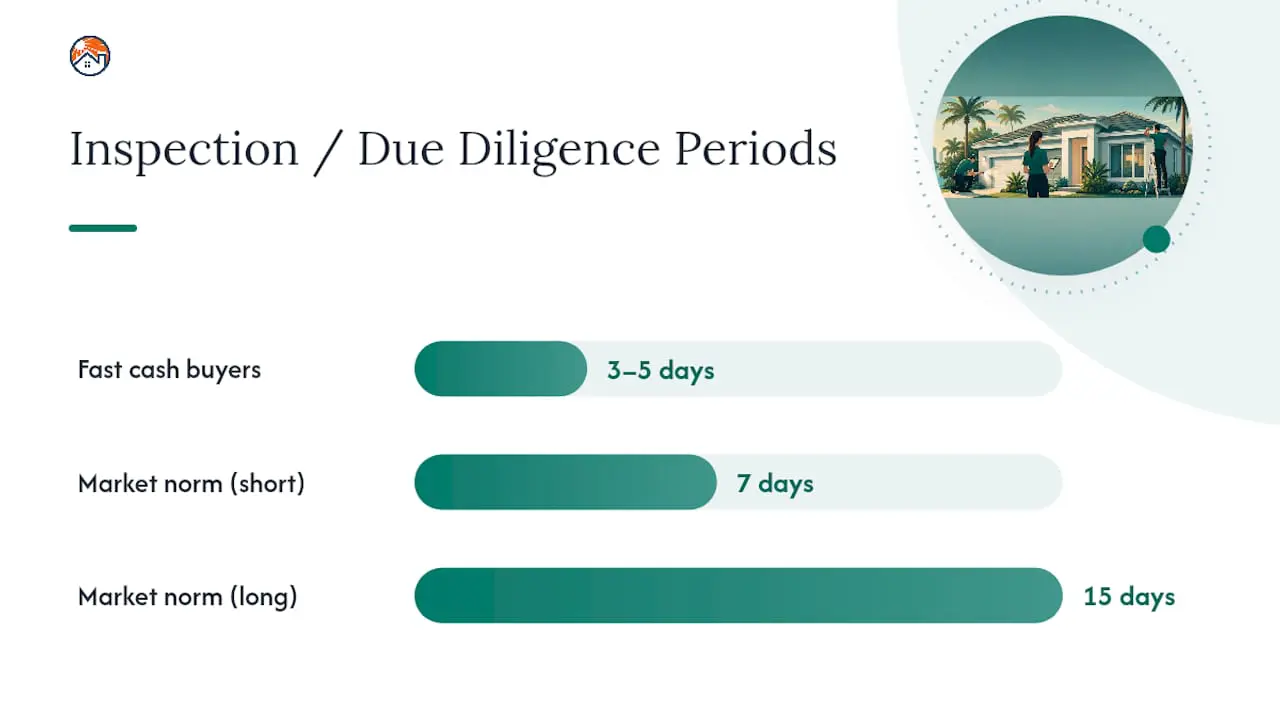
    Diagram of inspection period timelines in Florida as-is contracts

    That window is the inspection or due diligence period, and it’s negotiable. Market norms put it at 7 to 15 days, though cash buyers moving fast will sometimes shrink it to 3 to 5 days if they’ve already seen photos or done a walkthrough. Shorter isn’t always better for you. It just means less time before the deal is truly locked.

    Selling as-is doesn’t erase your legal disclosure duty. Florida law still requires you to disclose known material defects, things like a leaking roof, a failed septic system, or mold you’re aware of, regardless of whether the buyer plans to inspect. “As-is” describes the repair responsibility, not your honesty obligation.

    Behind the scenes, a title company runs the search, issues the title commitment, and handles owner’s title insurance, and that search is usually what determines your fastest possible closing date. Having your paperwork ready speeds everything up:

    • The deed from when you acquired the property
    • Your current mortgage payoff statement, if any
    • Recent property tax bills
    • HOA or condo association documents, if applicable

    Sellers dealing with damage or old code citations often assume buyers will walk. Cash buyers who specialize in sell damaged house Florida without repairs deals expect this and price around it instead.

    What’s the Fastest Timeline for a Florida As-Is Cash Sale?

    Speed in a cash sale isn’t really about the buyer’s decision. It’s about how clean your title is and how fast you can hand over documents. Here’s the realistic sequence:

    1. Request at least three offers and ask each buyer for proof of funds before you take any offer seriously. This single step creates real leverage and weeds out buyers who aren’t actually ready.
    2. Accept an offer and execute the contract. This locks in your price and closing date target.
    3. Inspection or due diligence period runs 7 to 15 days. The buyer confirms the property matches what they expected.
    4. Title search and commitment take another 7 to 14 days, often overlapping with the inspection window rather than starting after it.
    5. Closing happens at the title company, where you sign the deed and the buyer’s funds are wired in.

    A well-run cash sale can close very quickly, sometimes within about a week, but most take 14 to 21 days once you account for title search timing. Liens, unpaid property taxes, and HOA estoppel letters are the usual culprits when a closing slips past three weeks.

    You can head off most delays before they start. Pull your mortgage payoff figure early, request your HOA estoppel packet the same week you sign the contract (some associations take 10 business days just to produce it), and hand your title company a copy of your deed and recent tax receipts right away instead of waiting for them to ask.

    Pro Tip: Call your HOA or condo association on day one of the contract, not after inspection ends. Estoppel packets are one of the most common bottlenecks, and many associations won’t rush them even for a cash deal.

    Can You Sell Inherited, Foreclosed, or Tenant-Occupied Property As-Is?

    These three situations account for a large share of as-is cash sales in Florida, and each carries its own legal wrinkle.

    Inherited property. A personal representative generally cannot sell real estate without either explicit authorization in the will or a court order. If the estate qualifies for Summary Administration, because it’s small enough or the decedent died more than two years ago, the process moves faster. Otherwise, full probate applies. Creditor notice periods can affect when you actually receive proceeds, even though title work on the sale itself often proceeds in parallel. One practical upside: stepped-up basis usually sets your tax basis at the property’s value on the date of death, which can meaningfully reduce capital gains if you sell soon after inheriting.

    • Check the deed and will language immediately; the difference between having sale authority and needing to petition the court is often the difference between weeks and months.
    • A Personal Representative’s Deed conveys the property without broad warranties, so buyers lean on title insurance for protection.

    Foreclosure. Timing is everything here. Notify your lender as soon as you’re considering a sale, since a cash closing needs to happen before the trustee sale date to stop foreclosure entirely. Coordinating your payoff figure with the lender early prevents last-minute surprises at closing.

    Tenant-occupied property. Florida law requires proper notice to tenants regardless of a sale in progress, and existing leases typically survive the change in ownership. Cash buyers experienced with tenant-occupied homes usually close around the lease rather than requiring you to evict first.
    Exterior view of tenant-occupied Florida rental home

    What Closing Costs and Taxes Should Sellers Expect?

    Florida charges a documentary stamp tax of $0.70 per $100 of the sale price, and sellers customarily pay it in most counties.

    Add title company fees, recording fees, and prorated property taxes or HOA dues, and total seller-side costs on a $400,000 Florida cash sale typically run several thousand dollars, though county customs and negotiated terms shift that number.

    • Documentary stamp tax: $0.70 per $100 of sale price
    • Title search, title insurance, and title company closing fees
    • Recording fees for the deed
    • Prorated property taxes and HOA dues through closing day

    The title problems that most often eat into your timeline and your proceeds are contractor liens, HOA super-liens, tax delinquencies, and occasionally IRS liens. Most are clearable, but only if someone finds them early enough to negotiate a payoff before closing day arrives.

    How Do You Vet a Cash Buyer Before Signing?

    Not every “we buy houses” offer is what it claims to be, and the contract terms are more negotiable than most sellers realize, even in an all-cash deal.

    1. Ask for proof of funds and the name of the title company they intend to use. A legitimate buyer answers both without hesitation.
    2. Request local references or examples of recent closings in your county.
    3. Negotiate the details that matter, including inspection period length, earnest money amount, who covers which closing costs, and your exact closing date.
    4. Solicit at least three offers. Cash offers commonly land 70% to 85% of after-repair value, and comparing multiple offers is the only reliable way to know you’re not leaving money on the table.

    Walk away from anyone who pressures you to sign the same day, asks for a wire transfer outside of title company escrow, or refuses to name the title company they’ll use.

    Pro Tip: If a buyer won’t put their offer and closing terms in writing through an escrow account at a licensed title company, treat that as a hard stop, not a negotiating point.

    Sunshine State Buyers: A Local Option for a Fast, As-Is Cash Close

    If everything above sounds like more coordination than you want to manage on your own, that’s exactly the gap Sunshine State Buyers fills. As a local, family-run cash buyer, Sunshine State Buyers gives Florida sellers a written cash offer within 24 hours and a closing date you choose, typically 7 to 14 days out, without repairs, showings, or commissions eating into your proceeds.
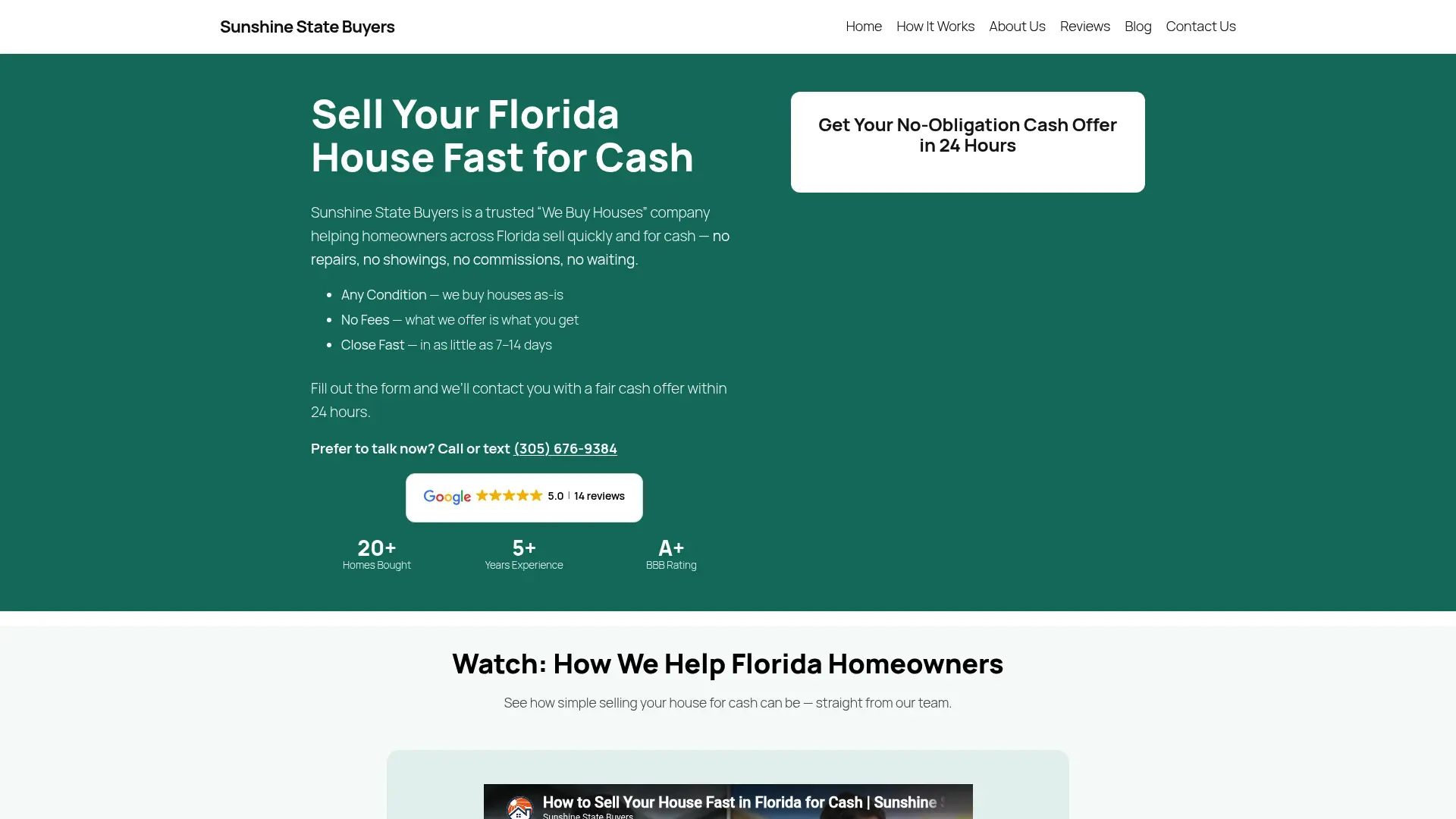
    Sunshine State Buyers homepage showing the Sell Your Florida House Fast for Cash headline

    Sunshine State Buyers carries an A+ BBB rating and works statewide, with particular depth in the situations covered above: foreclosure timelines that won’t wait, probate and inherited property, tenant-occupied rentals, and homes with code violations or damage that would scare off a traditional buyer. When you reach out, expect a straightforward process: a no-pressure written offer, closing handled through a licensed title company (not a private wire transfer), and transparent fees explained upfront rather than buried in fine print. If you’re weighing your options for a foreclosure situation specifically, the foreclosure solutions guide walks through how a cash sale can fit into that timeline. Ready to see where you stand? Get your cash offer and compare it against whatever else you’re considering, no obligation either way.

    Cash Sale or MLS Listing: How Should Florida Sellers Decide?

    Cash makes sense when your timeline is the constraint, not the price, foreclosure deadlines, expensive repairs you can’t front, or a probate sale that needs to close before other obligations pile up. Listing on the MLS makes more sense if you have months to spare and the cash to invest in repairs first.

    Whichever path you choose, get multiple offers, verify proof of funds before you get attached to a number, and loop in a title company or probate attorney the moment liens or estate authority questions surface. Skipping that step costs far more time than it saves.

    — David

    Sources

    Confirm figures directly: the Florida Department of Revenue’s documentary stamp tax page and probate sale rules for inherited property.

  • Cash Buyer vs Realtor in Miami: Which Is Faster and Why in 2026

    Cash Buyer vs Realtor in Miami: Which Is Faster and Why in 2026

    If your main goal is speed, you are asking the right question. A lot of sellers in Miami do not want a perfect process. They want a predictable closing date and a sale that does not drag on for months.

    That is why “cash buyer vs realtor Miami” is such a common comparison. It is not a debate about which method is “better.” It is a decision about which method is faster, and what you give up or gain when you choose it.

    In 2026, both paths can work. But they move at different speeds for specific reasons. Once you understand those reasons, you can choose the route that fits your timeline instead of guessing.

    If you want a full overview of selling options, our Sell House Miami page lays out the routes clearly. If you know you need speed, our Sell My House Fast Miami page aligns with that urgency. And if you want to understand how a direct cash purchase works, our We Buy Houses in Miami page explains the process step by step.

    What “Fast” Really Means in Miami

    When sellers say “fast,” they usually mean one of two things:

    Fast to get an offer
    Fast to actually close

    You can get an offer quickly in both paths. The bigger difference is closing speed, because closing speed depends on how many steps can slow a deal down.

    So if you want to sell my house fast Miami, focus less on how quickly you can list and more on what can delay closing after you accept an offer.

    Why Realtor Sales Often Take Longer

    A realtor listing can still be fast, especially for a move-in-ready home priced correctly. But traditional sales usually include more steps that can slow things down.

    Here are the most common reasons:

    Buyer Financing

    Most retail buyers use a mortgage. That means underwriting, lender conditions, and a timeline you do not control.

    Even motivated buyers can be delayed by:

    • Bank paperwork
    • Employment verification
    • Credit issues
    • Rate lock timelines
    • Lender conditions after inspection

    Appraisal

    When a buyer uses a loan, an appraisal is usually required. Appraisals can delay closings or force renegotiations if the value comes in low.

    Inspection Negotiations

    Most traditional deals include an inspection period. Even when the inspection finds normal items, the buyer often asks for repairs or credits.

    That negotiation can add days or weeks and sometimes causes the deal to fall apart.

    Showing and Access Logistics

    Before you even accept an offer, listings require showings. If you have tenants, a cluttered house, or limited access, showings become slower and more stressful.

    Deal Fallout

    This is the part many sellers do not plan for. In a traditional sale, deals can fail late because:

    • Financing falls apart
    • Appraisal is low
    • Inspection reveals an issue the buyer cannot accept
    • Buyers get cold feet after delays

    When a deal fails, you start over, and that costs time and momentum.

    So when people ask how long to sell a house in Miami, the honest answer is: it depends on how many of these steps show up.

    Why Cash Sales Are Usually Faster

    A true cash sale removes the biggest slowdowns. That is why Miami cash home buyers are often the fastest route when you need certainty.

    Cash sales are usually faster because:

    No Buyer Loan Approval

    There is no underwriting timeline. That alone removes one of the biggest reasons closings get pushed.

    No Appraisal Required by a Lender

    Cash buyers may still evaluate the property, but they are not waiting for a bank appraisal process.

    Fewer Negotiation Points

    Cash buyers who purchase as-is often negotiate less on repairs, because repairs are expected and priced in upfront.

    Cleaner Closing Timeline

    When there are fewer moving parts, you can often choose a closing date that fits your needs, assuming title is clear.

    This is why sellers who want to sell house as is Miami often lean toward cash. They do not want repairs, showings, and weeks of negotiation. They want a clean exit.

    If you want to see how a direct sale works in detail, our We Buy Houses in Miami page lays out the process clearly.

    What Can Still Slow a Cash Sale

    Cash is usually faster, but it is not magic. The most common delays in any sale, including cash, are:

    • Title issues, liens, or probate complications
    • HOA document delays for condos
    • Property access issues if the home is occupied
    • Seller paperwork delays

    The difference is that cash removes financing delays, not legal or title delays.

    If your situation involves probate or multiple heirs, closing speed depends on legal authority and agreement. If your property is a condo, HOA documents can still add time.

    That said, a direct cash buyer can often navigate these situations more smoothly because they do not rely on a lender timeline.

    Cash Buyer vs Realtor Miami: When Each Path Makes Sense

    Choose a Realtor Sale When:

    • The home is in great condition and shows well
    • You have time to list, show, and negotiate
    • You want to chase the highest retail price
    • You are comfortable with inspection and lender timelines
    • You can handle the uncertainty of possible delays

    Choose a Cash Sale When:

    • You need speed and certainty
    • The house needs repairs you do not want to do
    • The property is inherited, cluttered, tenant-occupied, or distressed
    • You want to avoid showings and long negotiations
    • You do not want to risk buyer financing failure

    In areas like Hialeah, Miami Gardens, Homestead, and many older-home pockets across Miami-Dade County, cash sales are often common because sellers want to avoid repair and access friction.

    The Net Proceeds Question: Faster Does Not Always Mean Worse

    Many sellers assume “fast” equals “less money.” Sometimes that is true. But the correct comparison is not cash offer vs dream list price.

    It is cash net vs listing net after everything.

    Listing net often includes:

    • Commission
    • Repairs and credits after inspections
    • Holding costs for months
    • Risk of delays or deal fallout

    Cash net often includes:

    • One clear offer
    • Fewer steps
    • No repair spend
    • Faster closing that reduces carrying costs

    If you want a full breakdown of what you keep in each path, our earlier Miami comparison on commission and net proceeds is supported by our Realtor Commission vs Cash Offer page, and our Sell House Miami page, which lays out the real tradeoffs clearly.

    FAQs

    Is a cash buyer always faster than a realtor sale in Miami

    Often, yes, because cash removes financing and appraisal steps. But both routes can be slowed by title issues, probate, HOA documents, or access problems.

    How long to sell a house in Miami if I list it

    It depends on condition, pricing, showings, and buyer financing. Some listings move quickly, but inspection, appraisal, and lender steps can extend timelines.

    Can I sell my house as is with a realtor

    Yes. You can list as-is, but buyers may still request inspections and credits. As-is does not always mean fewer negotiations in a traditional sale.

    What is the fastest way to sell my house fast Miami

    A direct cash sale is often fastest because it removes the buyer loan timeline and reduces steps. The exact speed depends on title and property details.

    What if my property is tenant occupied

    Tenant-occupied properties can be slower to sell through traditional listings because access is harder. Cash buyers and investor-style buyers often handle tenant situations more smoothly.

    Our Services at the End: How Sunshine State Buyers Helps Sellers Move Faster

    At Sunshine State Buyers, we help Miami-area homeowners choose the selling path that fits their situation. When speed matters, we simplify the process by making clear cash offers and purchasing homes as-is, including properties that need repairs, rentals with tenant issues, inherited homes, and distressed situations.

    If you want to explore the fastest path:

    Speed is only half the question

    The other half is what you walk away with. Realtor commission vs cash offer in Miami works through the net-proceeds side properly — commission, repair credits, and the months of carrying costs most sellers forget to count. Read both before you decide; if listing nets you more, we will say so.

  • Realtor Commission vs Cash Offer in Miami: What You Really Keep in 2026

    Realtor Commission vs Cash Offer in Miami: What You Really Keep in 2026

    If you are comparing realtor commission vs cash offer Miami, you are already asking the right question. The real question is not “Which option gets the highest price?” The real question is “Which option lets me keep more, with fewer headaches, on a timeline I can actually handle?”

    A lot of homeowners in Miami assume listing always wins. Sometimes it does. But once you subtract commission, repairs, credits, and months of carrying costs, the gap gets smaller than most people expect.

    On the other side, people sometimes assume a cash offer means you are giving the house away. That is also not always true. A cash offer is simply a different trade: less uncertainty and fewer steps, in exchange for not chasing a perfect retail price.

    This guide will help you compare both paths using real-world math and practical decisions, so you can choose the option that fits your life in 2026.

    If you want a simple overview of all selling routes, our Sell House Miami page lays out the options clearly. If speed is the priority, our Sell My House Fast Miami page is the best place to start. And if you want to understand the direct offer process, our We Buy Houses in Miami page explains how it works.

    Why Miami Sellers Get Confused About “Best Price”

    Miami is a huge market with every type of property: condos, rentals, inherited homes, older houses, move-in-ready homes, and full fixer-uppers across Miami-Dade County.

    The “best” method depends on your situation:

    • If your home is updated, easy to show, and you have time, listing can attract retail buyers and potentially higher offers.
    • If your home needs work, has tenant issues, is inherited, or you need speed, a cash offer can protect your time and often your real net.

    So instead of asking “What sells for more?” ask “What will I actually keep after everything?”

    That is the heart of net proceeds selling house Miami.

    What a Realtor Sale Really Costs in Miami

    When you list with an agent, the visible cost is commission. But the real costs usually include more than that.

    Here are the common costs most sellers face in a traditional sale:

    • Commission (varies by agreement, but it is usually one of the biggest costs)
    • Pre-listing prep: cleaning, paint, curb appeal, minor fixes
    • Repairs requested after inspection or credits given to the buyer
    • Closing costs on the seller side (varies by situation)
    • Holding costs while the home sits: mortgage, taxes, insurance, utilities, HOA
    • Time and stress costs: showings, scheduling, negotiations, delays

    People often search how much do Realtors charge in Miami because commission feels like the whole story. But in real life, inspections and credits are where sellers lose additional money.

    That is why many sellers end up considering sell house as is Miami options.

    What a Cash Offer Really Means

    A cash offer is usually coming from cash home buyers Miami who purchase properties as-is and handle repairs after closing.

    A real cash offer typically means:

    • No lender approval on the buyer side
    • Fewer steps and fewer delays
    • Less inspection negotiation (because the home is being bought as-is)
    • Faster, more predictable timeline
    • You do not need to renovate to sell

    The tradeoff is simple: the cash offer is usually lower than an ideal retail sale price, because the buyer is taking on repairs, risk, and the work.

    But again, the right comparison is not cash offer vs dream list price. It is cash offer vs your real net after listing costs.

    Realtor Commission vs Cash Offer Miami: A Practical Comparison

    To make this real, compare both paths using the same framework.

    Path A: Listing With a Realtor

    Your likely net is:

    Sale price
    Minus commission
    Minus repairs or credits
    Minus carrying costs during the timeline
    Minus deal risk and delays

    Listing can be a strong choice when the property is in good condition and you can wait for the best offer.

    Path B: Selling Directly for Cash

    Your likely net is:

    Cash offer
    Minus mortgage payoff or liens
    Minus any unavoidable closing items
    Plus the value of speed and no repairs

    Cash sales are often strongest when your situation demands certainty.

    When Listing Usually Wins in Miami

    Listing often makes more sense when:

    • Your home is updated and shows well
    • You can handle showings and buyer requests
    • You are not under time pressure
    • You can wait for financing, appraisal, and closing timelines
    • You want to maximize top-line price and have the patience for the process

    If your home is in a high-demand pocket like Coral Gables or a clean condo in Brickell with easy building paperwork, listing can be worth it.

    When a Cash Offer Usually Wins in Miami

    A cash offer usually makes more sense when:

    • The home needs repairs you do not want to fund
    • The property is inherited or tied to family decisions
    • You have tenants or access problems
    • The house is cluttered or needs cleanout
    • You are relocating, divorcing, or dealing with financial pressure
    • You want to avoid lender delays and appraisal risk

    This is common in real-life situations across Hialeah, Doral, Miami Gardens, and Homestead where homes may be older, rentals are common, or sellers want a clean exit.

    A cash sale is not “better.” It is simply more executable for certain situations.

    The Hidden Cost Most Miami Sellers Miss: Time

    Time is money in Miami, especially if you are paying:

    • Mortgage payments
    • Insurance
    • Property taxes
    • Utilities
    • HOA fees (condos especially in areas like Miami Beach)

    If your home sits for 2–4 months, that holding cost can erase a big chunk of the “extra” money you hoped to get from listing.

    This is why some sellers take a slightly lower cash offer and still come out ahead in real net, because they stop the monthly bleeding.

    How to Make the Decision in One Clean Step

    If you want a simple way to decide:

    1. Estimate your realistic listing price in its current condition (not your dream price).
    2. Subtract commission, expected credits, and repairs you would likely do.
    3. Add 2–3 months of holding costs (more if your home is likely to sit).
    4. Compare that net to a real cash offer.

    If the difference is small, choose the option that gives you peace and certainty. If the difference is huge, listing may be worth the effort.

    Our Sell House Miami page supports this exact comparison, and our We Buy Houses in Miami page explains what happens if you choose the direct route.

    FAQs

    How much do Realtors charge in Miami

    It depends on your agreement with the agent. The key is to look at total selling costs, not only commission, because inspections, credits, and holding costs often add up.

    Will I always make more money if I list my house

    Not always. Listing can bring a higher top-line price, but your real net depends on commission, repairs, credits, time on market, and whether the deal stays together.

    Can I sell my house as is in Miami

    Yes. You can list as-is or sell directly. Selling directly is often simpler when the home needs repairs, cleanout, or you want a faster timeline.

    Are cash home buyers in Miami legit

    Many are. The main thing is to work with a local buyer who explains the process clearly and gives you a written offer with a clear timeline.

    What is the fastest way to sell in Miami

    A direct cash sale is often fastest because it avoids buyer financing and reduces steps. The exact timeline depends on title and property details.

    Our Services at the End: How Sunshine State Buyers Helps Miami Sellers

    At Sunshine State Buyers, we help homeowners who want a clear plan, a straightforward process, and a sale that matches real life. We work with sellers who need speed, sellers who want to avoid repairs, and sellers dealing with inherited properties, tenants, clutter, or tight timelines.

    If you want to explore your options:

    Asking a different question?

    This page is about what you keep. If what you actually need to know is how fast each route closes, cash buyer vs realtor in Miami takes that question apart on its own. And if you would rather see the arithmetic run on a real property than in the abstract, several neighborhood pages work an example all the way through — Cutler Bay, North Miami and Brickell among them.

  • The Real Cost of Selling a House in Miami

    The Real Cost of Selling a House in Miami

    Most people focus on the sale price when considering the cost of selling a house in Miami. If a neighbor sold for 600,000 dollars, it is easy to assume that is the number you should aim for, too.

    The problem is that the number you see on a property website is not the number the seller actually receives. Once commissions, repairs, closing fees, holding costs, and last-minute buyer requests are taken out, the final amount can look very different.

    If you are already dealing with late payments, repairs you cannot afford, or a move that is coming up fast, knowing your true net matters more than chasing the biggest price tag. This is especially important if you are thinking about selling a house as-is, Miami option, with local buyers like Sunshine State Buyers, because you want to compare apples to apples.

    Selling a House in Miami: Cost Breakdown for Local Owners

    On paper, selling with a real estate agent sounds simple. You list, you accept an offer, and you close. In real life, the cost of selling a house in Miami is made up of several pieces that show up at different times. Some are obvious. Others surprise people at the closing table.

    Here are the main parts that most Miami sellers need to think about.

    Realtor commission in Miami

    Commission usually represents the single biggest cost. Many full-service agents in Miami charge a percentage of the final sale price and split it between the listing agent and the buyer’s agent. On a $600,000 sale, that can easily add up to tens of thousands of dollars.

    You might decide that it is worth it for the marketing and guidance you receive. Or you might prefer to put that money toward catching up on payments, moving expenses, or restarting your life somewhere else.

    Repairs and upgrades

    Very few homes are truly perfect when it is time to sell. In Miami, buyers and agents often expect:

    Fresh paint in the main living areas
    Minor repairs like patching drywall or fixing small leaks
    Updated fixtures or appliances in kitchens and bathrooms

    If the roof is older, the air conditioning is past its best days, or the property has visible damage, those items can turn into bigger repair bills or price cuts. For some owners, especially in areas like Hialeah, Miami Gardens, or Homestead, the cash simply is not there for this work.

    Closing costs for a Miami home sale

    In addition to commission and repairs, sellers usually pay:

    Title-related fees
    Owner’s title insurance in many cases
    Doc stamps on the deed
    Prorated taxes and association fees

    These numbers are not always huge on their own, but added together, they can make a noticeable dent in your check. When you work through the numbers or look at an estimate from your agent, make sure you understand each line and why it is there.

    Holding costs while you wait to sell

    While your home is on the market, you still have to pay:

    Mortgage or line of credit payments
    Property taxes
    Homeowners insurance
    Utilities, lawn care, and basic upkeep

    If the house takes three or four months to sell, that is three or four more months of carrying expenses before you even get to the closing table. These costs are easy to forget when you are comparing options, but they are very real.

    The Hidden Costs of Time and Stress in Miami

    Not all costs are financial. There is also the mental load of keeping a house show ready, arranging your life around last-minute appointments, and wondering if the buyer will actually make it to closing.

    For families with kids, pets, or elderly relatives, that constant disruption is real. For owners dealing with divorce, probate, or a job loss, the stress of an open-ended process can feel even heavier.

    This is one of the reasons some owners look for cash home buyers in Miami who can give a firm offer and a clear timeline. Even if the top line price is lower than what a perfectly renovated home might bring on the open market, the trade-off in time, certainty, and peace of mind can be worth it.

    Comparing a Traditional Sale and a Cash Sale in Miami

    To really understand the cost of selling a house in Miami, it helps to look at an example. These numbers are simplified, but they show how quickly things can change.

    Imagine a house that might sell for 500,000 dollars on the open market if it looks sharp.

    In a traditional agent sale, you might have:

    Commission and closing costs
    Repair bills before listing
    Three extra months of mortgage, insurance, and utilities
    A buyer inspection that leads to a price reduction or credit

    By the time everything is paid, your net might be closer to 430,000 dollars than 500,000 dollars. If you also spent your evenings and weekends managing repairs, showings, and stress, that cost is harder to measure but still real.

    Now imagine a direct sale house as is Miami offer from a local buyer like Sunshine State Buyers. The price might come in lower than 500,000 dollars because they are paying for repairs, closing costs, and holding costs on their side. But if you save months of payments, skip repair bills, and avoid commission, the net difference might be smaller than you first thought.

    This is why it is helpful to compare your options side by side using the guidance on the Sell House Miami page. You are not just comparing prices. You are comparing time, risk, and the amount of energy you need to spend.

    When Does a Sell House As Is Miami Option Make Sense

    A direct cash sale is not right for every homeowner. If your house is in great shape, you are not in a rush, and you are comfortable with showings and negotiations, a traditional listing might still be the best fit.

    However, a sell house as is Miami approach can make a lot of sense if:

    You are behind on payments or worried about foreclosure
    You have inherited a property you do not want to keep
    The house needs more repairs than you can afford
    You are a tired landlord dealing with difficult tenants.
    You have already moved and do not want to carry two homes

    In situations like these, getting a fair, firm offer and choosing a closing date can be more valuable than waiting months for a buyer who may or may not close.

    If you are not sure which group you fall into, you can always talk it through with a local buyer and look at the information on the We Buy Houses in Miami page. It explains how they look at properties across Miami-Dade, from Miami Beach and Coral Gables to Hialeah and Homestead.

    FAQs About the Cost of Selling a House in Miami

    Who usually pays closing costs when selling a house in Miami

    In a traditional sale, the seller usually pays a mix of title fees, doc stamps, and sometimes part of the buyer’s closing costs when the deal includes those terms. When you sell to a cash buyer, they often cover most of these costs themselves, so you should always ask exactly what the offer includes.

    How much are realtor commissions in Miami

    Commission is negotiable, but many full-service agents charge a percentage of the purchase price that is split with the buyer’s agent. On higher-priced homes in Miami, this can be one of the largest single expenses on your closing statement.

    Are repairs always required before I sell

    Not always. If you list on the open market, buyers and their lenders may require certain items to be repaired, especially major roof or safety issues. If you work with a direct buyer who focuses on as-is purchases, they may accept the property exactly as it stands, which can remove a large expense from your side.

    What other costs do sellers forget about

    Many owners forget about moving expenses, time off work for appointments, and months of extra payments while they wait to sell. These are not line items on a closing statement, but they are part of the real cost of selling a house in Miami.

    Do I still need to pay if I sell to a cash home buyer in Miami

    You should always confirm the details, but many cash buyers cover standard closing costs and do not charge traditional commissions. You are trading a higher possible top-line price for a simpler process and fewer moving parts, so make sure you understand the net amount you will receive.

    How Sunshine State Buyers Helps Miami Owners Control Their Costs

    Sunshine State Buyers is a local home-buying company that simplifies and makes the selling process more predictable for owners in Miami and across Miami-Dade County.

    Instead of asking you to fix, stage, and show your home, they buy it directly from you in as-is condition. You avoid repair bills, endless appointments, and the stress of waiting to see whether a buyer’s loan gets approved. They give you a clear cash offer, you choose your closing date, and their team handles every detail.

    They purchase houses in many neighborhoods listed on their Service Areas page, including Miami, Hialeah, Doral, Miami Gardens, Homestead, Coral Gables, and more. Whether you are dealing with an inherited house, a problem rental, or a property that simply needs too much work, their goal is to give you a straightforward way out.

    If you want to understand how a direct sale compares to listing, you can read the guide on the Sell House Miami page, then request a no-obligation offer through their simple form. Seeing a real number for your house can help you decide which path makes more sense for you, your timeline, and your peace of mind.

Call Now For A Cash Offer