A cash sale does not erase your closing costs. It removes lender fees, but you still cover items like documentary stamp tax, often the owner’s title policy, prorated taxes, and settlement fees… As a rule of thumb, expect roughly 1%–3% of your sale price in seller-side costs, higher if you’re also paying commissions or the buyer’s title policy. A cash buyer like Sunshine State Buyers can send a quick offer often within 24 hours and close in about one to two weeks, helping you understand your financials promptly.
TL;DR:
- Seller closing costs in Florida typically range from 1% to 3% of the sale price, and can reach 7% to 10% with agent commissions.
- The most significant costs include documentary stamp taxes, owner’s title insurance, settlement fees, and local transfer or HOA estoppel charges.
- Who pays the owner’s title policy varies by county, with buyers typically paying in some counties and sellers in others, affecting your net proceeds.
- Timing your closing date influences prorated property taxes and HOA dues, which can shift the final amount you net from the sale.
- Request itemized quotes early and negotiate fee responsibilities to lower your closing costs before signing any deal.
Table of Contents
- Seller-Side Cash Sale Closing Costs, Explained
- How Much Will Seller Closing Costs Actually Be?
- Who Pays What, and What Can You Negotiate?
- How Timing Changes Your Final Numbers
- Seven Ways to Keep Your Closing Costs Down
- What Happens at Your Closing Table
- Why Transparency at Closing Matters
- Get a Closing Cost Estimate Before You Decide
- Where to Verify These Numbers Yourself
- Sources
Seller-Side Cash Sale Closing Costs, Explained
When you sell for cash, you skip appraisal fees, loan origination charges, and underwriting costs entirely. Those belong to a financed buyer’s lender, not to you. But your settlement statement still fills up with items tied to the property itself, and understanding each one helps you spot a fair number versus an inflated one.
Here’s what typically shows up on your side of the ledger:
- Documentary stamp tax on the deed. Florida charges $0.70 per $100 of sale price in most counties, dropping to $0.60 per $100 in Miami-Dade for single-family homes. This tax is customarily paid by the seller statewide.
- Owner’s title insurance. This protects the buyer against title defects and is often your single largest cost. Florida uses promulgated rates, meaning the premium is set by state formula, not negotiated between insurers.
- Settlement or closing fee. Charged by the title company for managing the transaction, usually a few hundred dollars.
- Title search and document prep fees. Title search fees typically run a few hundred dollars, while document preparation is a smaller flat charge.
- Recording, wire, and courier fees. Small individually (often $10 to $50 each) but they add up across a file.
- HOA or condo estoppel fees, if your property sits in an association, plus any transfer fee your association charges.
- Mortgage payoff and curative costs, if you still owe a balance or need to clear a lien, judgment, or title defect before closing.
How Much Will Seller Closing Costs Actually Be?
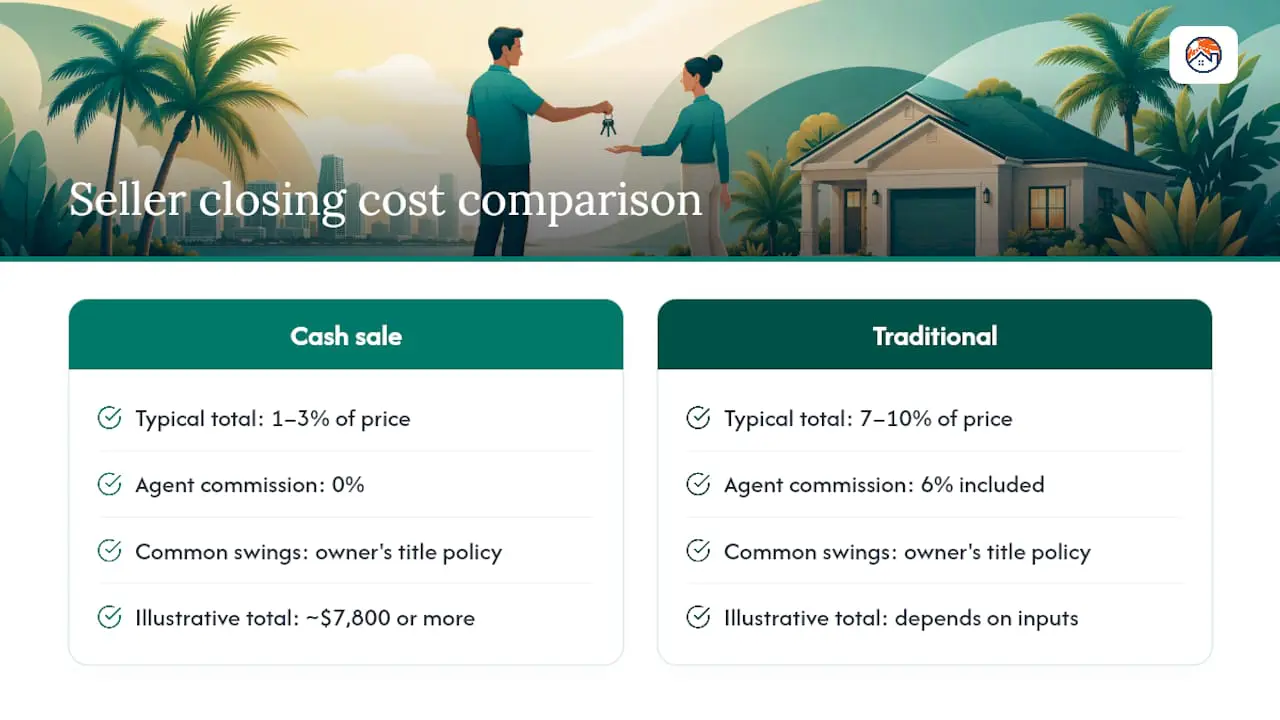
Seller-side costs in a clean Florida cash sale generally land between 1% and 3% of your sale price when there’s no agent commission involved. Add a 6% commission for a traditional listing and that combined total often jumps to 7% to 10%. The two biggest swing factors are whether you pay the owner’s title policy and how your county customarily splits fees.
Here’s how the math plays out at three sale prices, assuming the seller covers owner’s title insurance and standard admin fees:
These owner’s title insurance figures reflect Florida’s promulgated rate schedule, and a Florida cash-buyer calculator that layers in prorated taxes and recording fees can push total illustrative scenarios toward $7,800 or more, depending on your specific inputs. To find your net proceeds, subtract this total, plus any mortgage payoff and commissions, from your sale price.
Who Pays What, and What Can You Negotiate?
Florida doesn’t have one statewide rule for who pays the owner’s title policy. It comes down to county custom. In Miami-Dade, Broward, Sarasota, and Collier counties, the buyer typically pays that premium. In most other Florida counties, the seller pays it. That single difference can swing your net proceeds by thousands of dollars, so confirm your county’s norm before you assume a number.
Several line items are open to discussion even after custom sets the default:
- Who covers the owner’s title policy, especially outside the buyer-pays counties.
- How the settlement fee gets split between the two title bills.
- Who’s responsible for the HOA estoppel fee.
- Small concessions in exchange for a faster or more certain closing date.
Pro Tip: Ask for an itemized settlement estimate before you sign anything. If a buyer wants you to cover the owner’s policy, ask them to absorb the estoppel fee or a recording charge in return. Small trades add up.
How Timing Changes Your Final Numbers
Your closing date isn’t just a calendar detail. It resets your prorations. Here’s what shifts as that date moves:
- Property tax prorations. Florida taxes are paid in arrears, so closing earlier in the year typically means you owe the buyer a larger prorated tax credit at the table, since you’ve held the property for a smaller share of the tax year already billed.
- HOA due prorations. If dues are paid annually or quarterly, your closing date determines how much of that payment period you’re refunded for.
- Administrative readiness. A 7 to 14-day close is common with a cash buyer, but it also compresses your window to pull payoff letters and estoppel certificates. Order them the day you accept an offer, not the week before closing.
- Title curative work. Old liens, name discrepancies, or unresolved probate matters need resolution before your closing date, or they’ll delay it and often add curative fees to your bill.
Seven Ways to Keep Your Closing Costs Down
You have more control over these numbers than most sellers realize. Try these steps before you sign anything:
- Request itemized quotes from more than one title company or settlement service, since fees for the same closing service can vary by hundreds of dollars.
- Negotiate who pays the owner’s title policy, particularly if you’re outside a buyer-pays county.
- Ask whether the buyer will split or absorb the settlement fee in exchange for a firm closing date.
- Order your preliminary title search and HOA estoppel letter as soon as you accept an offer, not the week of closing.
- Gather your mortgage payoff statement early so the payoff amount is locked in and doesn’t create last-minute wire delays.
- Choose a buyer who provides an itemized closing-cost estimate before you accept, not after.
Pro Tip: Get one sample settlement statement in writing that shows the buyer’s offer net of estimated seller-side costs. It’s the fastest way to compare a cash offer against a traditional listing on an apples-to-apples basis.
What Happens at Your Closing Table
Closing day itself moves quickly once your file is prepared. Expect this sequence:
- Review your final settlement statement line by line before you sign.
- Verify your identity with government-issued ID.
- Confirm mortgage payoff wiring instructions directly with the title company, never by email link alone.
- Sign the deed, which the title company then records with the county.
The most common hold-ups are name mismatches between your ID and the deed, a missing HOA estoppel letter, or an unreleased old lien. Catching these a week ahead avoids a delayed closing date.
Why Transparency at Closing Matters
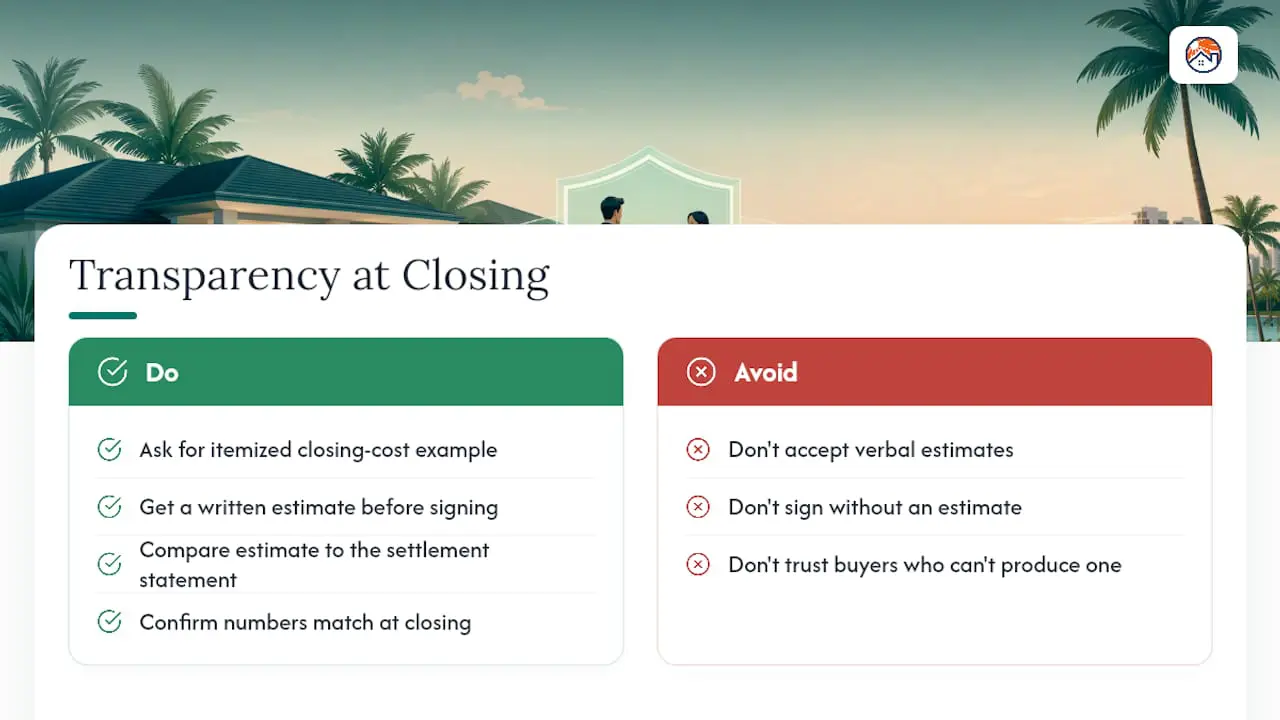
Sellers rarely get upset about paying a documentary stamp tax. They get upset when a number appears on the settlement statement they never saw coming. That’s the gap Sunshine State Buyers tries to close: we send a written estimate showing exactly what comes off the top before you ever sign an offer.
Our A+ BBB rating didn’t come from being the flashiest buyer in the state. It came from years of sellers, including people navigating foreclosure timelines, inherited properties, and difficult tenant situations, telling us the numbers matched what we promised. A 24-hour offer means nothing if the closing statement surprises you two weeks later.
If you’re weighing a cash sale, ask any buyer for an itemized closing-cost example before you commit. If they can’t produce one, that tells you something. We’d rather you compare our numbers against a real settlement statement than take our word for it.
— David
Get a Closing Cost Estimate Before You Decide
Sunshine State Buyers is the direct route to a cash sale in Florida without wondering what fees will surface at the table. Unlike listing with an agent, where commissions and closing costs often climb to 7% to 10% combined, our offers come with a written, itemized closing-cost breakdown before you ever sign anything.
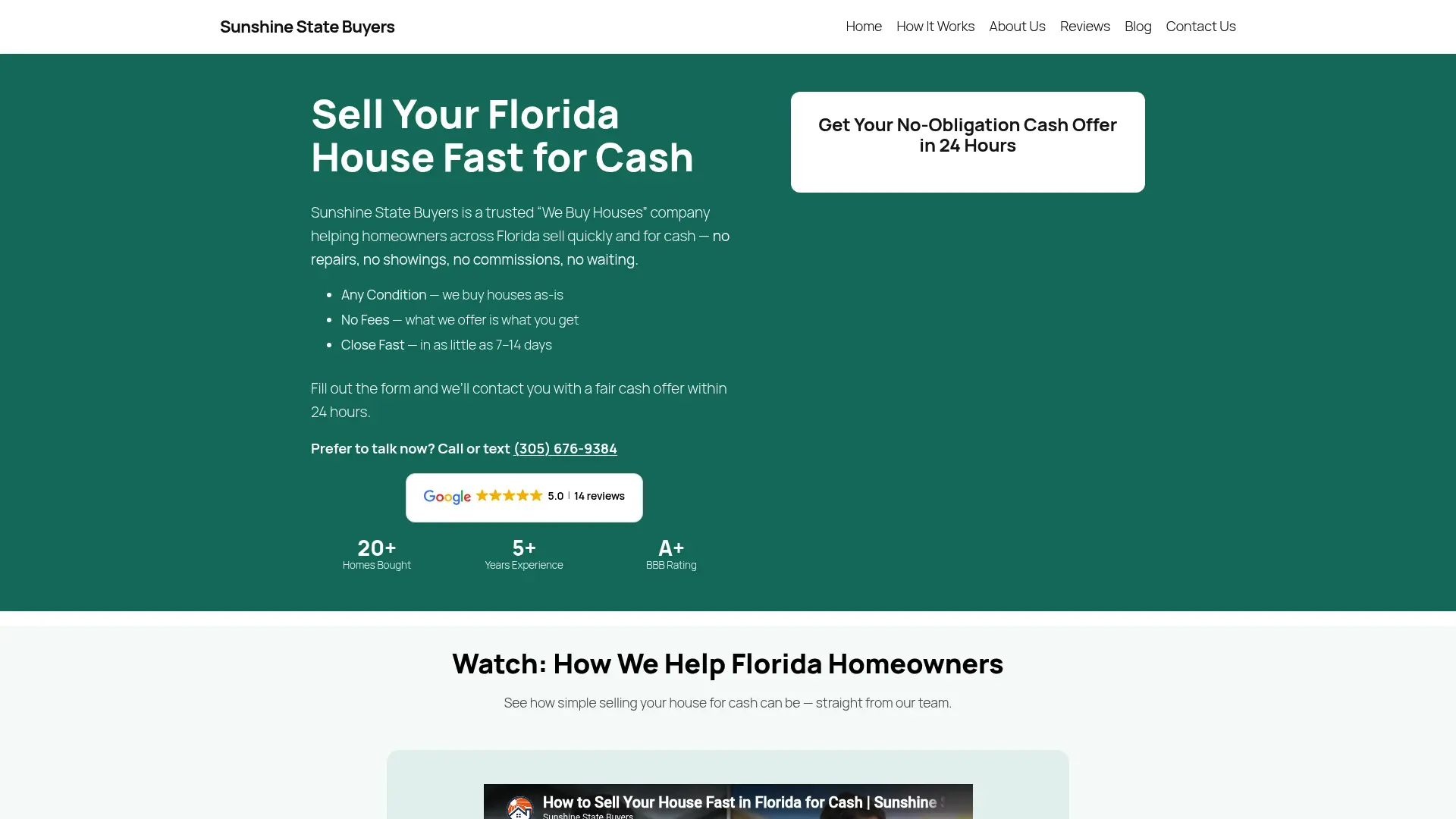
We send offers within 24 hours and work with title partners who prepare sample settlement statements up front, so you can see your estimated net proceeds before committing to a closing date. Closings typically happen in 7 to 14 days, and you pick the date that fits your situation, whether that’s a foreclosure deadline, a probate timeline, or a tenant issue you need resolved. Curious whether your offer holds up against the alternative? Compare the math yourself on our cash offer versus traditional sale breakdown, then request your free, no-obligation closing-cost estimate today.
Where to Verify These Numbers Yourself
For county-specific figures, Atlantic Title Firm’s Florida closing-cost breakdown covers statutory doc-stamp rates and sample owner’s-policy math in detail. To run your own scenario, the Florida cash-buyer closing-cost calculator lets you plug in your sale price and see an estimated total. For Miami-area sellers specifically, our Miami closing-cost guide breaks down local variations.
Sources
- FSBO seller closing costs in Florida — 2026 breakdown | Atlantic Title Firm
- Cash Buyer Closing Cost Calculator Florida – Estimate Your Costs

Leave a Reply